


Loading profile. Please wait . . .
Lindera subcoriacea B.E. Wofford
Bog Spicebush




Federal Protection: No US federal protection
State Protection: No Georgia state protection
Global Rank: G3
State Rank: S1?
Element Locations Tracked in Biotics: Yes
SWAP 2015 Species of Greatest Conservation Need (SGCN): Yes
SWAP 2025 Species of Greatest Conservation Need (SGCN): Yes
2025 SGCN Priority Tier: High Conservation Concern
Element Occurrences (EOs) in Georgia: 4
Habitat Summary for element in Georgia: Bayheads; seepy forested slopes
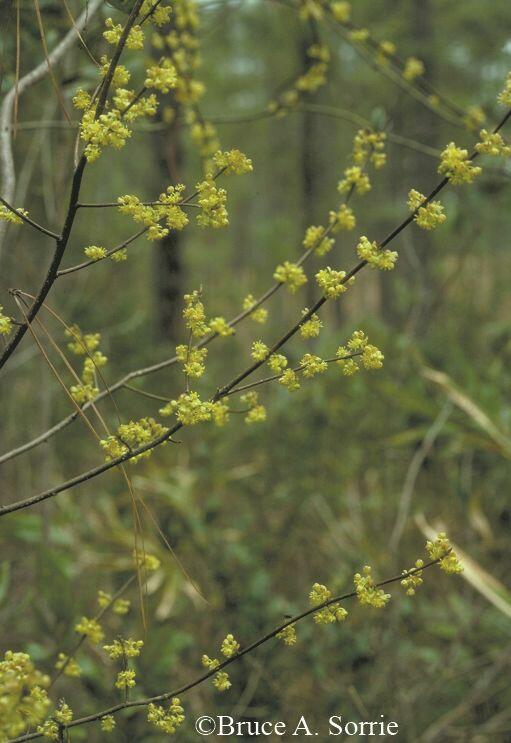
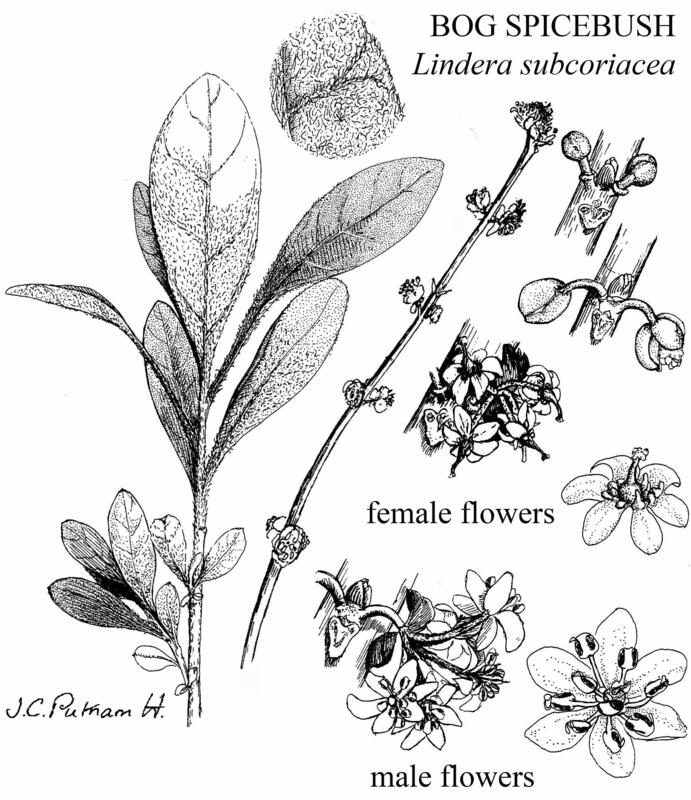
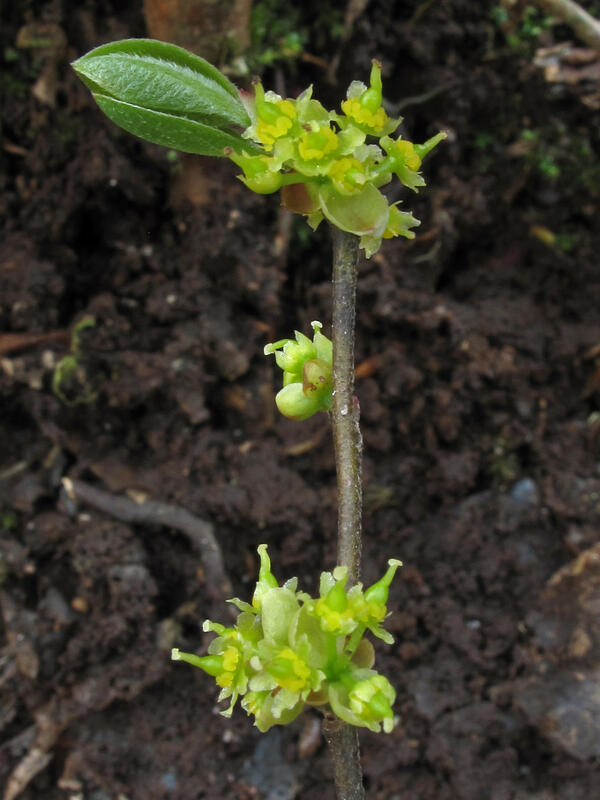
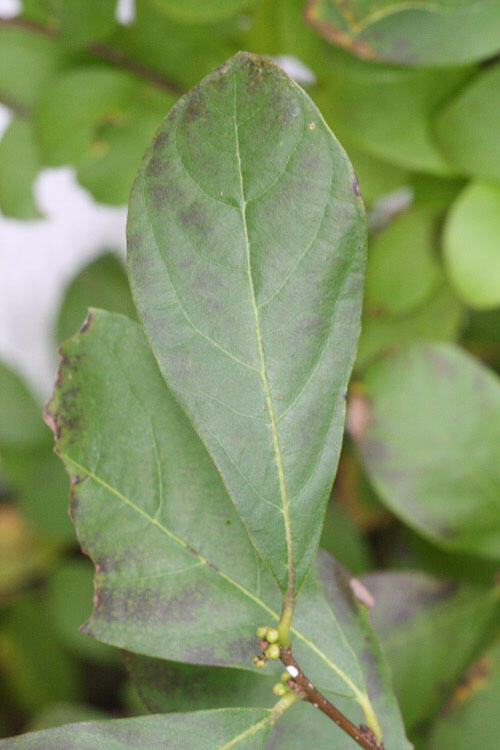
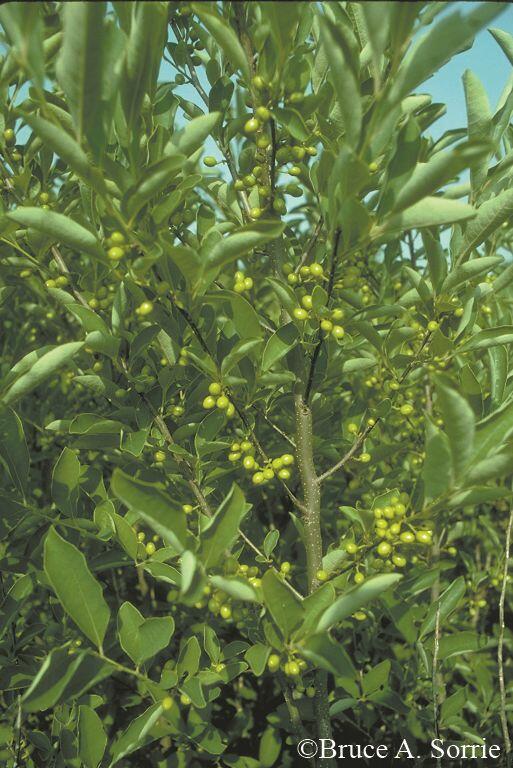
Deciduous shrub with erect stems up to 13 feet (4 meters) tall; new twigs are hairy; older branches are more or less hairless and have small, whitish, spongy patches (lenticels) and a faint lemon smell when cut. Leaf blades are 1.6 - 3 inches long and 0.8 - 1.6 inches wide (4 - 8 cm long and 2 - 4 cm wide), alternate, often widest above the middle, entire, somewhat thick and leathery, dark green on the upper surface, pale green and hairy on the lower surface; leaf base is wedge-shaped, leaf tip is blunt; leaf stalk is grooved; young leaves have a faint lemon smell when crushed, older leaves are odorless; leaves emerge after flowering. Female and male flowers are produced on separate plants, in paired clusters along the stems, appearing before the leaves; flowers have 6 pale yellow petals; female flowers have staminodes (sterile, vestigial sterile stamens). Fruits are about 0.4 inch (1 cm) long, oval, bright red, on short, slender stalks (tips of the fruiting stalks are not enlarged; fruiting stalks do not persist on the stem through the winter).
Spicebush (Lindera benzoin) is a common shrub of streamsides and rich, moist slopes that also flowers in early March; its leaves have a strong spicy or medicinal smell and pointed tips; its leaves are thin, not leathery, and green on both surfaces. Sassafras (Sassafras albidum) flowers about the same time, but does not have paired flower clusters; its leaves smell spicy not lemony.
The state- and federally listed Pondberry (Lindera melissifolia) occurs on the edges of sandhill ponds and limesinks in the Coastal Plain. For more information, see: https://www.georgiabiodiversity.org/portal/profile?group=plants&es_id=16447
Shrubby, seepage wetlands with peaty-mucky soils and continuous water source, such as hillside bogs, streamside thickets, streamheads, and pocosins; usually with sphagnum moss.
Bog Spicebush reproduces sexually and, primarily, by root suckering, forming stands usually consisting of 5 or fewer genetic individuals. Bog Spicebush is dioecious – female and male flowers are produced on separate plants. Female-flowered shrubs have smaller leaves with shorter hairs; microscopic differences between female and male plants include wax patterns on the leaf surfaces and features of the stomata. Bog Spicebush is often found in colonies of all-female or all-male plants. Because of habitat fragmentation, female and male colonies are often widely separated, thus reducing the chances of sexual reproduction. Bog Spicebush flowers are probably pollinated by bees and flies, as is the common species of Spicebush (Lindera benzoin). Common Spicebush produces more fruit and sets more seed when given more light; it seems likely that Bog Spicebush would also benefit from increased light. Common Spicebush is a host plant for Spicebush Swallowtail butterflies (Papilia troilus), which lays its eggs singly on the lower surface of the leaves; it is not known if swallowtails also use Bog Spicebush.
Bog Spicebush is currently at risk of infection by Laurel Wilt Disease, a fungal (Raffaelea sp.) infection that kills trees and shrubs in the laurel family. The fungus is carried by an exotic insect, the Red Bay Ambrosia Beetle (Xyleborus glabratus), and blocks water-conducting cells of infected plants, resulting in wilted leaves and, ultimately, death. Laurel Wilt has spread quickly along the southeastern coast and caused extensive mortality among Red Bay (Persea spp.). Laurel Wilt is likely to spread inland, infecting and killing rare species in the Laurel family such as Bog Spicebush, Pondspice (Litsea aestivalis), and Pondberry (Lindera melssifolia), as well as common species such as Sassafras (Sassafras albidum) and Spicebush (Lindera benzoin).
Surveys are best conducted during flowering (March) before leaves emerge and during fruiting (mid-summer) when the red fruits are conspicuous.
Georgia, Florida, Alabama, Mississippi, Louisiana, South Carolina, North Carolina, and Virginia.
Clearing, draining, and filling of wetlands. Fire suppression in surrounding uplands and fire exclusion from wetlands. Sedimentation into wetlands from road-building and upland development. Habitat destruction and fragmentation that results in all-female or all-male populations and reduced sexual reproduction and genetic diversity. Laurel Wilt Disease.
| Threat 1 | Threat 2 | Threat 3 | |
|---|---|---|---|
| General Threat | Natural system modifications | Agriculture & aquaculture | Natural system modifications |
| Specific Threat | None | None | None |
Lindera subcoriacea is ranked S1? by the Georgia Department of Natural Resources, indicating that it is probably critically imperiled in Georgia but that more data are needed for for a definitive ranking. Four populations are known in Georgia; none are protected on conservation land.
Protect wetlands from clearing, draining, and filling. Allow fires in adjacent uplands to periodically burn into and across wetlands. Avoid placing firebreaks in the transition zones between uplands and wetlands. Protect streamside wetlands from siltation and other disturbances during road and bridge building. Use fire or hand-clearing to create canopy gaps and admit more light to the understory. Transplant unrelated individuals of different sexes into existing populations to increase reproductive success and genetic diversity. Research treatment and prevention of Laurel Wilt Disease.
Anderson, L.C. 1999. Striking sexual dimorphism in Lindera subcoriacea (Lauraceae). Sida 18 (4): 1065-1070. https://www.jstor.org/stable/41967719?seq=1
Chafin, L.G. 2007. Field guide to the rare plants of Georgia. State Botanical Garden of Georgia and University of Georgia Press, Athens.
Chafin, L.G. 2000. Field guide to the rare plants of Florida. Florida Natural Areas Inventory, Tallahassee.
GADNR. 2020. Element occurrence records for Lindera subcoriacea. Georgia Department of Natural Resources, Wildlife Resources Division, Social Circle, Georgia.
Gramling, J.M. 2010. Potential effects of laurel wilt on the flora of North America. Southeastern Naturalist 9(4): 827-836.
NatureServe. 2019. Lindera subcoriacea comprehensive report. NatureServe Explorer. Arlington, Virginia. http://explorer.natureserve.org/servlet/NatureServe?searchName=Lindera+subcoriacea
Nelson, G. 1996. Shrubs and woody vines of Florida. Pineapple Press, Sarasota, Florida.
Niesenbaum, R.A. 1993. Light or pollen – seasonal limitations on female reproductive success in the understory shrub Lindera benzoin. Journal of Ecology 81(2): 315-323. https://www.jstor.org/stable/pdf/2261501.pdf?ab_segments=0%252Fbasic_SYC-5055%252Ftest&refreqid=excelsior%3A10d9224d6b3891248bfdc28736d831b6
Sorrie, B.A. 1992. Lindera subcoriacea element stewardship abstract. The Nature Conservancy, Arlington, Virginia.
Wall, W.A., M.G. Hohmann, A.S. Walker, and J.B. Gray. 2013. Sex ratios and population persistence in the rare shrub Lindera subcoriacea Wofford. Plant Ecology 214(9): 1105-1114. https://www.jstor.org/stable/pdf/24552024.pdf?ab_segments=0%252Fbasic_ SYC-5055%252Ftest&refreqid=excelsior%3A7720c1ac1ea468ab1f2b8018ee63f254
Weakley, A.S. 2015. Flora of the southern and mid-Atlantic States. University of North Carolina Herbarium, University of North Carolina, Chapel Hill. http://www.herbarium.unc.edu/flora.htm
Wofford, B.E. 1997. Lindera subcoriacea species account. Flora of North America, Vol. 3. Oxford University Press, New York. http://www.efloras.org/florataxon.aspx?flora_id=1&taxon_id=233500748
Wofford, B.E. 1983. A new Lindera (Lauraceae) from North America. Journal of the Arnold Arboretum 64: 325-331. https://www.jstor.org/stable/43782110?seq=1
Linda G. Chafin
L. Chafin, May 2007: original account
K. Owers, Feb. 2010: added pictures
L. Chafin, Mar. 2020: updated original account