

Loading profile. Please wait . . .
Triphora trianthophora (Sw.) Rydb.
Nodding Pogonia




Federal Protection: No US federal protection
State Protection: No Georgia state protection
Global Rank: G4?
State Rank: S2?
Element Locations Tracked in Biotics: Yes
SWAP 2015 Species of Greatest Conservation Need (SGCN): Yes
SWAP 2025 Species of Greatest Conservation Need (SGCN): Yes
2025 SGCN Priority Tier: High Conservation Concern
Element Occurrences (EOs) in Georgia: 11
Habitat Summary for element in Georgia: Loamy soils of rhododendron thickets; hardwood forests
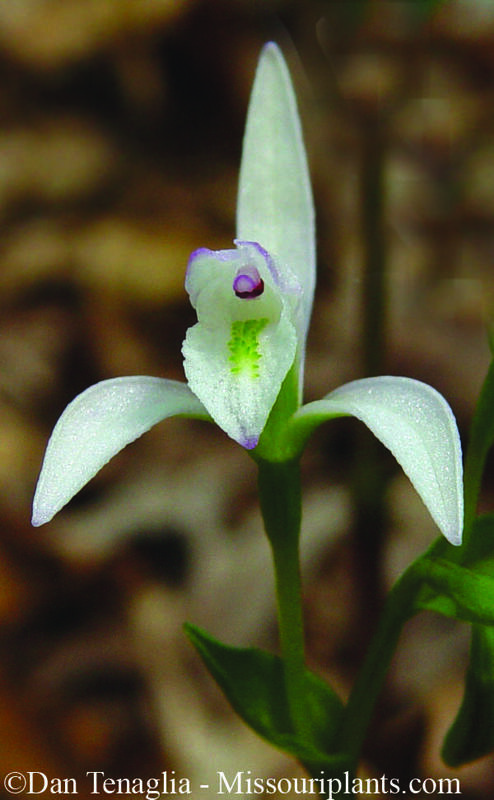
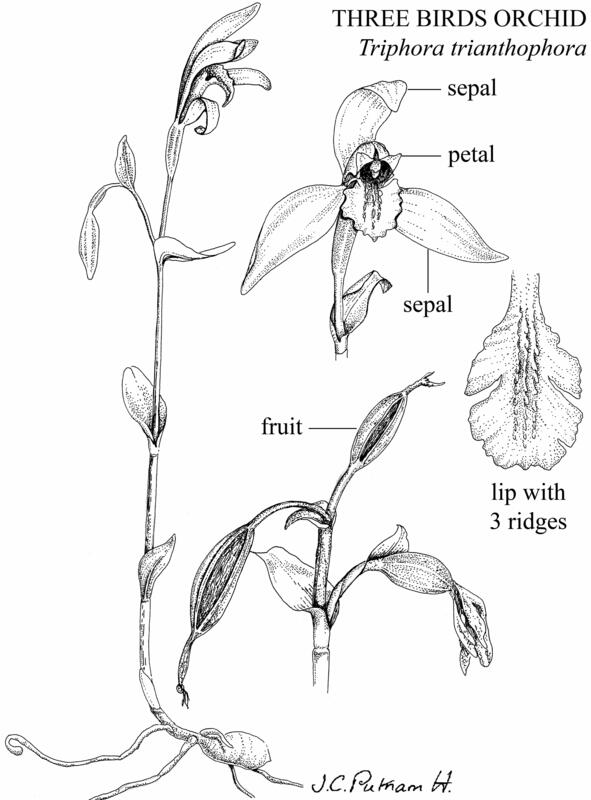
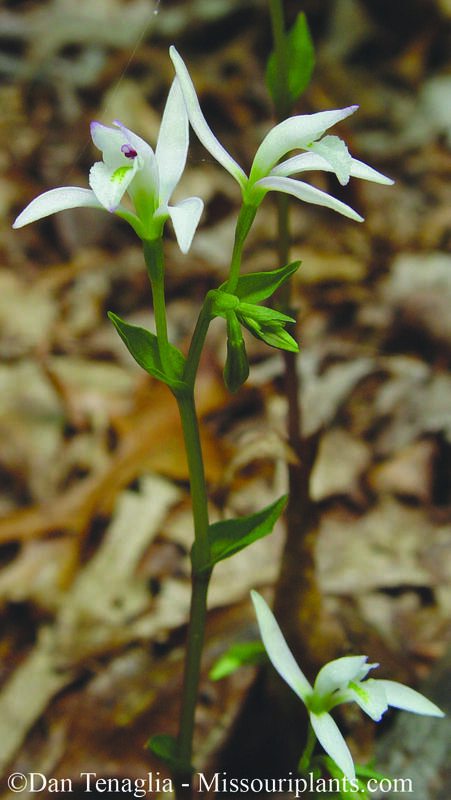
Perennial herb with a hairless stem 2.8 - 12 inches (7 - 30 cm) tall, usually less than 5 inches (13 cm) and green tinged with maroon. The leaves are 0.4 - 0.6 inch (1 - 1.5 cm) long and less than 0.6 inch (1.5 cm) wide, alternate, maroon-tinged, broadly oval, clasping the stem. The flowers are 1 - 6 in number, nodding on short stalks that arise from the angle between the stem and the upper leaves. Flowers have 3 spreading, lance-shaped sepals; 2 similar, forward-pointing, white or pale pink, petals; and a down-curved lip petal up to 0.8 inch (0.8 - 2 cm) long, with a crest of 3 bumpy, green ridges. Fruits are oval capsules about 0.5 inch (1 - 1.5 cm) long.
No other orchid in Georgia has such a short stem bearing small, pale flowers and small leaves.
Although there are more than 30 rare species of orchid in Georgia, this is the only species of Triphora in the state.
Floodplain terraces along creeks in the Piedmont; moist hardwood forests, especially hemlock / rhododendron forests, in the mountains, and moist hardwood hammocks in the Coastal Plain.
Three Birds Orchid is a perennial herb that reproduces both sexually by seed and vegetatively. Plants emerge from a fleshy, underground structure called a tuberoid (orchids do not form true tubers) in late summer when the canopy is fully closed and temperatures and humidity are high. Slender stolons (ground-level stems that spread horizontally beneath the leaf litter) radiate out from the tuberoid and form secondary tuberoids at the tips. The secondary tuberoids separate easily from the parent plant to form new – although genetically identical – plants. Colonies of Three Birds Orchid may persist for many years as tuberoids, never sending up a stem and never flowering; some colonies have been reported to be 70 years old. Because production of tuberoids is the dominant form of reproduction, Three Bird Orchid populations may suffer from a lack of genetic variability.
When plants do emerge and flower, the flowers remain open for only a day or so, possibly longer if not pollinated. All plants in a colony will flower in the same brief time period, which increases the chances of attracting pollinators. Little is known about Three Birds’ pollinators although bees are likely. If pollination and fertilization do occur, fruits mature and disperse their seeds in about one month. The seeds are dust-like and dispersed by the wind. The minute seeds have no endosperm and must quickly form a mycorrhizal relationship with a soil fungus from which the developing embryo and seedling can extract nutrients and moisture. Seedling establishment is probably low – the seeds must fall on a patch of soil with the right moisture levels and the appropriate fungus in order to germinate and become established as plants. Given that the opportunity to photosynthesize is limited (plants spend most of their lives as underground tuberoids, and emergent plants spend only a brief time aboveground, live in a low light habitat, and have small leaves), it is likely that Three Birds Orchid is dependent on mycorrhizal relationships as a source of carbohydrates throughout its life cycle.
Triphora trianthophora is also known by the spelling variant Triphora trianthophoros.
Surveys are best conducted during flowering (July–frost) when these inconspicuous plants are most obvious. Individual flowers usually last only for one day, from mid-morning to mid-afternoon, although a colony may flower for several days. Plants do not emerge every year, and population sizes may fluctuate greatly from year to year.
Georgia, Florida, north to Maine and Ontario, west to Nebraska and Texas. Our plants are considered variety trianthophoros. Variety mexicana occurs in Mexico and Central America.
Conversion of habitat to pine plantations and developments, disturbance to soil and ground layers, removal of canopy trees, and competition from invasive pest plants. Browsing by deer and rooting by hogs.
| Threat 1 | Threat 2 | Threat 3 | |
|---|---|---|---|
| General Threat | Agriculture & aquaculture | Invasive & other problematic species, genes & diseases | None |
| Specific Threat | Wood & pulp plantations | Invasive non-native/alien species/diseases | None |
Triphora trianthophora is ranked S2? by the Georgia Department of Natural Resources, indicating that the species is imperiled in Georgia, but that more information is needed to make a definitive ranking. Ten populations have been documented, 7 on federal public lands, including the Okefenokee National Wildlife Refuge and the Chattahoochee National Forest, and two on state wildlife management areas.
Protect mountain bogs, mature hardwood forests, and wetlands from logging, clearing, and draining. Eradicate exotic pest plants. Reduce the size of Georgia's deer herd. Eradicate feral hogs.
Argue, C.L. 2011. The pollination biology of North American orchids, vol. 1. Springer Science + Business Media, New York. https://www.google.com/books/edition/The_Pollination_Biology_of_North_America/xG-1gb9rf9kC?hl=en&gbpv=1&dq=inauthor:%22Charles+L.+Argue%22&printsec=frontcover
Brown, P.M. and S.N. Folsom. 2002. Wild orchids of Florida. University Press of Florida, Gainesville.
Brown, P.M. and S.N. Folsom. 2004. Wild orchids of the southeastern United States, north of peninsular Florida. University Press of Florida, Gainesville.
Chafin, L.G. 2007. Field guide to the rare plants of Georgia. State Botanical Garden of Georgia and University of Georgia Press, Athens.
Medley, M. 2003. Triphora trianthophoros subsp. trianthophoros species account. Flora of North America, Vol. 26, Magnoliophyta: Liliidae: Liliales and Orchidales. Oxford University Press, New York. http://beta.floranorthamerica.org/Triphora_trianthophoros_subsp._trianthophoros
GADNR. 2020. Element occurrence records for Triphora trianthophora. Georgia Department of Natural Resources, Wildlife Resources Division, Social Circle, Georgia.
Godfrey, R.K. and J.W. Wooten. 1979. Aquatic and wetland plants of southeastern United States, Vol. 1, monocotyledons. University of Georgia Press, Athens.
Horn, D., T. Cathcart, T.E. Hemmerly, and D. Duhl. 2005. Wildflowers of Tennessee, the Ohio Valley, and the southern Appalachians. Lone Pine Publishing, Auburn, Washington.
Jones, J., J.V. Jalava, and J. Ambrose. 2013-15. Recovery strategy for the Nodding Pogonia (Triphora trianthophora) in Ontario. Ontario Recovery Strategy Series. Prepared for the Ontario Ministry of Natural Resources, Peterborough, Ontario. https://www.canada.ca/en/environment-climate-change/services/species-risk-public-registry/recovery-strategies/nodding-pogonia-2016/part-2.html AND https://www.canada.ca/en/environment-climate-change/services/species-risk-public-registry/recovery-strategies/nodding-pogonia-proposed-2015/part-1.html
Luer, C.A. 1975. The native orchids of the United States and Canada, excluding Florida. New York Botanical Garden, New York.
NatureServe. 2020. Triphora trianthophora species account. NatureServe Explorer. NatureServe, Arlington, Virginia. https://explorer.natureserve.org/Taxon/ELEMENT_GLOBAL.2.144833/Triphora_trianthophora
Ramstetter, J.M. 2001. Conservation and research plan: Triphora trianthophora (Swartz) Rydb., three birds orchid. New England Wild Flower Society, Framingham, Massachusetts. https://tinyurl.com/y9vc22pf
Tenaglia, D. 2006. Triphora trianthophoros (Sw.) Rydb., Three Birds Orchid. Missouri plants: photographs and descriptions of flowering and non-flowering plants of Missouri. http://www.missouriplants.com/Triphora_trianthophoros_page.html
Weakley, A.S. 2015. Flora of the southern and mid-Atlantic States. University of North Carolina Herbarium, University of North Carolina, Chapel Hill. http://www.herbarium.unc.edu/flora.htm
Linda G. Chafin
L.Chafin, Jan. 2009: original account
D.Weiler, Jan. 2010: added pictures
L. Chafin, June 2020: updated original account.