

Loading profile. Please wait . . .
Marshallia ramosa Beadle & F.E. Boynt.
Southern Barbara's-buttons




Federal Protection: No US federal protection
State Protection: Rare
Global Rank: G2G3
State Rank: S2
Element Locations Tracked in Biotics: Yes
SWAP 2015 Species of Greatest Conservation Need (SGCN): No
SWAP 2025 Species of Greatest Conservation Need (SGCN): Yes
2025 SGCN Priority Tier: Highest Conservation Concern
Element Occurrences (EOs) in Georgia: 48
Habitat Summary for element in Georgia: Altamaha Grit outcrops; open forests over ultramafic rock
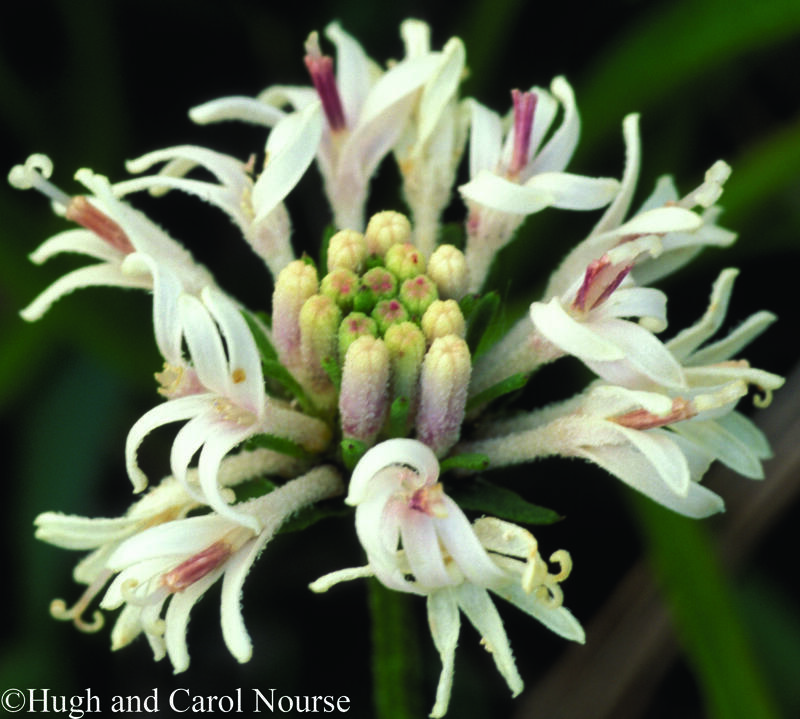
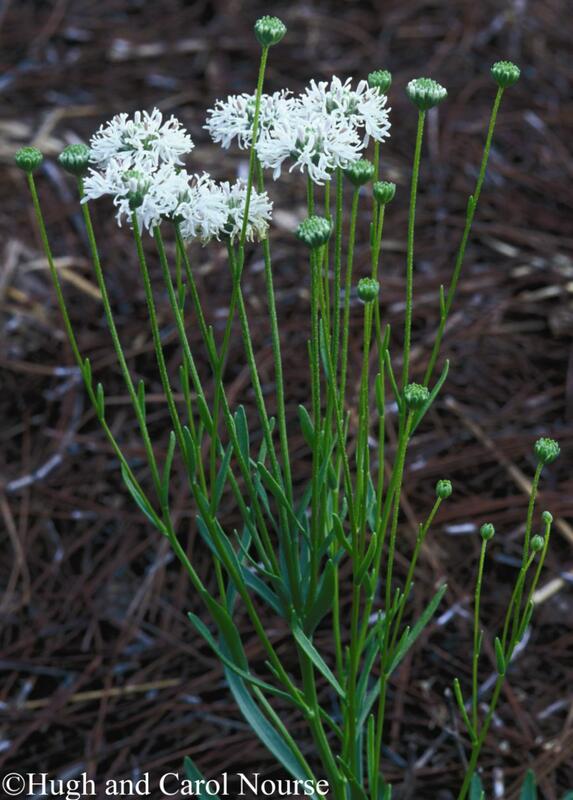
Perennial herb with stiff, erect stems 0.7 - 2.3 feet (20 - 70 cm) tall, branching from near the middle of the stem. The leaves are in a basal rosette and also on the stems and are 2 - 8 inches (5 - 20 cm) long and less than 0.25 inch (2 - 7 mm) wide, the stem leaves decreasing in size and number upward on the stems. Flower heads are 4 - 12 per plant, held at the tips of branches, each head less than 1 inch (2 cm) across, with a whorl of pointed involucral bracts surrounding the underside of the head. The heads have many pale pink or white disk flowers, each with 5 long, twisting, spreading lobes that, when fully opened, give the heads a frilly look; there are no ray flowers. Fruits are dry, seed-like, 5-angled achenes.
Narrow-leaved Barbara’s Buttons (Marshallia graminifolia) is usually taller, up to 3 feet (1 meter). It is usually a single-stemmed plant, branched near or below the middle. Its lower leaves are 2 - 8 inches (5 - 20 cm) long and 0.2 - 0.6 inch (0.5 - 1.5 cm) wide, widest above the middle, tapering to the base and to a rounded tip; stem leaves are numerous, much smaller and narrower, held upright against the stem. Its flower heads are 0.8 - 1.2 inch (2 - 3 cm) white, with purple, rarely white, disk flowers. The involucral bracts surrounding the underside of the flower head have long-tapering, pointed tips (see drawing). It flowers late July-mid October.
Mohr’s Barbara’s buttons (Marshallia mohrii) occurs on shale outcrops along streams and in small, prairie openings in the Coosa River valley; also in clearings, such as roadsides and utility rights-of-way, through these habitats. For more information, see: https://georgiabiodiversity.org/portal/profile?group=plants&es_id=20983
Broadleaf Barbara’s buttons (Marshallia trinervia, Special Concern) occurs on sand bars, natural levees, and shady, streamside woods in Harris, Bartow, and Walker Counties. For more information, see: https://georgiabiodiversity.org/portal/profile?group=plants&es_id=18378
Altamaha Grit outcrops, ultramafic rock outcrops and the shallow soils of surrounding Longleaf Pine forests; also roadsides and utility rights-of-way through these habitats.
Pineland Barbara’s buttons is a perennial herb. Its flowers are pollinated by beetles, butterflies, and other small insects, and must be cross-pollinated in order to set viable fruit. As a means of avoiding self-pollination, flowers on a given plant produce pollen before that plant’s stigmas become receptive. The seeds are probably dispersed by birds and other small animals.
Surveys are best conducted during flowering (mid-May–June, sometimes until July).
Found almost entirely in Georgia, with one population in the Florida Panhandle.
Fire suppression and encroachment by woody plants, use of herbicides in utility rights-of-way, conversion of habitat to pine plantations, clearing, and residential and commercial development.
| Threat 1 | Threat 2 | Threat 3 | |
|---|---|---|---|
| General Threat | Biological resource use | Human intrusions & disturbance | Natural system modifications |
| Specific Threat | None | None | None |
Marshallia ramosa is ranked S2 by the Georgia Department of Natural Resources, indicating that the species is imperiled in Georgia. It is listed as Rare by the State of Georgia. Approximately 40 populations have been documented in Georgia but only half have been confirmed since 2000; 15 populations occur on conservation lands.
Conduct frequent prescribed fires to control woody species. Avoid broadcast use of herbicides in rights-of-way. Avoid mechanical clearing and bedding. Purchase sites for conservation or acquire conservation easements.
Chafin, L.G. 2007. Field guide to the rare plants of Georgia. State Botanical Garden of Georgia and University of Georgia Press, Athens.
Channell, R.B. 1957. A revisional study of the genus Marshallia (Compositae). Contributions of the Gray Herbarium 181:41-132. https://www.jstor.org/stable/41764637?seq=1
Cronquist, A. 1980. Vascular flora of the southeastern United States, Vol. 1, Asteraceae. University of North Carolina Press, Chapel Hill.
GADNR. 2020. Element occurrence records for Marshallia ramosa. Georgia Department of Natural Resources, Wildlife Resources Division, Social Circle, Georgia.
Kral, R. 1983. A report on some rare, threatened, or endangered forest-related vascular plants of the South. Technical Publication R8-TP2. United States Forest Service, Atlanta.
NatureServe. 2019. Marshallia ramosa comprehensive report. NatureServe Explorer. Arlington, Virginia. http://explorer.natureserve.org/servlet/NatureServe?searchName=Marshallia+ramosa
Patrick, T.S., J.R. Allison, and G.A. Krakow. 1995. Protected plants of Georgia. Georgia Department of Natural Resources, Natural Heritage Program, Social Circle.
Watson, L.E. 2006. Marshallia ramosa species account. Flora of North America, Vol. 21. Oxford University Press, New York. http://www.efloras.org/florataxon.aspx?flora_id=1&taxon_id=250067164
Watson, L.E. and J.R. Estes. 1990. A biosystematic and phenetic analysis of morphological variation in Marshallia (Asteraceae). Systematic Botany 15: 403-414. https://www.jstor.org/stable/2419354?seq=1#metadata_info_tab_contents
Weakley, A.S. 2015. Flora of the southern and mid-Atlantic States. University of North Carolina Herbarium, University of North Carolina, Chapel Hill. http://www.herbarium.unc.edu/flora.htm
Linda G. Chafin
L. Chafin, June 2008: original account
K. Owers, Feb. 2010: added pictures
L. Chafin, Mar. 2020: updated original account.