


Loading profile. Please wait . . .
Chelonia mydas (Linnaeus, 1758)
Green Sea Turtle




Federal Protection: Listed Threatened
State Protection: Threatened
Global Rank: G4
State Rank: S3
Element Locations Tracked in Biotics: Yes
SWAP 2015 Species of Greatest Conservation Need (SGCN): Yes
SWAP 2025 Species of Greatest Conservation Need (SGCN): Yes
2025 SGCN Priority Tier: High Conservation Concern
Element Occurrences (EOs) in Georgia: 8
Habitat Summary for element in Georgia: Open ocean; sounds; coastal rivers; beaches
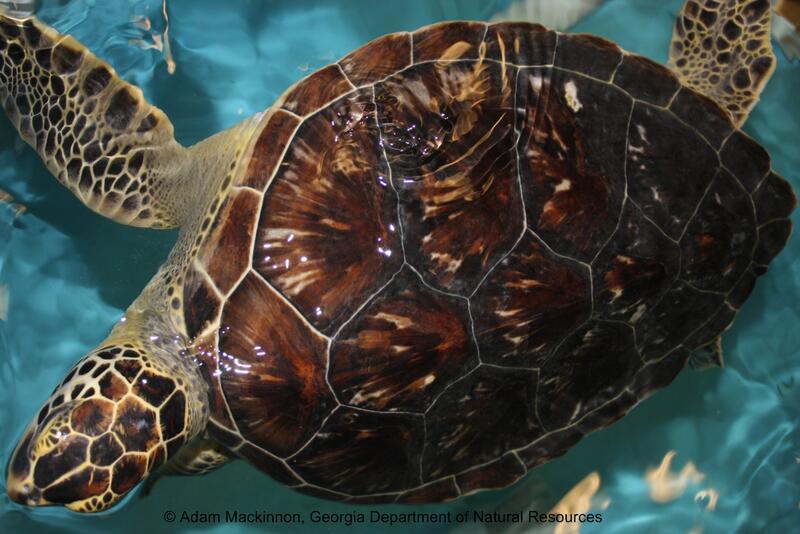
Adult green turtles have a carapace length of 90-122 cm (35-48 in). The carapace is usually heart-shaped, flat, broad, and smooth. Although the plastron is white or yellow, the overall carapace color is brown or olive with radiating rays of yellow or cream evident, especially in younger turtles. Skin color can vary from white to black with intermediate shades of brown and grey, and the distinct head scales are frequently bordered by yellow. Interestingly, the common name of this turtle comes from the color of its fat.
Although belonging to different genera, loggerhead, Kemp’s ridley, and hawksbill sea turtles are superficially similar in appearance to green sea turtles. The anterior-most costal scute on loggerheads and Kemp’s ridleys touches the nuchal scute, but is separated from it on green sea turtles. Hawksbill sea turtles have two pairs of prefrontal scales on the top of the head, while green sea turtles have just one pair.
Green turtles are found in oceanic habitat as post-hatchlings and juveniles. They are generally associated with concentrations of sargassum weed found in oceanic convergence zones. When they reach a carapace length of approximately 20 to 25 cm (8-10 in), they leave the oceanic habitat and move into shallow coastal waters where they feed on sea grasses and algae. In Georgia, juveniles have been documented foraging on macroalgae found on docks and jetties. During the nesting season, adults may be found in proximity to nesting beaches.
Green sea turtles are herbivorous and eat primarily sea grasses and algae. Georgia's estuaries and coastal waters lack the submerged aquatic vegetation favored by adult green turtles for food. However, juveniles have been documented feeding on macroalgae growing on docks and jetties.
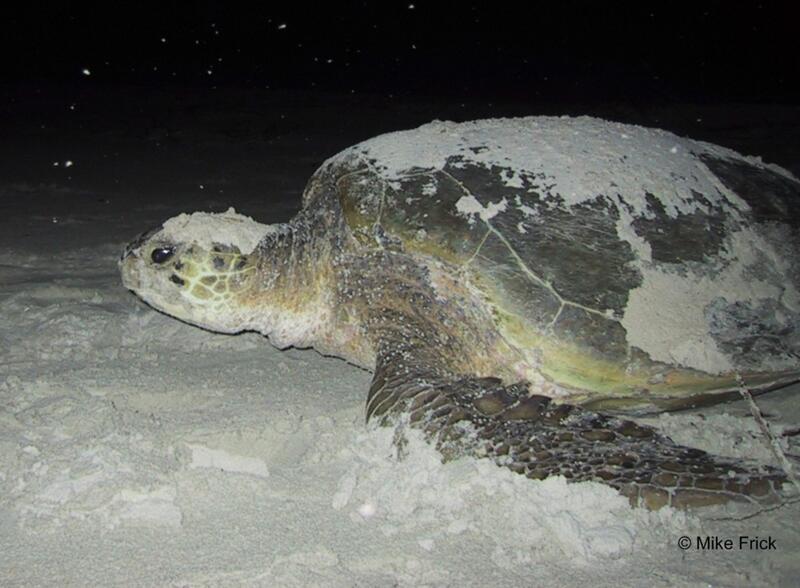
Green turtle nesting occurs in Georgia from May through August. The average size of nesting green sea turtles in the Atlantic is over 100 cm (39 in) carapace length. These turtles are thought to be at least 19 years old before they nest for the first time, with nesting occurring every 2-3 years. Green turtle nesting has increased significantly in Florida since the early 1990’s; however, nesting in Georgia has historically been low with only a handful of nests each season. Clutches of green sea turtle eggs usually number between 100-120, but can be as large as 238 eggs. One to seven nests are laid during a nesting season. Incubation can vary between 30-90 days but averages 50-55 days. Post-hatchlings and small juveniles are found in oceanic habitat and later move to shallow coastal waters to feed on sea grasses and algae. Green sea turtles are found primarily in the tropical zones of the Atlantic, Pacific, and Indian oceans, although juveniles may be found in more temperate regions of those oceans.
None
None
The greatest threats to green sea turtles, both historical and current, are human-related. The eggs and meat of green sea turtles are in demand around the world, particularly in developing countries. Green sea turtles as well as other marine life are threatened by oceanic fisheries including longlines and gillnets. Loss of foraging habitat through eutrophication, increased sedimentation and over use has also contributed to the declines in green turtle populations. Pollution including oil spills may have effects on all life stages. Green turtles in Georgia waters are most likely susceptible to the same hazards as other species including incidental capture and drowning in the shrimp trawl fishery, collision with recreational and commercial boats, fishing line entanglements, and habitat loss.
| Threat 1 | Threat 2 | Threat 3 | |
|---|---|---|---|
| General Threat | Biological resource use | Human intrusions & disturbance | Transportation & service corridors |
| Specific Threat | Fishing & harvesting aquatic resources | Recreational activities | Shipping lanes |
The U.S. nesting population of green turtles is listed as endangered as a result of human consumption and loss of habitat. A significant proportion of Georgia’s green turtle nesting habitat is in conservation ownership including Little Tybee Island Natural Area, Wassaw Island National Wildlife Refuge, Ossabaw Island Heritage Preserve, Blackbeard Island National Wildlife Refuge, Sapelo Island Wildlife Management Area, Wolf Island National Wildlife Refuge, Jekyll Island State Park, Little Cumberland Island, and Cumberland Island National Seashore.
International green turtle conservation efforts are focused on reducing human consumption of meat and eggs and reducing fishery-related mortality. In addition, efforts to protect foraging habitat (seagrass beds) are critical for population recovery. In Georgia, the proper use of Turtle Excluder Devices (TED) in the shrimp trawl fishery will help reduce juvenile and adult female mortality. Because sea turtles are long-lived with delayed sexual maturity, a significant conservation effort over a long period of time will be necessary to recover regional green turtle populations.
Andrews, K. M. and J. I. Richardson. 2008. Loggerhead Sea Turtle Caretta caretta. Pp. 444-446 in Jensen, J. B., C. D. Camp, J. W. Gibbons, and M. J. Elliott (eds.). Amphibians and Reptiles of Georgia. University of Georgia Press, Athens, GA. 575 pp.
Lutz, P.L., J.A. Musick, and J. Wyneken (editors). 2003. The Biology of Sea Turtles, Volume II. CRC Press. Boca Raton, Florida. 455 pages.
Lutz, P.L. and J.A. Musick (editors). 1997. The Biology of Sea Turtles. CRC Press. Boca Raton, Florida. 432 pages.
Ernst, C. H., J. E. Lovich, and R. W. Barbour. 1994. Turtles of the United States and Canada. Smithsonian Institution Press, Washington D.C. 578 pp.
Magnuson, J. J., K. A. Bjorndal, W. D. DuPaul, G. L. Graham, F. W. Owens, C. H. Peterson, P.C. H. Pritchard, J. I. Richardson, G. E. Saul, and C. W. West. 1990. Decline of the sea turtles: causes and prevention. National Acad. Press, Washington, D.C. 259 pp.
National Marine Fisheries Service and U.S. Fish and Wildlife Service. 1991. Recovery Plan for the U.S. Population of Atlantic Green Turtle. National Marine Fisheries Service, Washington, DC. 52 pp.
Website of interest: http://www.seaturtle.org/nestdb/index.shtml?view=3
John B. Jensen, Mark Dodd, and Bradford Winn
28-Feb-11