

Loading profile. Please wait . . .
Orbexilum virgatum (Nutt.) Rydb.
Slender Leather-root




Federal Protection: No US federal protection
State Protection: No Georgia state protection
Global Rank: G1
State Rank: SH
Element Locations Tracked in Biotics: Yes
SWAP 2015 Species of Greatest Conservation Need (SGCN): No
SWAP 2025 Species of Greatest Conservation Need (SGCN): Yes
2025 SGCN Priority Tier: High Conservation Concern
Element Occurrences (EOs) in Georgia: 2
Habitat Summary for element in Georgia: Sandridges
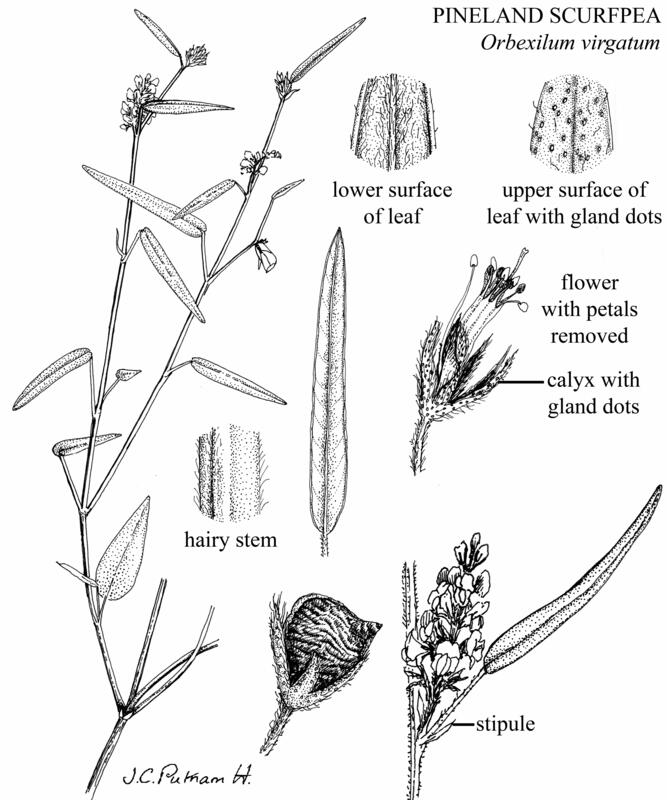
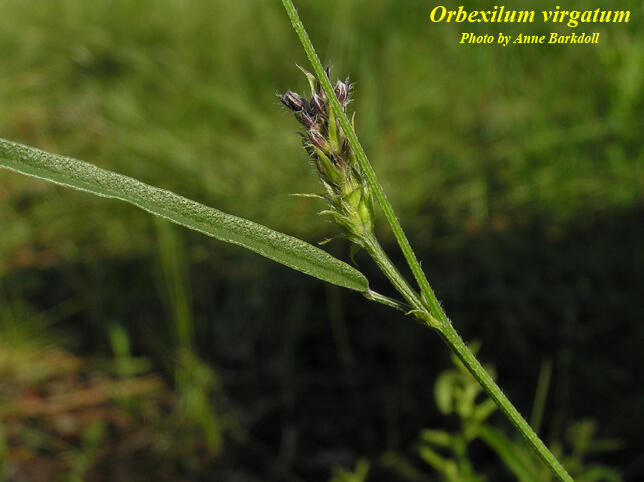
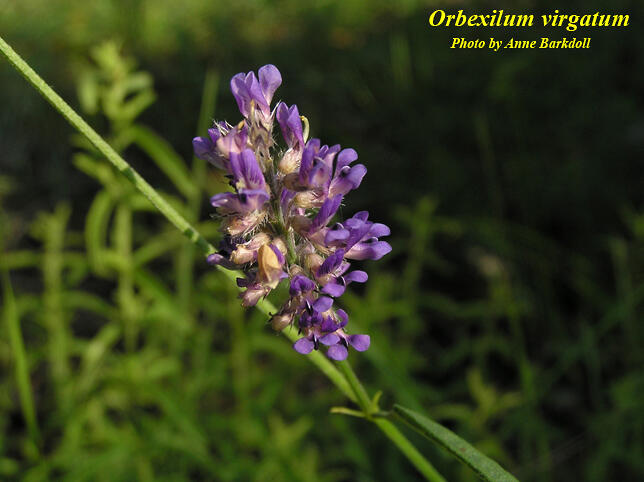
Perennial herb with 1 - 3 slender, hairy, erect stems 1 - 2 feet (30 - 60 cm) tall. The leaves are simple, 1 - 3 inches (3 - 8 cm) long and less than 0.2 inch (5 mm) wide at the base, tapering to a pointed tip, with a conspicuous midvein; upper leaf surfaces have dark gland dots, lower leaf surfaces are hairy. The lower leaves have leaf stalks up to 2 inches (5 cm) long; the upper leaves have very short or no stalks; a pair of pointed stipules about 0.2 inch (4 - 8 mm) long are attached to the base of each leaf stalk. Flower clusters are up to 2 inches (2 - 5 cm) long, compact, on a stalk rising from the angle of leaf and stem. Flowers are less than 0.3 inch (8 mm) long, purple or dark blue, typically pea flower-shaped with an erect banner petal. Fruits are small, one-seeded pods with a bumpy, ridged surface and a short beak.
Lupine Scurf-pea (Orbexilum lupinellum) occurs throughout Georgia’s Coastal Plain; it has similar flowers but its leaves are palmately compound, with 3 - 7 extremely narrow leaflets radiating from a single point.
None in Georgia.
Dry to moist Longleaf Pine-Wiregrass savannas and flatwoods.
Nothing is known about the reproductive biology of this extremely rare plant. As with most pea-type flowers, Pineland Scurfpea is probably pollinated by bees and the seeds are probably dispersed by small animals.
Surveys are best conducted during flowering (May–June). These plants are very hard to spot amongst other flatwoods vegetation.
Georgia and northeast Florida.
Fire suppression and conversion of habitat to pine plantations.
| Threat 1 | Threat 2 | Threat 3 | |
|---|---|---|---|
| General Threat | Agriculture & aquaculture | Transportation & service corridors | Residential & commercial development |
| Specific Threat | None | None | None |
Orbexilum virgatum is ranked SH by the Georgia Department of Natural Resources, indicating that it has not been seen in Georgia in several decades. Two populations were documented in southeast Georgia in the 1930s, but neither have been confirmed since then.
Apply prescribed fire to pine flatwoods every 2 - 3 years during the growing season. Avoid clearcutting, bedding, plowing fire breaks, and other mechanical disturbances. Conduct flowering-season surveys in southeast Georgia to determine current status.
Chafin, L.G. 2007. Field guide to the rare plants of Georgia. State Botanical Garden of Georgia and University of Georgia Press, Athens.
GADNR. 2020. Element occurrence records for Orbexilum virgatum. Georgia Department of Natural Resources, Wildlife Resources Division, Social Circle, Georgia.
Godfrey, R.K. and J.W. Wooten. 1981. Aquatic and wetland plants of southeastern United States, Vol. 2, dicotyledons. University of Georgia Press, Athens.
Isely, D. 1990. Vascular flora of the southeastern United States, Vol. 3, Part 2, Leguminosae (Fabaceae). University of North Carolina Press, Chapel Hill.
NatureServe. 2019. Orbexilum virgatum comprehensive report. NatureServe Explorer. Arlington, Virginia. http://explorer.natureserve.org/servlet/NatureServe?searchName= Orbexilum+virgatum
Nelson, G. 2006. Atlantic Coastal Plain wildflowers. Globe Pequot Press, Guilford, Connecticut.
Turner, B.L. 2008. Revision of the Genus Orbexilum (Fabaceae: Psoraleeae). Lundellia, 2008(11): 1-7. https://bioone.org/journals/Lundellia/volume-2008/issue-11/1097-993X-1.11.1/Revision-of-the-Genus-Orbexilum-Fabaceae-Psoraleeae/10.25224/1097-993X-1.11.1.short
Weakley, A.S. 2015. Flora of the southern and mid-Atlantic States. University of North Carolina Herbarium, University of North Carolina, Chapel Hill. http://www.herbarium.unc.edu/flora.htm
Linda G. Chafin
L. Chafin, Jul. 2008: original account
K. Owers, Feb. 2010: added pictures
L. Chafin, Mar. 2020: updated original account