

Loading profile. Please wait . . .
Chamaecrista horizontalis A.R. Franck
Florida Senna




Federal Protection: No US federal protection
State Protection: No Georgia state protection
Global Rank: G2
State Rank: S1?
Element Locations Tracked in Biotics: Yes
SWAP 2015 Species of Greatest Conservation Need (SGCN): Yes
SWAP 2025 Species of Greatest Conservation Need (SGCN): Yes
2025 SGCN Priority Tier: Highest Conservation Concern
Element Occurrences (EOs) in Georgia: 12
Habitat Summary for element in Georgia: Sandhill scrub; longleaf pine-wiregrass savannas
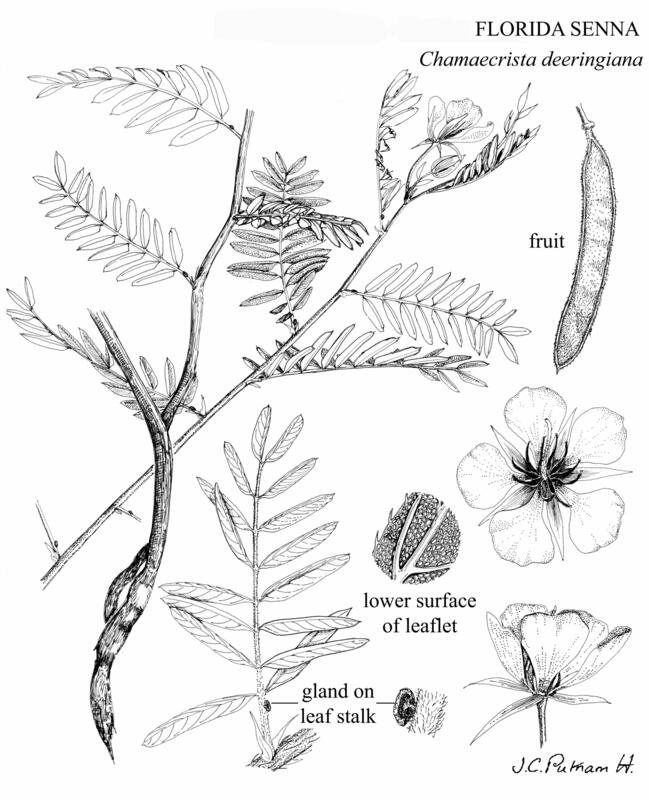
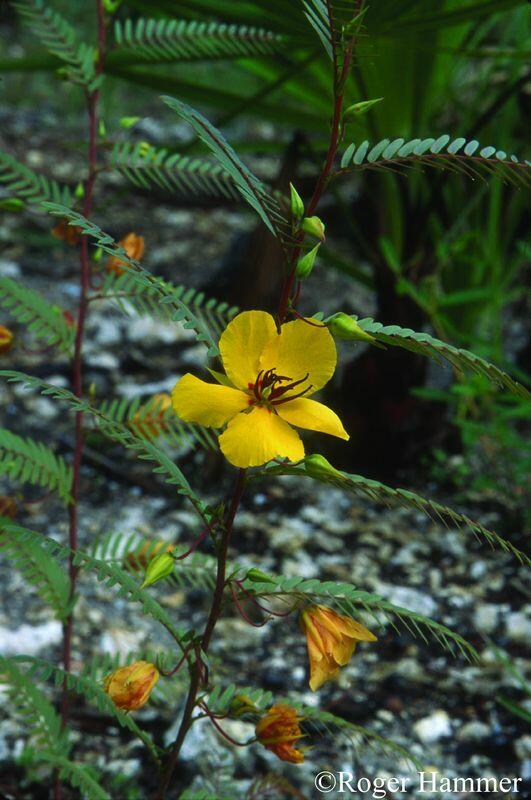
Perennial herb with 1 - 6 erect, usually unbranched stems, 8 - 28 inches (20 - 70 cm) tall, rising from a horizontal, woody rhizome. The leaves have 8 - 18 pairs of oblong leaflets, about 0.5 inch (1 - 1.5 cm) long, that fold up when touched. The leaf stalk is 1.4 - 2.4 inches (3.5 - 6 cm) long, with a reddish, round gland near the base. Flowers are wider than 1 inch (2.5 cm), the larger petals 0.5 - 0.75 inch (1.3 - 1.8 cm) long, with 5 yellow petals (red-spotted at the base), 10 red stamens, and red flower stalks longer than 0.4 inch (1 - 1.5 cm). Fruits are flat, oblong pods, 1.2 - 2.4 inch (3 - 6 cm) long.
Partridge-pea (Chamaecrista fasciculata) is a common, weedy annual with a taproot that sends up a single, much-branched stem. Its flowers usually have yellow stamens.
Sensitive-plant (Chamaecrista nictitans), also a tap-rooted annual, has several branches; its flowers are about 0.4 inch (1 cm) wide, with 5 - 9 red stamens; its leaves have 7- 25 pairs of leaflets; the flower and fruit stalk is less than 0.25 inch (0.6 cm) long.
Like Florida Senna, both of these species have a red gland on the leaf stalk and leaflets that fold up when touched.
This is the only rare Chamaecrista species in Georgia.
Longleaf Pine-Wiregrass savannas and Fall Line sandhills.
Florida Senna is pollinated by bees, which are drawn to the flower’s color and pollen rewards; the flowers do not produce nectar. Florida Senna has a gland at the base of each leaf stalk – an extra-floral nectary – that exudes a sweet nectar; ants (and possibly spiders) feed on the nectar and attack leaf-eating insects that try to crawl onto the leaf. Seeds are eaten by birds and other small animals. Other species of Chamaecrista are larval hosts for several butterfly species, including Cloudless Sulphur, Little Yellow and Sleepy Orange; it is likely that Florida Senna is also.
The leaflets of Chamaecrista species fold up when touched and also in response to nightfall. Leaf movements are called "nastic movements." Folding in response to touch is called thigmonasty; folding in response to changes in light is called nyctinasty. The folding and unfolding movements are the result of changes in turgor pressure (swelling and shrinking) in the cells of the pulvini, enlarged areas at the base of each leaf or leaflet. The changes are driven by the plant's biological clock in the case of nyctinasty, and by touch or vibration in the case of thigmonasty. Leaf folding scares and discourages herbivores.
Surveys are best conducted during flowering (June–August).
Georgia, Florida, Alabama, and Mississippi, in the Coastal Plain.
Fire suppression. Conversion of habitat to pine plantations, pastures, fields, and development.
| Threat 1 | Threat 2 | Threat 3 | |
|---|---|---|---|
| General Threat | Energy production & mining | Natural system modifications | Agriculture & aquaculture |
| Specific Threat | None | None | None |
Chamaecrista horizontalis is ranked as S1? by the Georgia Department of Natural Resources, indicating that it is probably critically imperiled in the state but that sufficient informaton is not available to make a definitive ranking. Eleven populations have been documented in Georgia over the last century or so, but only 7 have been seen since 2000. Two populations occur on conservation lands.
Apply prescribed fire to Longleaf Pine stands every 2 - 3 years, primarily in the growing season. Protect sandhills and savannas from conversion to pine plantations and development.
Braam, J. 2004. In touch: plant responses to mechanical stimuli. New Phytologist 165(2): 373-389. https://nph.onlinelibrary.wiley.com/doi/10.1111/j.1469-8137.2004.01263.x
Chafin, L.G. 2007. Field guide to the rare plants of Georgia. State Botanical Garden of Georgia and University of Georgia Press, Athens.
Davis, F. 2016. What do plants do at night? Understanding nyctinastic movement. Exploring Sound and Circadian Rhythms: A Plants in Motion Project Site. http://blogs.evergreen.edu/pim-group7/understanding-nyctinastic-movement/
GADNR. 2019. Element occurrence records for Chamaecrista deeringiana. Georgia Department of Natural Resources, Wildlife Resources Division, Social Circle, Georgia.
Keener, B. R. 2020. Chamaecrista deeringiana species account. Alabama Plant Atlas, Alabama Herbarium Consortium and the The University of West Alabama, Livingston, Alabama. http://www.floraofalabama.org/Plant.aspx?id=1899
Isely, D. 1990. Vascular flora of the southeastern United States, Vol. 3, Leguminosae (Fabaceae). University of North Carolina Press, Chapel Hill.
NatureServe. 2019. Chamaecrista deeringiana comprehensive report. NatureServe Explorer. Arlington, Virginia. http://explorer.natureserve.org/servlet/NatureServe?searchName=Carex%20dasycarpa
Norden, H. and K. Kirkman. 2006. Field guide to common legume species of the longleaf pine ecosystem. Joseph W. Jones Ecological Research Center, Newton, Georgia. https://www.nclongleaf.org/pdfs/FieldGuideLegumes_JonesCenter.pdf
Weakley, A.S. 2015. Flora of the southern and mid-Atlantic States. University of North Carolina Herbarium, University of North Carolina, Chapel Hill. http://www.herbarium.unc.edu/flora.htm
Wolfe, A.D. and J.R. Estes. 1992. Pollination and the function of floral parts in Chamaecrista fasciculata (Fabaceae). American Journal of Botany 79(3): 314-317. https://www.jstor.org/stable/2445021?seq=1#metadata_info_tab_contents
Linda G. Chafin
L. Chafin, Oct. 2007: original account.
K. Owers, Jan. 2010: updated status and ranks, added pictures.
L. Chafin, Jan 2020: updated original account..