

Loading profile. Please wait . . .
Sanguisorba canadensis L.
Canada Burnet




Federal Protection: No US federal protection
State Protection: Threatened
Global Rank: G5
State Rank: S1
Element Locations Tracked in Biotics: Yes
SWAP 2015 Species of Greatest Conservation Need (SGCN): Yes
SWAP 2025 Species of Greatest Conservation Need (SGCN): Yes
2025 SGCN Priority Tier: High Conservation Concern
Element Occurrences (EOs) in Georgia: 6
Habitat Summary for element in Georgia: Seepy meadows and thickets
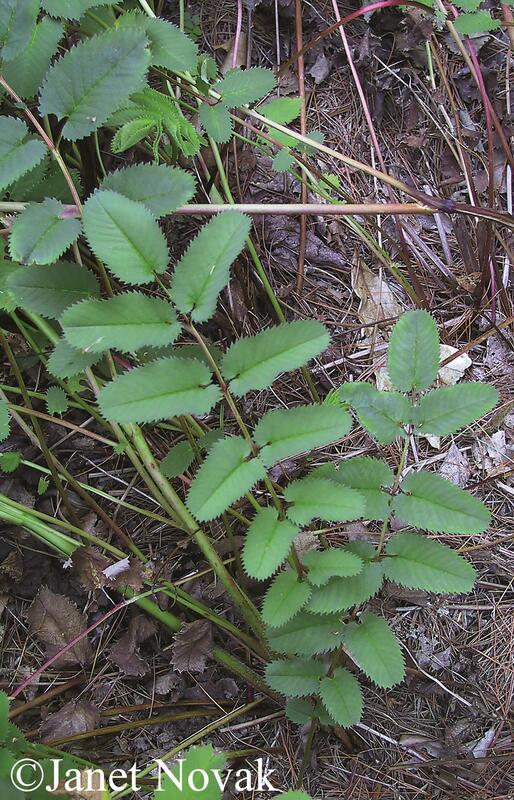
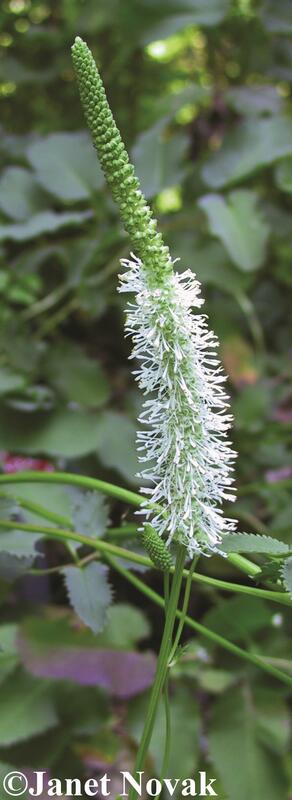
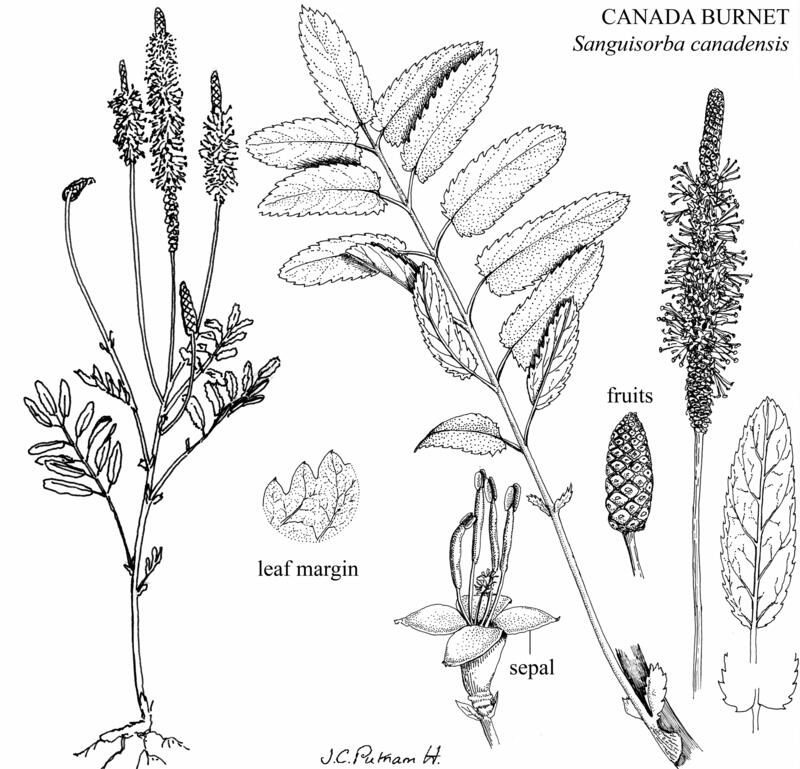
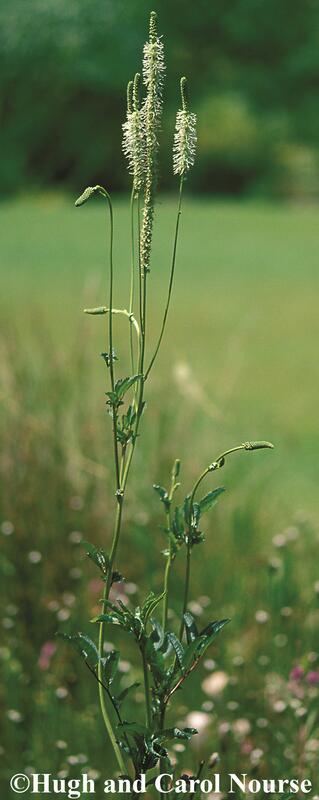
Perennial herb up to 6 feet (2 meters) tall with 1 to several erect branches near the top of the plant. Its leaves are up to 2.5 feet (80 cm) long near the base of the plant, becoming shorter upward, with a small leafy stipule at the base of each. Each leaf is divided into 7 - 17 oblong leaflets with rounded bases and evenly toothed margins. Flower clusters are long-stalked, densely flowered spikes up to 6 inches long. Each flower has 4 white sepals, no petals, and 4 long, showy stamens that give the flower spike a shaggy appearance. Fruits are small, dry, and single-seeded, tightly packed into a cone-like structure up to 6 inches (15 cm) long.
Black Cohosh (Actaea racemosa, synonym Cimicifuga racemosa) has tall, white-flowered spikes but its leaves are divided into many, coarsely and irregularly toothed leaflets; it flowers in early summer and usually does not grow in wetlands.
None in Georgia.
Wet meadows with basic soils, mountain bogs, seepy streamside thickets, seeps over ultramafic rock.
Canada Burnet is a perennial herb that reproduces sexually. Individual flowers of Canada Burnet lack petals and are inconspicuous, but the densely flowered spikes are showy and attract a variety of insect pollinators, especially bees, flies, and butterflies, which extract nectar from the flowers.
Surveys are best conducted during flowering (August–October) and fruiting (October–November).
Georgia, north to Labrador and west to Alaska.
Logging and clearing in wetlands and streamside zones. Invasion by exotic pest plants such as Chinese Silk-grass (Miscanthus chinensis) and Japanese Stilt-grass (Microstegium vimineum).
| Threat 1 | Threat 2 | Threat 3 | |
|---|---|---|---|
| General Threat | Biological resource use | Invasive & other problematic species, genes & diseases | None |
| Specific Threat | Logging & wood harvesting | Invasive non-native/alien species/diseases | None |
Sanguisorba canadensis is ranked S1 by the Georgia Department of Natural Resources, indicating that the species is critically imperiled in Georgia. It is listed as Threatened by the State of Georgia. Only 6 populations have been documented in Georgia, most on national forest land.
Avoid mechanical clearing and logging along mountain streams and in mountain wetlands. Use fire or hand-clearing to create sunny openings and wet meadows. Monitor sites for exotic pest plant invasion and eradicate when needed.
Georgia’s plants are the southernmost populations of this species. Plants occurring at the periphery of a species’ range are thought to be of special conservation importance. Peripheral populations are usually smaller and less genetically diverse within the population, but genetically divergent from centrally located populations. These genetic differences may confer special survival traits that plants in other portions of the species’ range lack, such as the ability to survive changes in the climate or the arrival of a new pathogen. Peripheral populations may be in the process of evolving into a new species. They are especially deserving of conservation action.
Chafin, L.G. 2007. Field guide to the rare plants of Georgia. State Botanical Garden of Georgia and University of Georgia Press, Athens.
Godfrey, R.K. and J.W. Wooten. 1981. Aquatic and wetland plants of southeastern United States, Vol. 2, dicotyledons. University of Georgia Press, Athens.
Holloway, P.S. and G.E.M. Matheke. 2003. Seed germination of burnet. Native Plants 4(2): 95-200. https://rngr.net/npn/journal/articles/seed-germination-of-burnet-sanguisorba-spp
NatureServe. 2020. Sanguisorba canadensis species account. NatureServe Explorer. Arlington, Virginia. NatureServe Explorer. NatureServe, Arlington, Virginia. https://explorer.natureserve.org/Taxon/ELEMENT_GLOBAL.2.156704/Sanguisorba_canadensis
Patrick, T.S., J.R. Allison, and G.A. Krakow. 1995. Protected plants of Georgia. Georgia Department of Natural Resources, Natural Heritage Program, Social Circle.
Radford, A.E., H.E. Ahles, and C.R. Bell. 1968. Manual of the vascular flora of the Carolinas. University of North Carolina Press, Chapel Hill.
Weakley, A.S. 2015. Flora of the southern and mid-Atlantic States. University of North Carolina Herbarium, University of North Carolina, Chapel Hill. http://www.herbarium.unc.edu/flora.htm
Weakley, A.S. 2015. Sanguisorba canadensis species account. Flora of North America, vol. 9. http://beta.floranorthamerica.org/Sanguisorba
Linda G. Chafin
L.Chafin, Aug. 2008: original account
D.Weiler, Feb. 2010: added pictures
L. Chafin, May 2020: updated original account.