

Loading profile. Please wait . . .
Helianthus smithiorum Heiser
Smith's Sunflower




Federal Protection: No US federal protection
State Protection: No Georgia state protection
Global Rank: G3
State Rank: S1
Element Locations Tracked in Biotics: Yes
SWAP 2015 Species of Greatest Conservation Need (SGCN): Yes
SWAP 2025 Species of Greatest Conservation Need (SGCN): Yes
2025 SGCN Priority Tier: Highest Conservation Concern
Element Occurrences (EOs) in Georgia: 13
Habitat Summary for element in Georgia: Dry open woods and thickets
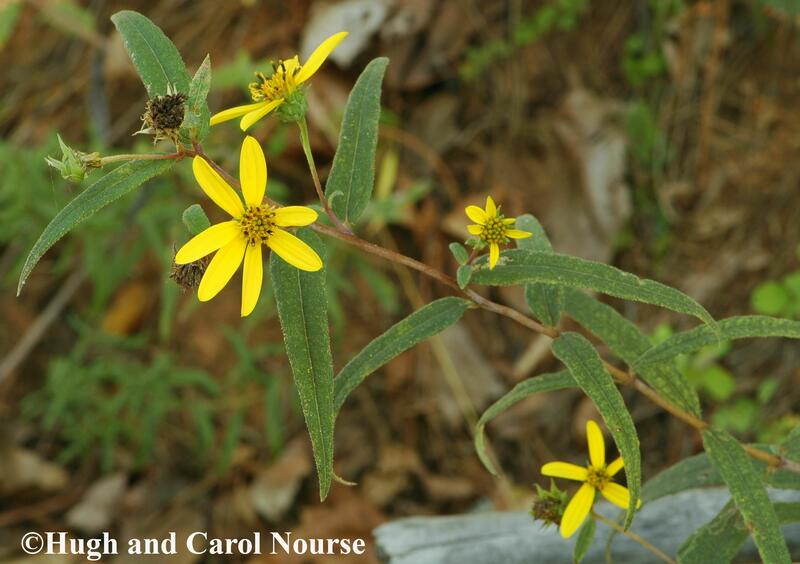
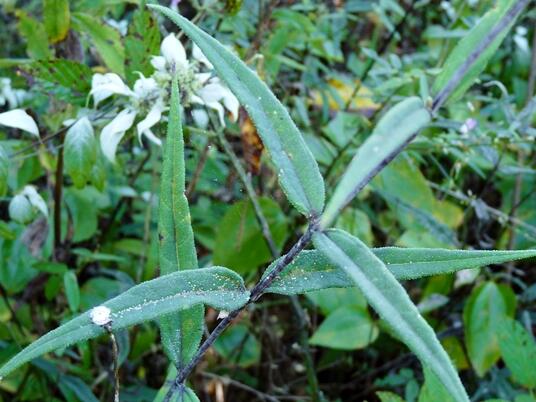
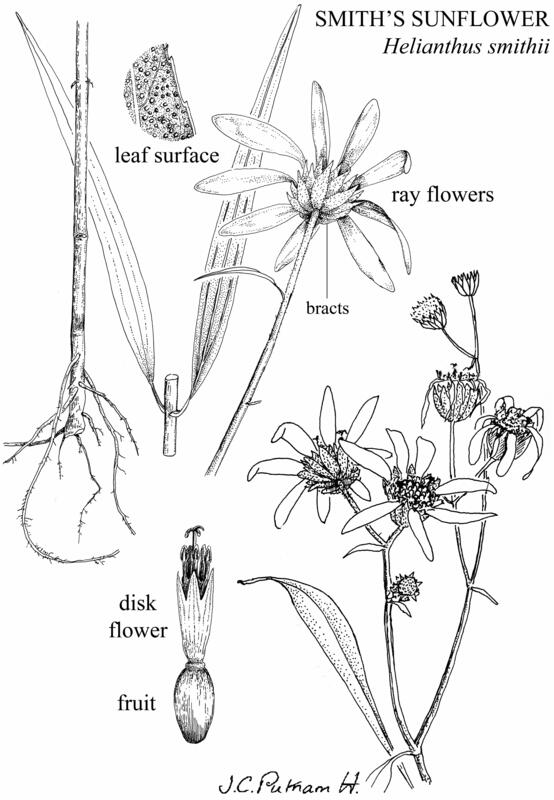
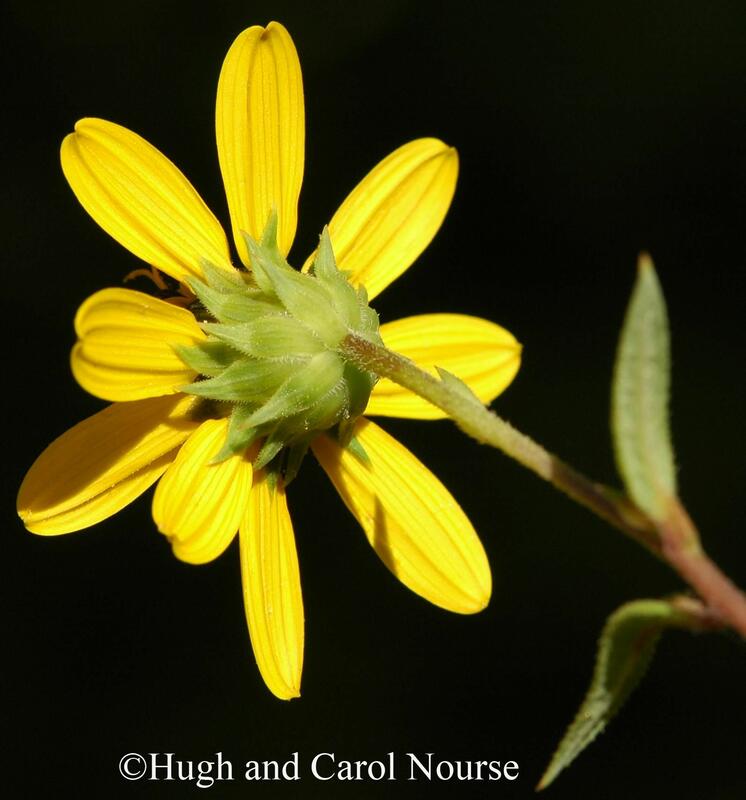
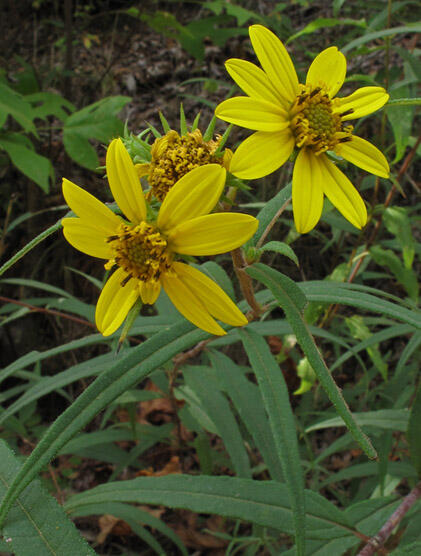
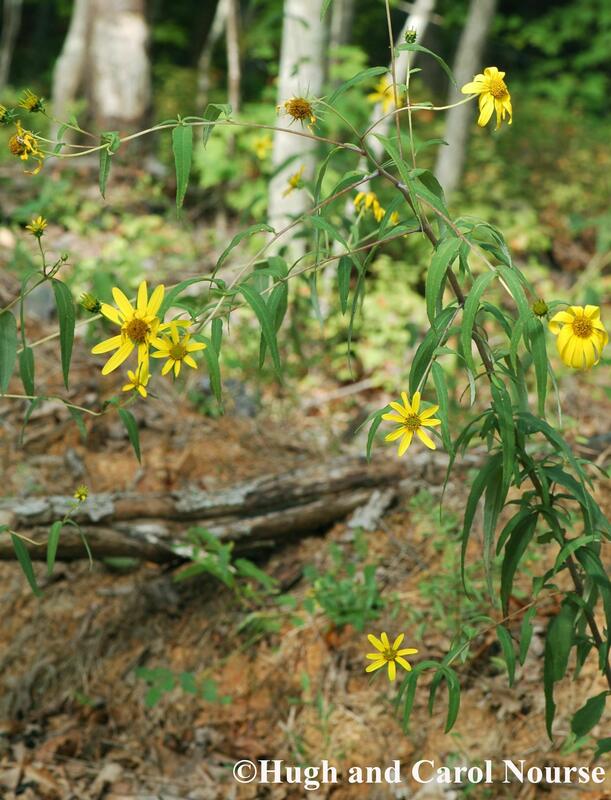
Perennial herb with a smooth, waxy, erect, purplish stem up to 5 feet (150 cm) tall and branched near the top. Leaves are 2.8 - 7 inches (7 - 18 cm) long and 0.4 - 0.7 inch (1 - 1.8 cm) wide, lance-shaped with tapering bases, finely toothed and/or inrolled margins, a single raised midvein on the upper surface, and golden gland dots on the lower surface (dots may disappear by late summer); both upper and lower leaf surfaces are rough-hairy; leaves are opposite except near the top of the plant, where they may become alternate. Leaf stalks are less than 0.5 inch (1.3 cm) long. Flower heads are 1 - 5 in number (sometimes more) per plant; each head has 6 - 10 yellow ray flowers, up to 0.6 inch (1 - 1.5 cm) long and many yellow disk flowers; a whorl of 15 - 20 green, lance-shaped involucral bracts forms a cup surrounding the lower part of the head. Fruits are dry, seed-like, dark brown, about 0.1 inch (3 mm) long.
Smith’s Sunflower produces fertile hybrids as a result of crossing with several other sunflower species, including Helianthus microcephalus, H. decapetalus, H. hirsutus, and H. strumosus, especially when growing in disturbed areas, making positive identification difficult.
Forest Sunflower (Helianthus decapetalus) occurs in habitats similar to Smith's Sunflower's though often with moister or even wet soils. Its leaves have 3 conspicuous veins at the base of the leaf and leaf tissue that often continues onto the leaf stalk as wings. Its flower heads have 8 - 12 ray flowers.
Spreading Sunflower (Helianthus divaricatus) occurs in similar habitats. Its leaves have 3 conspicuous veins at the base of the leaf and no or very short leaf stalks. The flower heads have 10 - 15 ray flowers.
Hairy Sunflower (Helianthus hirsutus) occurs in similar habitats. Its leaves have 3 conspicuous veins at the base of the leaf. The flower heads have 10 - 15 ray flowers.
Small-headed Sunflower (Helianthus microcephalus) occurs in similar habitats. It also has small heads and its leaves are also dotted with glands on the lower surface. But Small-headed Sunflower leaves have 3 conspicuous veins and its leaf stalks are usually longer than 0.5 inch (1.3 cm). Its heads have fewer ray flowers than Smith's, only 5 - 8.
Roughleaf Sunflower (Helianthus strumosus) occurs in similar habitats. Its leaves have 3 conspicuous veins at the base of the leaf and are roughly hairy on the upper surface, with leaf stalks 0.4 - 1.2 inches (1 - 3 cm) long. Its flower heads have 10 - 20 ray flowers.
There are 6 rare species of Helianthus in Georgia:
Helianthus agrestis (Southeastern Sunflower) occurs in mucky, wet soils in open pine flatwoods in the Coastal Plain. For more information, see: http://explorer.natureserve.org/servlet/NatureServe?searchName=Helianthus%20agrestis
Helianthus glaucophyllus (Whiteleaf Sunflower) occurs in moist forests and woodlands in the Southern Appalachian mountains and foothills. For more information, see: https://www.georgiabiodiversity.org/portal/profile?group=plants&es_id=16054.
Helianthus heterophyllus (Wetland Sunflower) occurs in bBogs and wet pine savannas. For more information, see: http://www.efloras.org/florataxon.aspx?flora_id=1&taxon_id=250066885
Helianthus occidentalis (Barrens Sunflower) occurs in limestone glades and barrens with rocky or cherty soils. For more information, see: http://www.efloras.org/florataxon.aspx?flora_id=1&taxon_id=242416636
Helianthus smithii (Smith's Sunflower) occurs in dry upland woods in north Georgia. For more information, see: https://www.georgiabiodiversity.org/portal/profile?group=plants&es_id=20250
Helianthus verticillatus (Whorled Sunflower) occurs in wet prairies over dolomite in northwest Georgia. For more information, see: https://www.georgiabiodiversity.org/portal/profile?group=plants&es_id=21967
Sunny gaps in dry, upland Oak-Hickory-Pine woodlands and roadsides and utility rights-of-way through this habitat in northeast Georgia. Before widespread fire suppression, this species would have occupied native prairies, grasslands, and openings in the Piedmont and Blue Ridge foothills.
Smith’s Sunflower is a perennial herb that reproduces sexually as well as vegetatively by sprouting from crown buds and rhizomes. Its flower heads are composed of sterile ray flowers and fertile, bisexual disk flowers. The flowers are pollinated by bees and a variety of other insects. Smith’s Sunflower produces fertile hybrids as a result of crossing with several other sunflower species, including Helianthus microcephalus, H. decapetalus, H. hirsutus, and H. strumosus.
Surveys are best conducted during flowering (August–October).
Georgia, Alabama, and Tennessee.
Logging, roadside use of herbicides, fire suppression in woodlands and prairies, conversion of habitat to pine plantations and commerical and residential developments, invasion by exotic pest plants.
| Threat 1 | Threat 2 | Threat 3 | |
|---|---|---|---|
| General Threat | Natural system modifications | Natural system modifications | Residential & commercial development |
| Specific Threat | None | None | None |
Helianthus smithii is ranked S1 by the Georgia Department of Natural Resources, indicating that it is critically imperiled in the state. Eight populations have been documented in Georgia in the last 25 years, one on national forest land, two on military lands, and one on a state wildlife management area.
Protect and restore native prairies and grasslands. Discontinue use of herbicides in roadside maintenance. Maintain forest openings with fire or hand-clearing. Eradicate exotic pest plants.
Cronquist, A. 1980. Vascular flora of the southeastern United States, Vol. 1, Asteraceae. University of North Carolina Press, Chapel Hill.
GADNR. 2020. Element occurrence records for Helianthus smithii. Georgia Department of Natural Resources, Wildlife Resources Division, Social Circle, Georgia.
Heiser, C.B., D.M. Smith, S. Clevenger, and W.C. Martin. 1969. The North American sunflowers (Helianthus). Memoranda of Torrey Botanical Club 22(3).
Kral, R. 1983. A report on some rare, threatened, or endangered forest-related vascular plants of the South. Technical Publication R8-TP2. United States Forest Service, Atlanta.
NatureServe. 2019. Helianthus smithii comprehensive report. NatureServe Explorer. Arlington, Virginia. http://explorer.natureserve.org/servlet/NatureServe?searchName= Helianthus+smithii
Schilling, E.E. 2006. Helianthus smithii species account. Flora of North America, Vol. 21. Oxford University Press, New York. http://www.efloras.org/florataxon.aspx?flora_id=1&taxon_id=114871
Weakley, A.S. 2015. Flora of the southern and mid-Atlantic States. University of North Carolina Herbarium, University of North Carolina, Chapel Hill. http://www.herbarium.unc.edu/flora.htm
Linda G. Chafin
L. Chafin, Oct. 2007: original account
K. Owers, Feb. 2010: added pictures
L. Chafin, Feb 2020: updated original account.