


Loading profile. Please wait . . .
Amblyscirtes alternata (Grote and Robinson, 1867)
Dusky Roadside-Skipper




Federal Protection: No US federal protection
State Protection: No Georgia state protection
Global Rank: G3G4
State Rank: S3
Element Locations Tracked in Biotics: Yes
SWAP 2015 Species of Greatest Conservation Need (SGCN): Yes
SWAP 2025 Species of Greatest Conservation Need (SGCN): Yes
2025 SGCN Priority Tier: High Conservation Concern
Element Occurrences (EOs) in Georgia: 14
Habitat Summary for element in Georgia: Sunny patches in pine forests
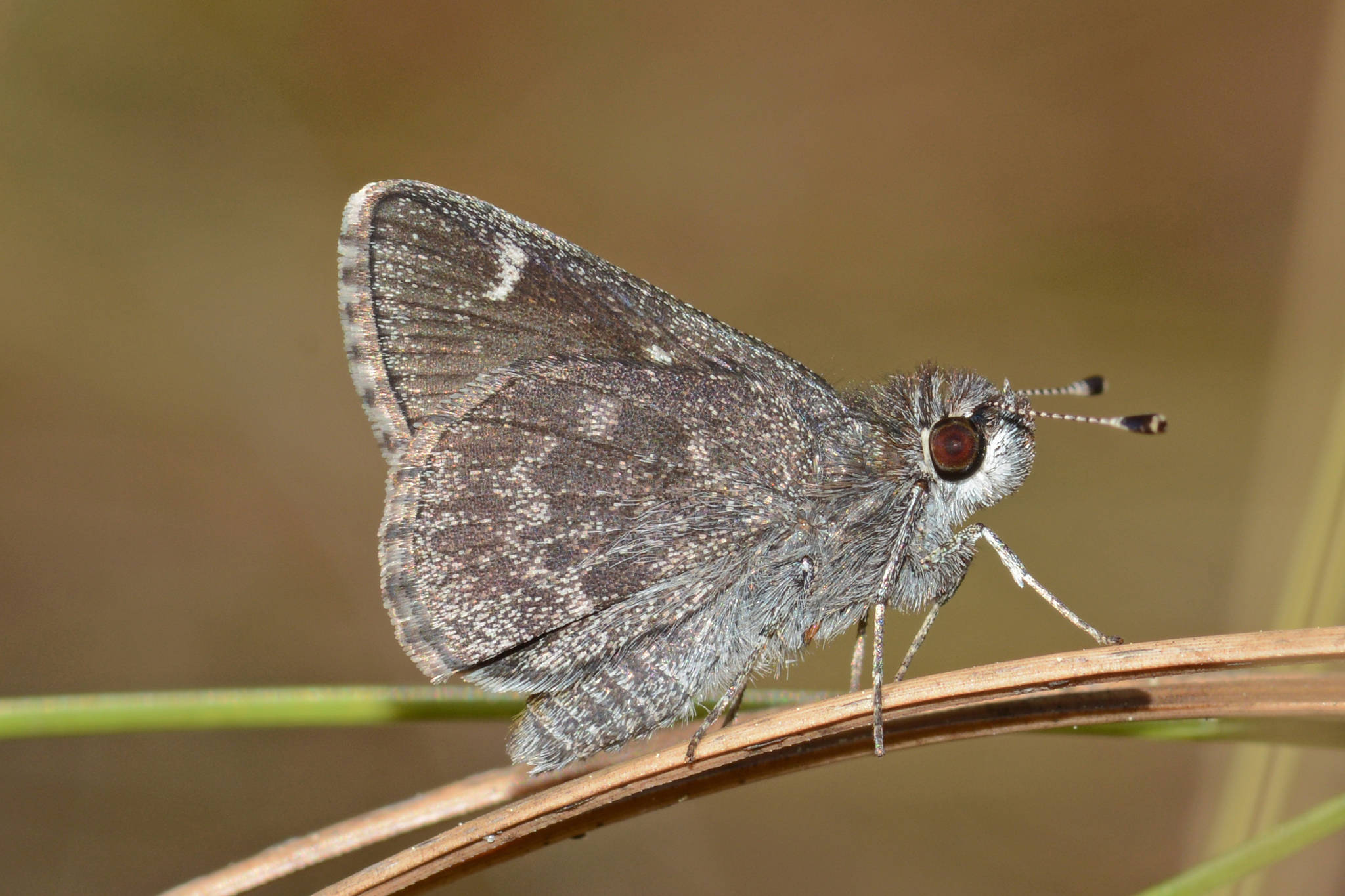
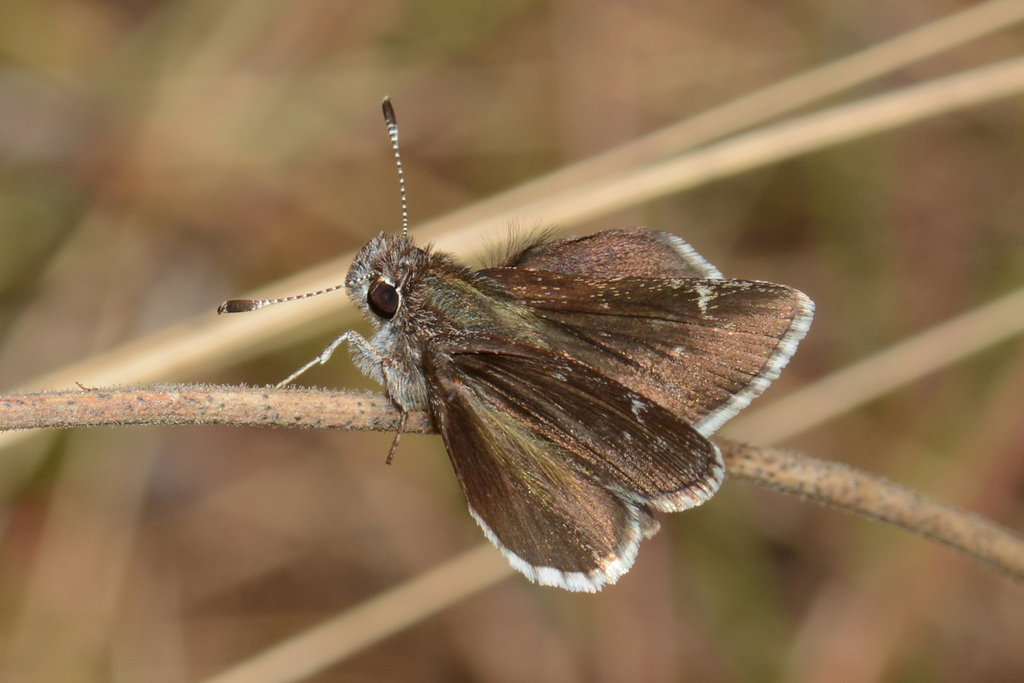
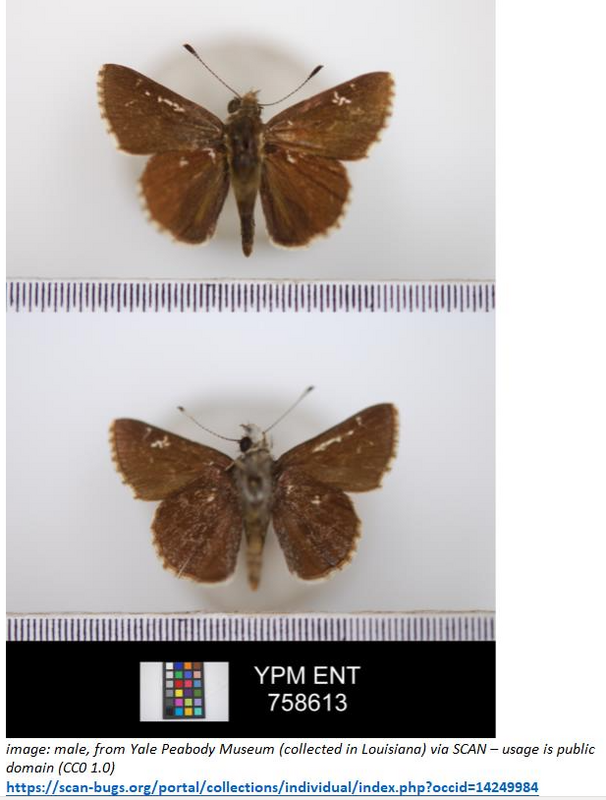
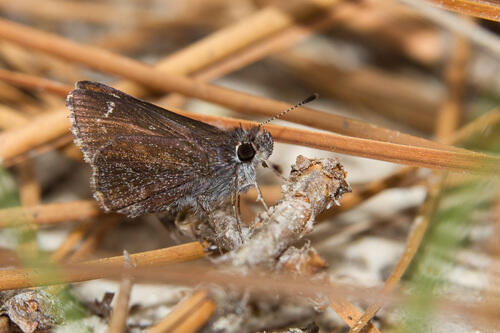
Amblyscirtes alternata, the dusky roadside-skipper, is a dark brown butterfly with a wingspan of 7/8 - 1 inch (2.2-2.5 cm). It has white fringes with small black checks at the margins of its wings. Its wings and abdomen may appear dusted with white speckles. Like other skippers, it has a stout body, and it holds its wings angled upward at rest. Females’ bodies may be lighter than males’.
Its larval form has a pale and waxy body. Its head is brown with reddish-brown stripes.
Hesperia alternata and Amblyscirtes meridionalis are synonyms for this species.
Many Amblyscirtes species are difficult to distinguish by non-experts, especially at a distance or while moving. A. vialis and A. belli are notable for their striking similarities and potentially overlapping ranges.
Amblyscirtes vialis, the common roadside-skipper, has similar dark brown coloration, and its wings have lighter fringes with black checks. The undersides of its wings have a blue-gray or violet-gray tint, especially at the wingtips. Its range is known to overlap with A. alternata – records are reported across central and north Georgia. This similar species is typically larger than A. alternata, but smaller individuals may be particularly ambiguous.
Amblyscirtes belli is similar in coloration and life history but is larger than A. alternata. It is found in the Georgia Piedmont, outside of but close to A. alternata’s documented range.
Pine flatwoods – open, grassy pine forests – in the southeastern United States. Depending on the season, these areas can be moist or dry and are subject to frequent burning. A. alternata has also been reported living in pine savannas or sandhills, typically containing longleaf pine (Pinus palustris). Besides the need to contain the larval foodplant, other habitat needs remain unknown and unstudied.
Adult A. alternata feed on flower nectar. Larvae feed on bearded skeletongrass (Gymnopogon ambiguous) and potentially other grasses.
In Georgia, two or three broods emerge each year. Adults are known to be active from late April-August. Larvae overwinter on the ground in cocoons made from host plant leaves.
Search for A. alternata in grassy pine habitats, especially those with historical occurrences and those containing P. palustris and G. ambiguous. Focus on southern, coastal, and central Georgia, and attempt to confirm whether historical populations still exist.
Records exist across the southeastern United States from central Texas to southeastern Virginia. In Georgia, most records lie in central and far southern regions, with two historical records near Atlanta. It is closely associated with longleaf pine (Pinus palustris).
Its historic habitats have been severely disrupted, degraded, and fragmented. In Georgia, much pine flatwood habitat has been converted to pine plantations. Even in its remaining range, A. alternata is rare.
It is primarily threatened by development and inappropriate burning of grasses and litter. Since all life stages live above ground, A. alternata is vulnerable to fire, especially frequent or complete burns.
| Threat 1 | Threat 2 | Threat 3 | |
|---|---|---|---|
| General Threat | Natural system modifications | Pollution | None |
| Specific Threat | Fire & fire suppression | Air-borne pollutants | None |
S3 – vulnerable due to a restricted range, relatively few populations, recent and widespread declines, or other factors.
The dusky roadside-skipper is often overlooked, and its rarity is unclear. Recent occurrence records are hard to come by. It is recommended that efforts be made to conserve and protect grassy pine habitats and to survey existing flatwoods for viable populations of A. alternata.
This butterfly should also be considered when planning controlled burns of pine flatwoods, savannas, and sandhills since all life stages are vulnerable to fire.
Additionally, more research into A. alternata’s habitat needs, life history, and sensitivity to BTK is required. Gypsy moths now occupy parts of its remaining range in other states, and it is unknown how Georgia's control measures intended for invasive moths might affect dusky roadside-skippers.
Amblyscirtes alternata | NatureServe Explorer 2.0 (n.d.). Retrieved from https://explorer.natureserve.org/Taxon/ELEMENT_GLOBAL.2.114517/Amblyscirtes_alternata
Common Roadside-Skipper Amblyscirtes vialis (W.H. Edwards, 1862). (2019, May 06). Retrieved from https://www.butterfliesandmoths.org/species/Amblyscirtes-vialis
Dusky Roadside-Skipper Amblyscirtes alternata (Grote & Robinson, 1867). (2020, September 10). Retrieved from https://www.butterfliesandmoths.org/species/Amblyscirtes-alternata
Pelham, J. P. 2008. A catalogue of the butterflies of the United States and Canada with a complete bibliography of the descriptive and systematic literature. The Journal of Research on the Lepidoptera. Volume 40. 658 pp. Revised 14 February, 2012.
Schweitzer, D. F., M. C. Minno, and D. L. Wagner. 2011. Rare, declining, and poorly known butterflies and moths (Lepidoptera) of forests and woodlands in the eastern United States. USFS Forest Health Technology Enterprise Team, Technology Transfer Bulletin FHTET-2011-01. 517 pp.
Q. Collins, University of Georgia
8 December 2020