

Loading profile. Please wait . . .
Sideroxylon macrocarpum (Nutt.) J.R. Allison
Ohoopee Bumelia




Federal Protection: No US federal protection
State Protection: Rare
Global Rank: G3Q
State Rank: S3
Element Locations Tracked in Biotics: Yes
SWAP 2015 Species of Greatest Conservation Need (SGCN): Yes
SWAP 2025 Species of Greatest Conservation Need (SGCN): Yes
2025 SGCN Priority Tier: Highest Conservation Concern
Element Occurrences (EOs) in Georgia: 61
Habitat Summary for element in Georgia: Dry longleaf pine woods with oak understory; often hidden in wiregrass
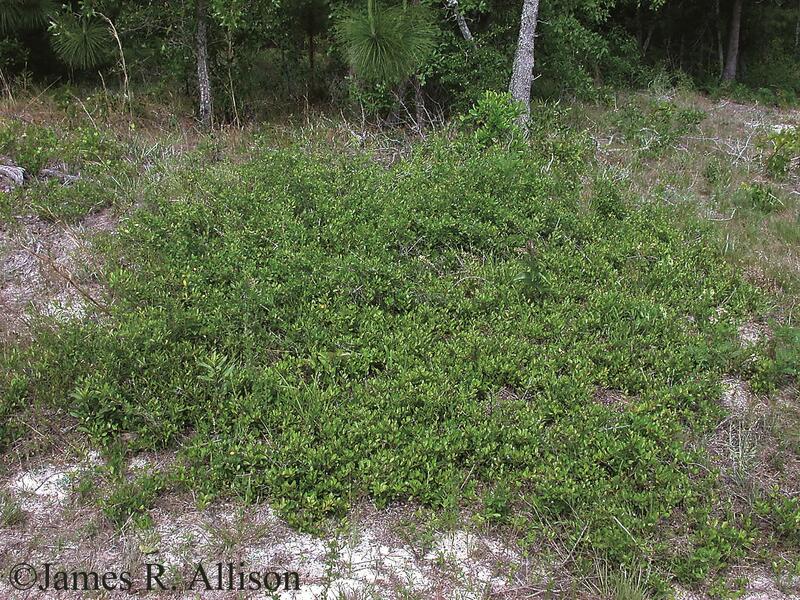
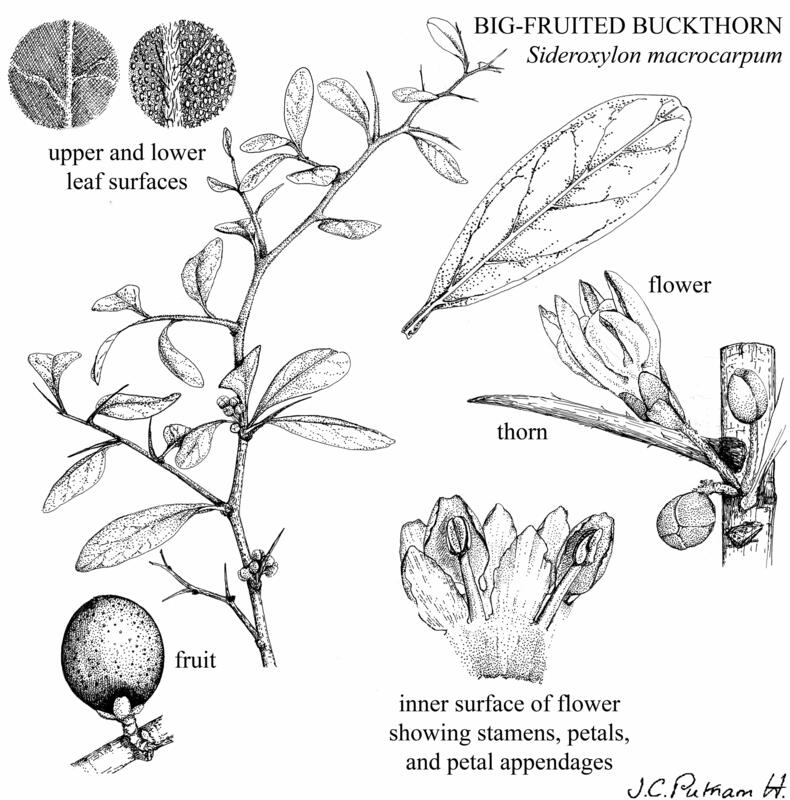
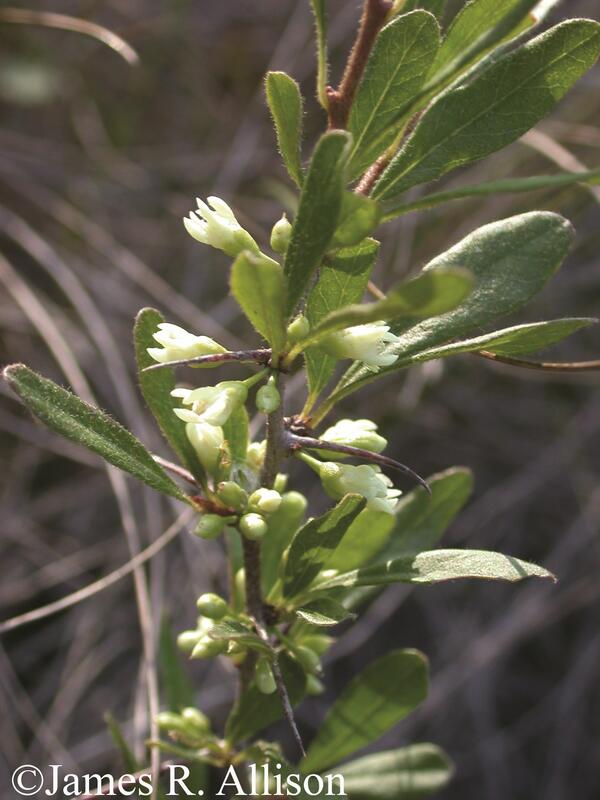
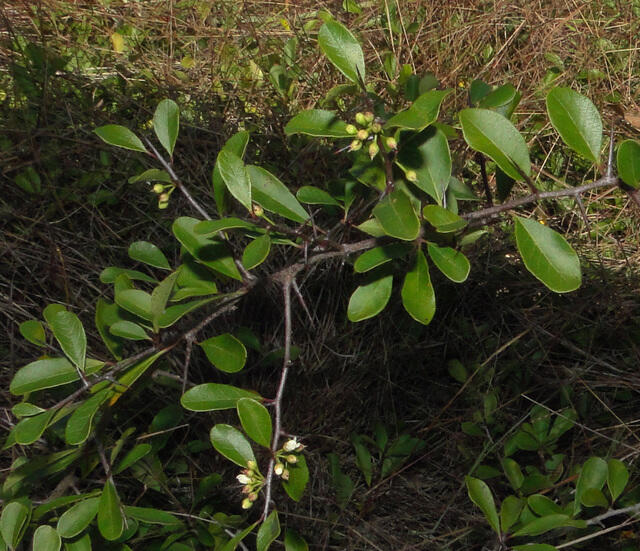
Low shrub usually less than 20 inches (50 cm) tall (rarely up to 1 meter tall), with thorny aboveground stems rising from thick, woody underground stems. Long shoots are tan or reddish-brown with blond or rusty hairs when young, and bearing slender, slightly curved, sharply pointed thorns. Some thorns become short shoots or branchlets bearing small leaves. Leaves are usually 0.8 - 1.6 inches (1 - 4 cm, sometimes up to 5.2 cm) long, spirally alternate on long stems and clustered on the tips of short shoots, tardily deciduous, leathery, with tapering bases and bluntly rounded or notched tips; the upper leaf surface is dark green, the lower surface is covered with straight, blond or (rarely) rust-colored hairs. The flower clusters are held on short shoots of the previous year and have up to 18 flowers. Flowers are about 0.1 inch (3 - 4 mm) long, creamy white, usually with 5 petals (sometimes 4 or 6). Mature fruits are about 0.8 inch (1 cm) long, black, oval or round, with one large seed.
Woolly Buckthorn (Sideroxylon lanuginosum) is a tall shrub or small tree with shoots hairy throughout the first year, and the lower surfaces of leaves densely covered with rust-colored hairs; it occurs in dry to moist woodlands.
Smooth Buckthorn (S. reclinatum) is a shrub up to 15 feet (4 meters) tall; the lower surfaces of its young leaves have short, pale hairs which quickly slough off as the leaves mature; its fruits are less than 0.4 inch (1 cm) long.
Red-haired Bully (Sideroxylon rufohirtum) occurs in Alabama and Florida in Longleaf Pine woodlands; it has not yet been found in Georgia. Like S. macrocarpum, it is a low, clonal shrub with large berries (0.8 - 1.3 cm); it is distinguished by its persistently hairy twigs and the reddish to brown hairs on the lower leaf surfaces.
Silver Buckthorn (Sideroxylon alachuense) occurs in the Coastal Plain in calcareous hammocks, shell middens, maritime forests on barrier islands, and on islands in the Okefenokee Swamp. For more information, see: https://www.georgiabiodiversity.org/portal/profile?group=plants&es_id=21718
Thorne’s Buckthorn (Sideroxylon thornei) occurs in forested limesink depressions and in calcareous swamps in the Coastal Plain. For more information, see: https://www.georgiabiodiversity.org/portal/profile?group=plants&es_id=16690
Sandy, open, well-drained pine-oak woodlands, often with Longleaf Pine and a variety of oak species (Sand Post, Sand Laurel, Bluejack, Turkey, and Blackjack Oaks). Roadsides and utility rights-of-way through these habitats.
Big-fruited Buckthorn reproduces sexually by seed as well as vegetatively by the spread of underground stems, often forming large colonies. It flowers in late spring and again in September; the flowers are mildly fragrant and attract a variety of insect pollinators. Although pollination studies have not been conducted for this species, most buckthorns are capable of both cross- and self-pollination. The large fruit is fleshy and sweet, making it attractive to animals, which disperse the seeds. Big-fruited Buckthorn is tardily deciduous, dropping its leaves in late winter and then quickly leafing out again.
Flowers late May–June and in September, but plants are recognizable by growth form and leaf traits throughout the year except for a brief period in spring.
Sideroxylon macrocarpum is found only in 13 counties in southeast Georgia.
Conversion of habitat to pine plantations, pastures, and developments. Fire suppression.
| Threat 1 | Threat 2 | Threat 3 | |
|---|---|---|---|
| General Threat | Natural system modifications | Energy production & mining | Agriculture & aquaculture |
| Specific Threat | None | None | None |
Sideroxylon macrocarpum is ranked S3 by the Georgia Department of Natural Resources, indicating that the species is vulnerable to extirpation. Approximately 40 populations are known, all but 5 on private lands or in highway rights-of-way.
Apply prescribed fire every 3 - 7 years, preferably during the growing season. Prevent conversion of Longleaf Pine woodlands to pine plantations or residential and commercial developments.
Allison, J.R. 2006. Big-fruited Buckthorn, Sideroxylon macrocarpum (Sapotaceae), a long-forgotten Georgia endemic. Sida 22(1): 243-265. https://www.jstor.org/stable/41968577?seq=1#metadata_info_tab_contents
Chafin, L.G. 2007. Field guide to the rare plants of Georgia. State Botanical Garden of Georgia and University of Georgia Press, Athens.
Corogin, P.T. 2015. Sideroxylon section Frigoricola (Sapotaceae): a clade endemic to temperate North America. Dissertation, University of Florida, Gainesville. https://search.proquest.com/docview/1992164999?pq-origsite=gscholar
Elisens, W.J. and J.M. Jones. 2009. Sideroxylon macrocarpum species account. Flora of North America, vol. 8. http://beta.floranorthamerica.org/Sideroxylon_macrocarpum
GADNR. 2020. Element occurrence records for Sideroxylon macrocarpum. Georgia Department of Natural Resources, Wildlife Resources Division, Social Circle, Georgia.
Godfrey, R.K. 1988. Trees, shrubs, and woody vines of northern Florida and adjacent Georgia and Alabama. University of Georgia Press, Athens.
Huegel, C. 1992. Bumelias. The Palmetto12(3): 1 - 3. https://www.fnps.org/palmetto/findarticles
NatureServe. 2020. Sideroxylon macrocarpum species account. NatureServe Explorer. NatureServe, Arlington, Virginia. https://explorer.natureserve.org/Taxon/ELEMENT_GLOBAL.2.136353/Sideroxylon_macrocarpum
Weakley, A.S. 2015. Flora of the southern and mid-Atlantic States. University of North Carolina Herbarium, University of North Carolina, Chapel Hill. http://www.herbarium.unc.edu/flora.htm
Linda G. Chafin
L. Chafin, Aug. 2008: original account.
K. Owers, Feb. 2010: added pictures.
L. Chafin, May 2020: updated original account.