

Loading profile. Please wait . . .
Chamaecyparis thyoides (L.) B.S.P.
Atlantic White-cedar




Federal Protection: No US federal protection
State Protection: Rare
Global Rank: G4
State Rank: S2
Element Locations Tracked in Biotics: Yes
SWAP 2015 Species of Greatest Conservation Need (SGCN): Yes
SWAP 2025 Species of Greatest Conservation Need (SGCN): Yes
2025 SGCN Priority Tier: High Conservation Concern
Element Occurrences (EOs) in Georgia: 44
Habitat Summary for element in Georgia: Clearwater stream swamps in fall line sandhills
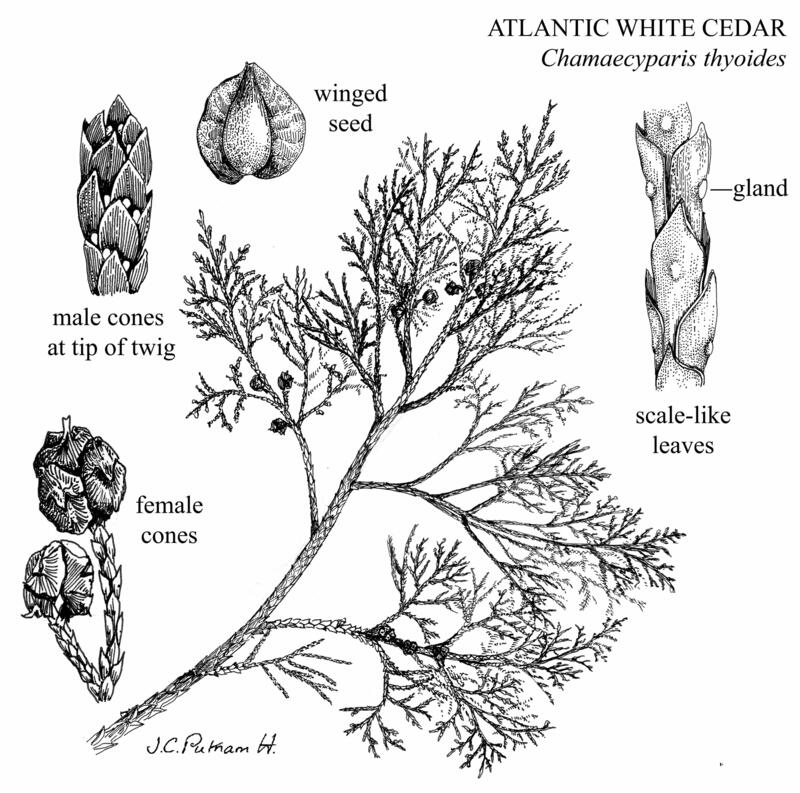
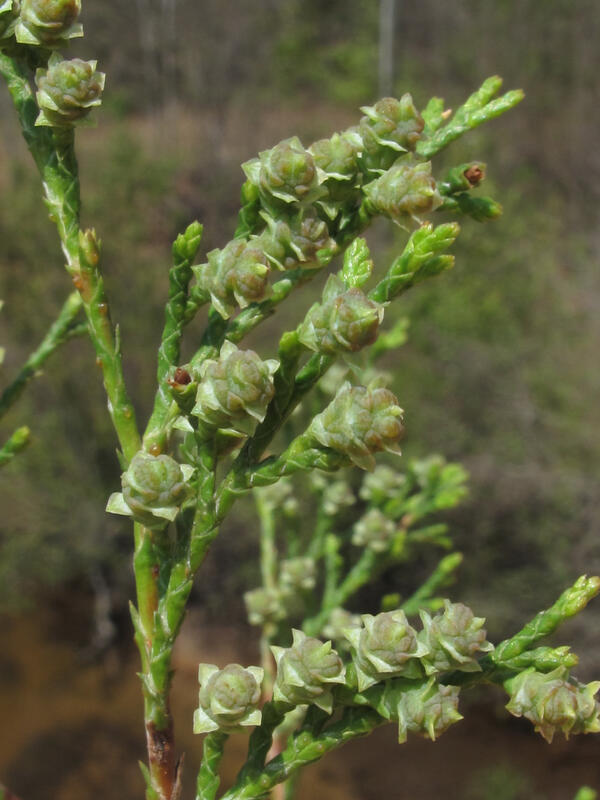
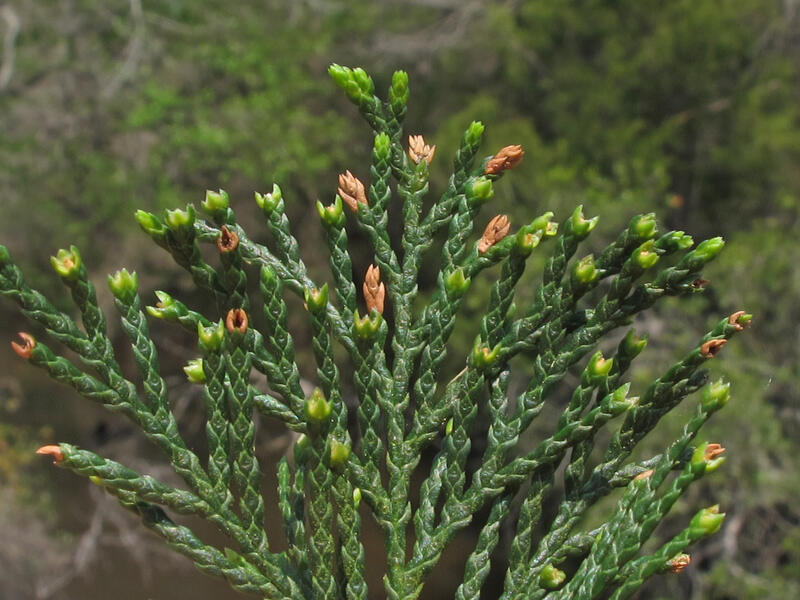
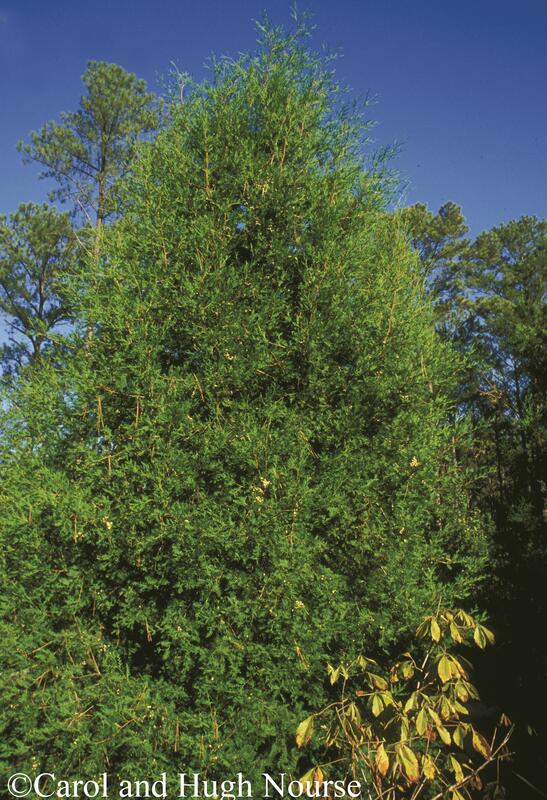
Evergreen, cone-bearing tree up to 92 feet (28 meters) tall. Bark of older trees is gray to reddish-brown, with long furrows and fibrous ridges, often twisted around the trunk. Branches are held in a single plane, forming flattened, fan-like sprays. Twigs are flattened, not 4-sided. The leaves on older branches are very small and scale-like, opposite and paired at right angles to the adjacent pairs; most leaves have one tiny resin gland on the outer surface. Leaves on new growth are needle-like. Female and male cones are on the same tree (monoecious). Female cones are about 0.25 inch (5 - 8 mm) wide, round, with 6 - 12 small, leathery, plate-like scales, each with a point in the center; they become woody and brown with age, opening in the fall to release winged seeds, and persisting through the winter. Male cones are about 0.1 inch (2 - 4 mm) long, solitary at the tips of branchlets. Seeds are small, light, winged, and abundant.
Bald Cypress and Pond Cypress are the only other conifers with scale-like leaves instead of needles growing in Georgia's wetlands. Their twigs do not form fan-shaped sprays, and their leaves are alternate and narrow. Both cypresses are deciduous in the fall and also form "knees" which Atlantic White Cedar does not do.
Eastern Red Cedar (Juniperus virginiana) is an upland tree with loosely shredding, reddish or light gray bark. Its branches do not form flattened sprays, and the twigs are 4-sided. Female and male cones are on separate trees; female cones (“juniper berries”) are fleshy, blue-green, and smell like gin; male cones are yellow and showy in the fall and winter.
None in Georgia.
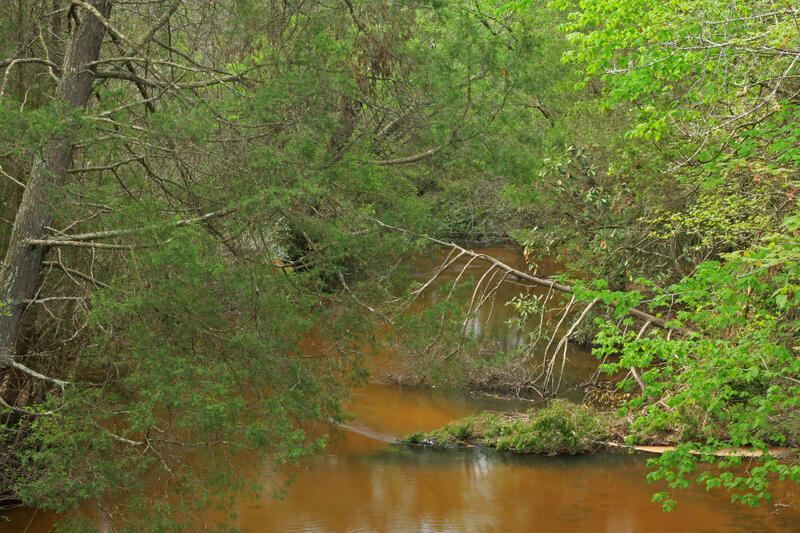
Sphagnum-based shrub bogs, bay/gum swamps, beaver swamps, sandhill ponds, wet terraces and floodplains along clear or tannic-stained, spring-run streams in the Fall Line sandhills, often growing with the state-listed (Threatened) Sweet Pitcherplant (Sarracenia rubra).
Atlantic White Cedar is monoecious, with both female and male cones present on the same tree. It may begin producing cones as early as 3 - 5 years of age, though heaviest seed production begins at 10 - 20 years. Male cones release their pollen in March and April. Female cones mature during the summer, and shed their seeds primarily in October and November but also during the winter and spring of the next year. Seeds are dispersed by the wind, aided by the two tiny wings on the seeds.
Although Atlantic White Cedartrees are killed by fire, the long-term survival of Atlantic White Cedar stands depends on occasional fire to create seed beds and kill competing hardwoods such as Red Maple and Swamp Black Gum. Seeds remain viable in a seed bed of peat for 1 - 2 years.
Atlantic White Cedar is a larval host plant for Hessel's Hairstreak butterfly (Callophrys hesseli). Seedlings and saplings are preferred winter browse for deer.
Surveys may be conducted all year.
Georgia, Florida, Alabama, Mississippi, and northwards, primarily in the Atlantic Coastal Plain, to Maine.
Logging, clearing, and draining wetlands and streamside zones. Sedimentation into streams during road and bridge construction.
| Threat 1 | Threat 2 | Threat 3 | |
|---|---|---|---|
| General Threat | Human intrusions & disturbance | Agriculture & aquaculture | Natural system modifications |
| Specific Threat | None | None | None |
Atlantic White Cedar is ranked S2 by the Georgia Department of Natural Resources, indicating that it is imperiled in the state. It is listed as Rare by the State of Georgia. Only a few thousand trees in 44 populations are known; all but 8 populations are on private, non-conservation lands.
Avoid logging, clearing, and draining wetlands. Avoid damming Fall Line streams. Prevent sedimentation into streams during road construction. Protect streamside buffer zones.
Chafin, L.G. 2007. Field guide to the rare plants of Georgia. State Botanical Garden of Georgia and University of Georgia Press, Athens.
GADNR. 2019. Element occurrence records for Chamaecyparis thyoides. Georgia Department of Natural Resources, Wildlife Resources Division, Social Circle, Georgia.
Godfrey, R.K. 1988. Trees, shrubs, and woody vines of northern Florida and adjacent Georgia and Alabama. University of Georgia Press, Athens.
Kirkman, L.K., C.L. Brown, and D.J. Leopold. 2007. Native trees of the southeast. Timber Press, Portland, Oregon.
Lance, R. 2004. Woody plants of the southeastern United States: a winter guide. University of Georgia Press, Athens.
Michener, D.C. 1993. Chamaecyparis thyoides. Flora of North America, Vol. 2, pteridophytes and gymnosperms. Oxford University Press, New York. http://www.efloras.org/florataxon.aspx?flora_id=1&taxon_id=210000241
Patrick, T.S., J.R. Allison, and G.A. Krakow. 1995. Protected plants of Georgia. Georgia Department of Natural Resources, Natural Heritage Program, Social Circle.
NatureServe. 2019. Chamaecyparis thyoides comprehensive report. NatureServe Explorer. Arlington, Virginia. http://explorer.natureserve.org/servlet/NatureServe?searchName=Chamaecyparis%20thyoides
NC State Extension. 2020. Chamaecyparis thyoides. North Carolina State Extension Gardener Plant Toolbox. https://plants.ces.ncsu.edu/plants/chamaecyparis-thyoides/
Tirmenstein, D. A. 1991. Chamaecyparis thyoides. Fire Effects Information System, U.S. Department of Agriculture, Forest Service, Rocky Mountain Research Station, Fire Sciences Laboratory. http://www.fs.fed.us/database/feis/plants/tree/chathy/all.html
Weakley, A.S. 2015. Flora of the southern and mid-Atlantic States. University of North Carolina Herbarium, University of North Carolina, Chapel Hill. http://www.herbarium.unc.edu/flora.htm
Linda G. Chafin
L. Chafin, Nov. 2007: original account.
K. Owers, Jan. 2010: updated status and ranks, added pictures.
L. Chafin, Jan 2020: updated original account.