Loading profile. Please wait . . .
Graptemys barbouri Carr and Marchand, 1942
Barbour's Map Turtle




Federal Protection: Similarity of Appearance (Threatened)
State Protection: Threatened
Global Rank: G2G3
State Rank: S3
Element Locations Tracked in Biotics: Yes
SWAP 2015 Species of Greatest Conservation Need (SGCN): Yes
SWAP 2025 Species of Greatest Conservation Need (SGCN): Yes
2025 SGCN Priority Tier: Moderate Conservation Concern
Element Occurrences (EOs) in Georgia: 43
Habitat Summary for element in Georgia: Rivers and large creeks of Apalachicola River drainage possibly in Ochlockonee
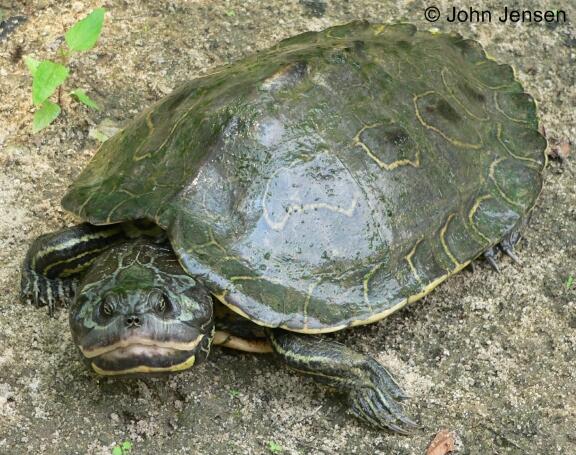
Barbour's map turtle is known for the extreme sexual dimorphism it displays. While adult males reach a maximum carapace length of only 13 cm (5⅛ inches), females may obtain a length of 33 cm (13 inches) and a body mass 80% greater than that of males. In addition, females have enormous heads relative to males. The carapace has a mid-dorsal keel with black-tipped spines posteriorly, these often obscured in older females. Yellow, C-shaped markings adorn the pleural and marginal scutes on the otherwise olive to olive-brown carapace. The plastron is pale yellow with narrow, dark markings confined to the seams. Skin color is generally dark-green to black with light green or yellow markings and stripes. A large yellowish blotch is present behind each eye; a conspicuous isolated light bar, following the curvature of the jaw, is found on the chin. The female has powerful jaws used for crushing snails and bivalves.
No other species of Graptemys occurs with this species.
Relatively wide and swiftly flowing streams with abundant snags and fallen trees are the preferred habitat for this species. Concentrations of Barbour's map turtles are often associated with areas of exposed limestone.
Primarily snails and bivalves; also aquatic insects, especially caddisfly larvae.
Females, which may not reach sexual maturity until 15 or more years of age, typically deposit 4-11 eggs a few centimeters beneath the surface on sandbars or riverbanks. Several clutches may be produced in a season. Nesting occurs from June through August, and eggs take approximately 60 days to hatch. Barbour's map turtle, like many other turtle species, has temperature-dependent sex determination. Eggs incubated at 25°C (77°F) produce all males, while those incubated at 30°C (86°F) produce only females. A considerable amount of time is spent basking in full sun on logs or rocks.
Although basking traps may be effective, baited hoop traps, which are successful at catching many species of freshwater turtles, are not likely to capture many individuals of any map turtle species unless long fyke nets are used to draw them in. The most effective survey technique is visual surveys for turtles basking on exposed rocks or logs during warm, sunny days.
The range of this species includes the Choctawhatchee drainage of Florida and Alabama, the Apalachicola drainage of Florida, Alabama, and Georgia, and the Ochlockonee River (Georgia & Florida). The Flint and Chattahoochee rivers and their larger tributaries, as well as the Ochlockonee River are home to Barbour's map turtles occurring in Georgia; and, although a few known localities along the Flint River are within the Piedmont physiographic province, most of their range is confined to the Coastal Plain.
The streams and rivers used by Barbour's map turtles have been negatively altered by impoundment, dredging, and pollution. These impacts have affected the turtles by slowing the natural water flow, reducing the available basking sites, and nearly eliminating the native mollusk prey base. Illegal collection for both meat and the pet trade continues to exacerbate the problem. Unattended or infrequently visited trotlines and bush hooks often snag and kill non-targeted animals such as Barbour's map turtle and may contribute to localized declines or extirpations. The shooting of basking turtles is an additional threat. The restricted natural range of the species makes them especially vulnerable.
| Threat 1 | Threat 2 | Threat 3 | |
|---|---|---|---|
| General Threat | Natural system modifications | Pollution | None |
| Specific Threat | Other ecosystem modifications | Agricultural & forestry effluents | None |
Public waterways inhabited by this species include stretches of the Flint and Chattahoochee rivers, as well as Spring Creek. Lake Blackshear and Lake Walter F. George are also home to Barbour’s map turtle. Public lands where this turtle may be observed include Georgia Veterans State Park, Florence Marina State Park, Joe Kurz Wildlife Management Area, Big Lazer Wildlife Management Area, Sprewell Bluff Wildlife Management Area, Ft. Benning Military Reservation, and Eufaula National Wildlife Refuge.
Remaining stretches of streams and rivers harboring this species should be protected from chemical poisoning, dredging, and further impoundment. The practice of removing trees and snags for boat navigability should be kept to a minimum. Trotlines and bush-hooks should be checked daily and removed when not in use to prevent ensnarement of non-targeted animals. Although creating competition problems for native mollusks, the introduction of the Asian clam has enhanced the prey availability for Barbour's map turtle.
Crenshaw, J. W., Jr., and G. B. Rabb. 1949. Occurrence of the turtle Graptemys barbouri in Georgia. Copeia 1949: 226.
Jackson, D. R. 1986. Barbour's map turtle. Pages 37-38 in Mount, R. H., ed. Vertebrate animals of Alabama in need of special attention. Alabama Agricultural Experiment Station, Auburn University, Auburn. 124pp.
Lee, D. S., R. Franz, and R. A. Sanderson. 1975. A note on the feeding habits of male Barbour's map turtles. Florida Field Naturalist 3:45-46.
Moulis, R. 2008. Barbour's map turtle Graptemys barbouri. Pp. 478-480 in Jensen, J. B., C. D. Camp, J. W. Gibbons, and M. J. Elliott (eds.). Amphibians and Reptiles of Georgia. University of Georgia Press, Athens. 575 pp.
Sanderson, R. A. and J. E. Lovich. 1988. Graptemys barbouri Carr and Marchand. Catalogue of American Amphibians and Reptiles 421.1-421.2. Sanderson, R. A. and J. E. Lovich. 1992. Barbour's map turtle. Pages 196-199 in P. E. Moler, ed. Rare and endangered biota of Florida, Volume 3, Amphibians and reptiles. University Press of Florida, Gainesville.291pp.
Vitt, L. J. 1981. A survey of the status, distribution, and abundance of potentially threatened and endangered vertebrate species in Georgia, Part II: reptiles and amphibians. Unpublished report to Georgia Department of Natural Resources. 210pp. Wahlquist, H., and G. W. Folkerts. 1973. Eggs and hatchlings of Barbour’s map turtle, Graptemys barbouri Carr and Marchand. Herpetologica 29: 236-237.
John B. Jensen
J. Jensen, Dec. 2007: original account
K. Owers, Sept. 2009: updated status and ranks, added pictures
J. Jensen, Apr. 2018: edited text