

Loading profile. Please wait . . .
Malaxis spicata Sw.
Florida Adder's-mouth Orchid




Federal Protection: No US federal protection
State Protection: No Georgia state protection
Global Rank: G4?
State Rank: S1
Element Locations Tracked in Biotics: Yes
SWAP 2015 Species of Greatest Conservation Need (SGCN): Yes
SWAP 2025 Species of Greatest Conservation Need (SGCN): Yes
2025 SGCN Priority Tier: High Conservation Concern
Element Occurrences (EOs) in Georgia: 2
Habitat Summary for element in Georgia: Low hammocks; spring-fed river swamps
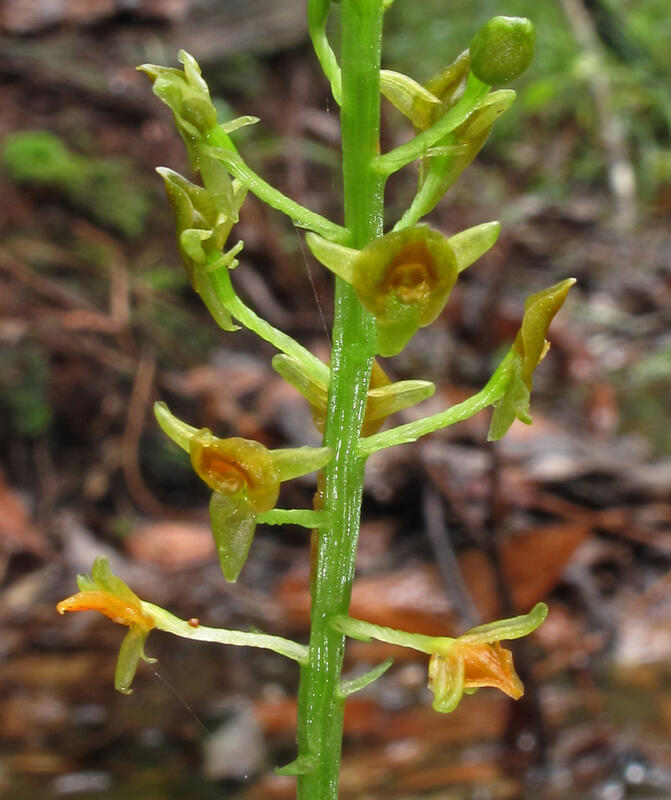
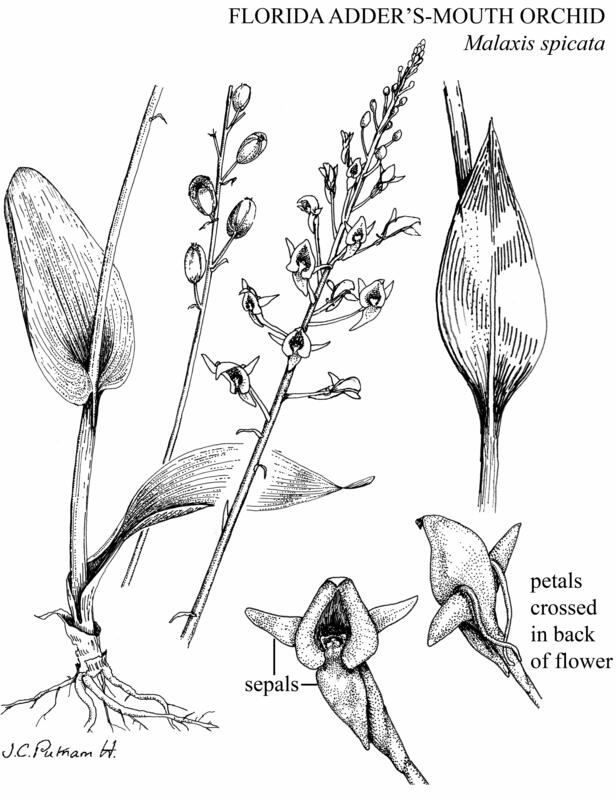
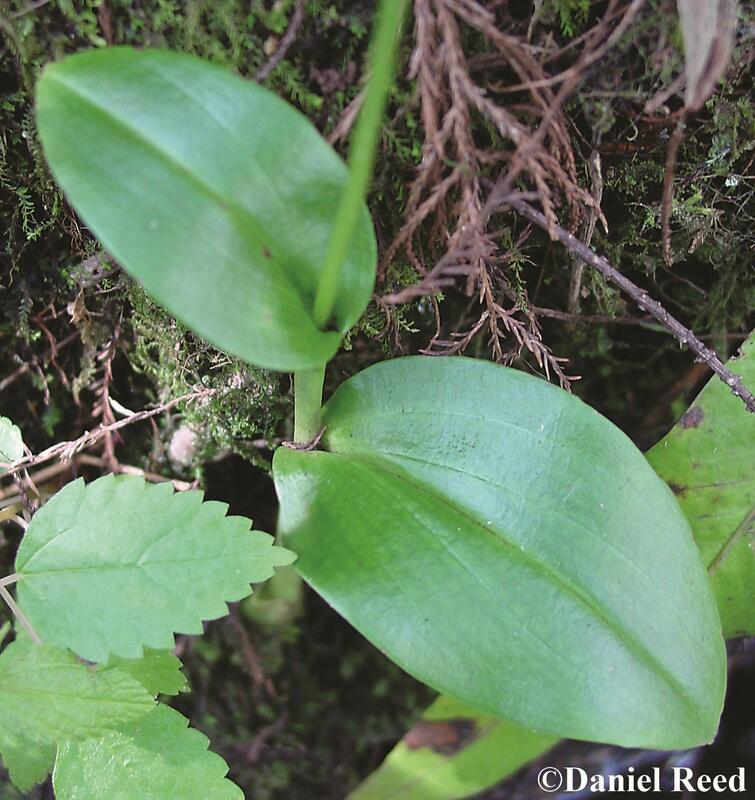
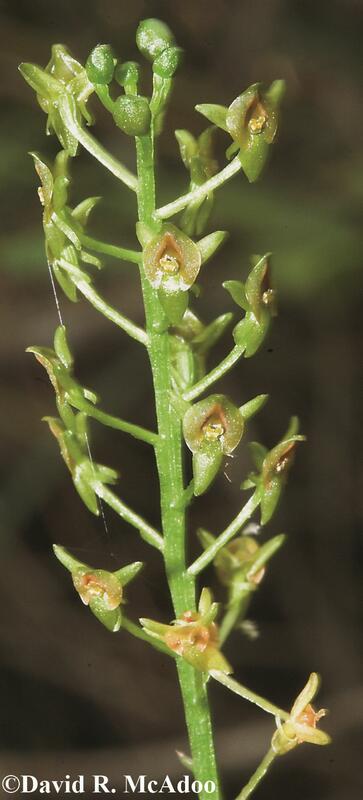
Perennial herb 3 - 18 inches (7 - 35 cm) tall (usually less than 8 inches / 20 cm tall in Georgia) with 2 - 3 leaves sheathing the stem. The leaves are 0.8 - 4 inches (2 - 10 cm) long, oval, alternate, dark green, smooth, and glossy, with a conspicuous midvein. The flower stalk bears a spike of 6 - 150 flowers. Each flower is less than 0.2 inch (3 - 5 mm) long, each with 3 green, spreading sepals; 2 very narrow, green petals that are not visible from the front of the flower but curve backwards to overlap at the back of the flower; and a yellow-orange, erect lip petal with a flaring base that nearly surrounds the central column. Fruits are erect capsules, about 0.3 inch (8 mm) long.
Green Adder’s-mouth (Malaxis unifolia) occurs largely in the Piedmont in upland forests. One leaf (sometimes 2) encircles the middle of the stem. Its green flowers are in a small, flat-topped spike that elongates as flowers open; the lip petal is green and has 2 - 3 teeth at the tip.
Other leafy-stemmed, green-flowered orchids in Georgia include Little Club-spur Orchid (Platanthera clavellata), which has a half-inch spur, and Tubercled Orchid (Platanthera flava), which has a rounded, down-pointing lip petal.
More than 30 species of Georgia’s orchids are rare.
Low hammocks, floodplains, spring-fed river swamps, usually in soils high in calcium or magnesium; often grows on tree stumps and bases.
The leaves of Florida Adder’s-mouth Orchid emerge in the spring from a pea-sized pseudobulb (which is actually the base of the previous year’s plant). The flower spike arises in midsummer, eventually producing 6 - 150 flowers which open successively as the spike elongates. Each flower is twisted 360º on its stalk; after fruit formation, the stalk untwists. The flowers are probably pollinated by flies, but only the occasional flower is fertilized and forms fruit. The seeds are minute and dust-like, and are dispersed by gravity and wind. The tiny seeds contain no stored food reserves (endosperm), and must land on a patch of soil containing a specific fungus that provides nutrients for germination and subsequent plant growth.
Surveys are best conducted during flowering (August–September).
Georgia, Florida, South Carolina, North Carolina, Virginia, Bahamas, and West Indies.
Ditching and draining of wetlands. Clearing and logging of habitat. Conversion of habitat to pine plantations, agriculture, and developments. Invasion of exotic pest plants. Alteration of stream hydrology.
| Threat 1 | Threat 2 | Threat 3 | |
|---|---|---|---|
| General Threat | Natural system modifications | Biological resource use | Invasive & other problematic species, genes & diseases |
| Specific Threat | Dams & water management/use | Logging & wood harvesting | Invasive non-native/alien species/diseases |
Malaxis spicata is ranked S1 by the Georgia Department of Natural Resources, indicating that it is critically imperiled in Georgia. Only two populations have been documented in Georgia, and neither have been seen in the last 20 years.
Avoid clearcutting, draining, or filling in wetlands. Eradicate exotic pest plants. Maintain historic flows in rivers.
Brown, P.M. and S.N. Folsom. 2004. Wild orchids of the southeastern United States, north of peninsular Florida. University Press of Florida, Gainesville.
Cameron, K.M. 2005. Leave it to the leaves: a molecular phylogenetic study of Malaxideae (Epidendroideae, Orchidaceae). American Journal of Botany 92(6): 1025-1032. https://bsapubs.onlinelibrary.wiley.com/doi/full/10.3732/ajb.92.6.1025
Catling, P.M. and L.K. Magrath. 2003. Flora of North America. Vol. 26. Oxford University Press, New York. http://www.efloras.org/florataxon.aspx?flora_id=1&taxon_id=220008061
Chafin, L.G. 2007. Field guide to the rare plants of Georgia. State Botanical Garden of Georgia and University of Georgia Press, Athens.
GADNR. 2020. Element occurrence records for Malaxis spicata. Georgia Department of Natural Resources, Wildlife Resources Division, Social Circle, Georgia.
Luer, C.A. 1972. The native orchids of Florida. New York Botanical Garden, New York
NatureServe. 2019. Malaxis spicata comprehensive report. NatureServe Explorer. Arlington, Virginia. http://explorer.natureserve.org/servlet/NatureServe?searchName=Malaxis+spicata
Weakley, A.S. 2015. Flora of the southern and mid-Atlantic States. University of North Carolina Herbarium, University of North Carolina, Chapel Hill. http://www.herbarium.unc.edu/flora.htm
Linda G. Chafin
L. Chafin, June 2008: original account
K. Owers, Feb. 2010: added pictures
L. Chafin, March 2020: updated original account.