


Loading profile. Please wait . . .
Sabatia capitata (Raf.) Blake
Cumberland Rose-gentian




Federal Protection: No US federal protection
State Protection: Rare
Global Rank: G2
State Rank: S2
Element Locations Tracked in Biotics: Yes
SWAP 2015 Species of Greatest Conservation Need (SGCN): Yes
SWAP 2025 Species of Greatest Conservation Need (SGCN): Yes
2025 SGCN Priority Tier: Highest Conservation Concern
Element Occurrences (EOs) in Georgia: 49
Habitat Summary for element in Georgia: Meadows over sandstone or shale
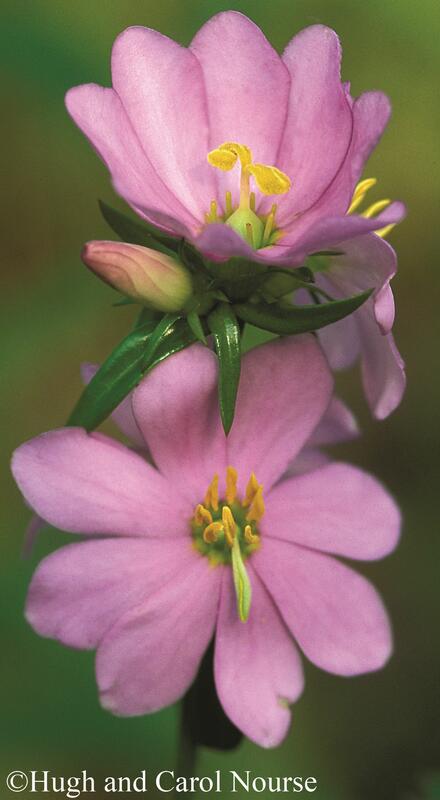
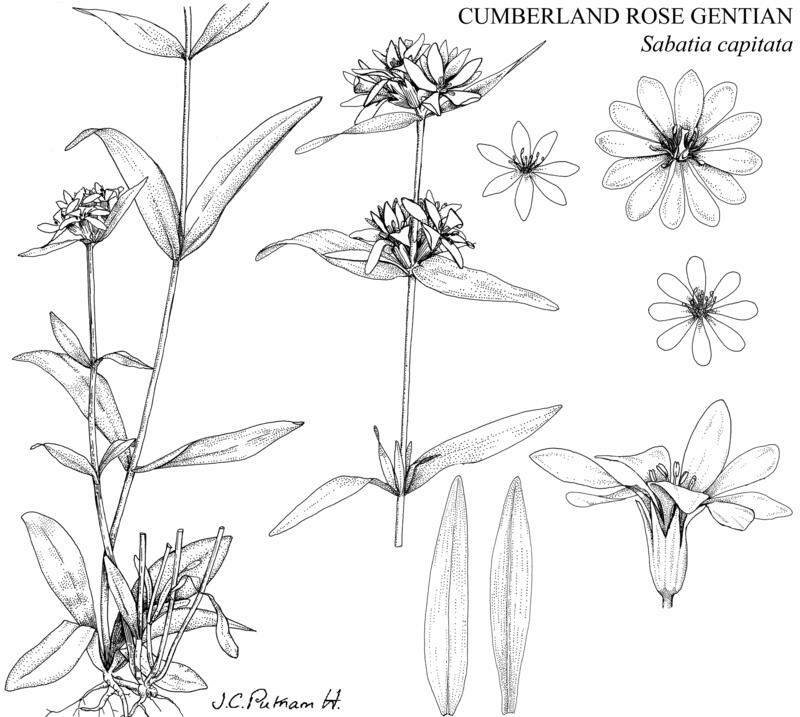
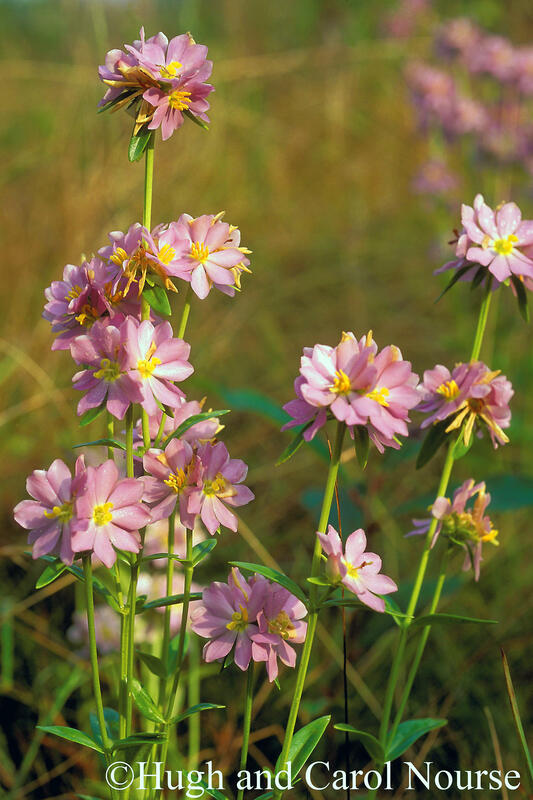
Annual or short-lived perennial herb 6 - 28 inches (15 - 70 cm) tall. Leaves are 1 - 2 inches (2.3 - 5 cm) long and 0.4 - 0.8 inch (1 - 2 cm) wide, opposite, with rounded to pointed tips and a slightly clasping base. Flowers are held singly or in tight clusters of 2 or more flowers, with no or very short flower stalks, at the top of the stem or in the angle between stem and leaf. Petals are 7 - 12 (usually 8) in number, dark pink to almost white, with a yellow mark at the base; different shapes and sizes of petals sometimes occur within the same flower. Stamens 7 - 12 in number, showy, bright yellow, twisted. Fruits are oval capsules 0.7 - 0.9 inch (1.7 - 2.2 cm) long.
Most of Georgia’s Rose Gentians (Sabatia spp.) occur in the Coastal Plain. The other species that occur in north Georgia (Sabatia angularis, S. brachiata, and S. campanulata) have 5-petaled, stalked flowers in loosely branched clusters.
Sabatia grandiflora (Large-flowered Rose Gentian) occurs in pine flatwoods, marshes, cypress-gum depressions, limesink ponds, and disturbed areas in these habitats. For more information, see: https://www.georgiabiodiversity.org/portal/profile?group=plants&es_id=33702
Openings in Oak-Hickory-Pine forests, wet meadows over sandstone caprock or shale, and roadsides and utility rights-of-way through these habitats.
Cumberland Rose Gentian is an annual or a short-lived perennial herb. Little else is known about the biology of this species. All species of Sabatia are capable of self- and cross-pollination, but outcrossing is favored by the fact that the pistils and stamens mature at different times, usually with the anthers maturing first. Observations of pollinators and seed dispersers for Cumberland Rose Gentian have not been reported.
Surveys are best conducted during flowering (July–August).
Georgia, Alabama, Tennessee, and North Carolina.
Conversion of habitat to pine plantations, agriculture, or developments; use of herbicides in rights-of-way, logging and other clearing.
| Threat 1 | Threat 2 | Threat 3 | |
|---|---|---|---|
| General Threat | Natural system modifications | Residential & commercial development | Agriculture & aquaculture |
| Specific Threat | None | None | None |
Sabatia capitata is ranked S2 by the Georgia Department of Natural Resources, indicating that it is imperiled in Georgia. It is listed as Rare by the State of Georgia. Forty-six populations have been documented in Georgia since the early 1900s, but only 25 of these have been confirmed since 2000, and only 6 occur on conservation lands.
Use prescribed fire or hand-clearing to control competing shrubs and herbs. Avoid herbicide use in rights-of-way; schedule mowing well before flowering or after fruiting. Avoid clearing or logging in the species habitat. Conduct basic life history research.
Chafin, L.G. 2007. Field guide to the rare plants of Georgia. State Botanical Garden of Georgia and University of Georgia Press, Athens.
Clark, J. 2004. Wildflowers of Pigeon Mountain, Lookout Mountain, Cloudland Canyon State Park, and Chickamauga National Military Park in northwest Georgia. Waldenhouse Publishers, Walden, Tennessee.
Duncan, W.H. and M.B. Duncan. 1999. Wildflowers of the eastern United States. University of Georgia Press, Athens.
GADNR. 2020. Element occurrence records for Sabatia capitata. Georgia Department of Natural Resources, Wildlife Resources Division, Social Circle, Georgia.
Good, A. 2004. Sabatia capitata: annual or perennial? Tipularia, Journal of the Georgia Botanical Society 19: 36-38.
Horn, D., T. Cathcart, T.E. Hemmerly, and D. Duhl. 2005. Wildflowers of Tennessee, the Ohio Valley, and the southern Appalachians. Lone Pine Publishing, Auburn, Washington.
Mathews, K.G., M.S. Ruigrok, G. Mansion. 2015. Phylogeny and biogeography of the eastern North American Rose Gentians (Sabatia, Gentianaceae). Systematic Botany 40(3): 811-825.
NatureServe. 2020. Species account for Sabatia capitata. NatureServe Explorer. NatureServe, Arlington, Virginia. https://explorer.natureserve.org/Taxon/ELEMENT_GLOBAL.2.133642/Sabatia_capitata
Patrick, T.S., J.R. Allison, and G.A. Krakow. 1995. Protected plants of Georgia. Georgia Department of Natural Resources, Wildlife Resources Division, Social Circle.
Perry, J.D. 1971. Biosystematic studies in the North American genus Sabatia (Gentianaceae). Rhodora 73: 309-369. https://www.jstor.org/stable/23310932?seq=1#metadata_info_tab_contents
Weakley, A.S. 2015. Flora of the southern and mid-Atlantic States. University of North Carolina Herbarium, University of North Carolina, Chapel Hill. http://www.herbarium.unc.edu/flora.htm
Wilbur, R.L. 1955. Revision of the North American genus Sabatia (Gentianaceae). Rhodora 57: 1-104. https://www.jstor.org/stable/23304875?seq=1#metadata_info_tab_contents
Linda G. Chafin
L.Chafin, Aug. 2008: original account
D.Weiler, Jan. 2010: added pictures
L. Chafin, May 2020: updated original account