

Loading profile. Please wait . . .
Paronychia virginica Spreng.
Yellow Nailwort




Federal Protection: No US federal protection
State Protection: Endangered
Global Rank: G4
State Rank: S1
Element Locations Tracked in Biotics: Yes
SWAP 2015 Species of Greatest Conservation Need (SGCN): Yes
SWAP 2025 Species of Greatest Conservation Need (SGCN): Yes
2025 SGCN Priority Tier: High Conservation Concern
Element Occurrences (EOs) in Georgia: 1
Habitat Summary for element in Georgia: Serpentine outcrops
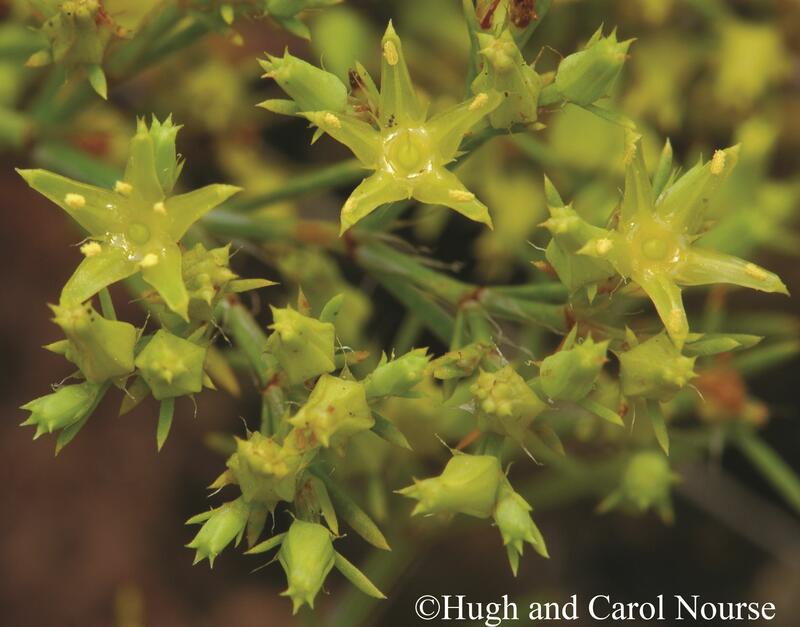
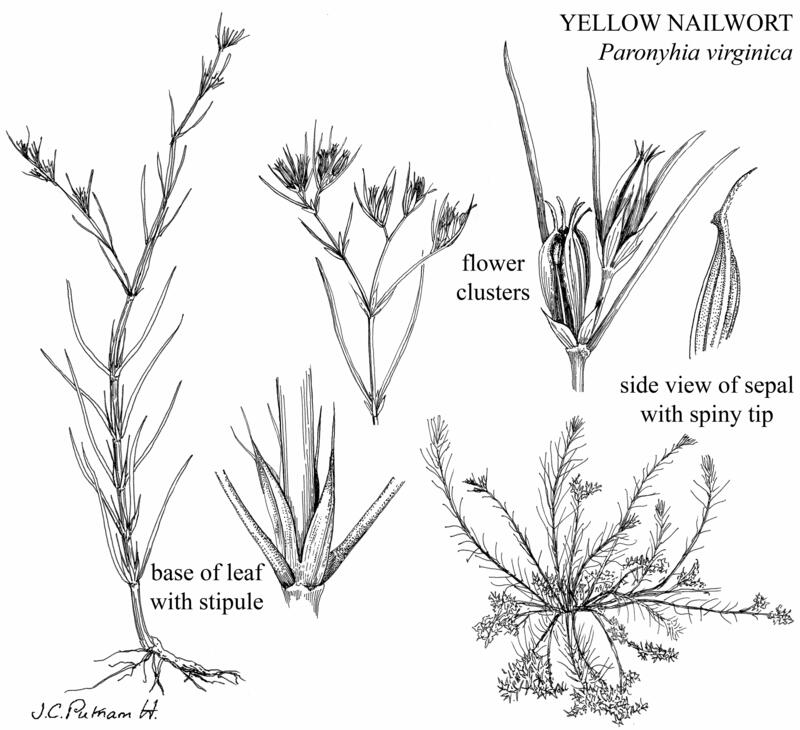
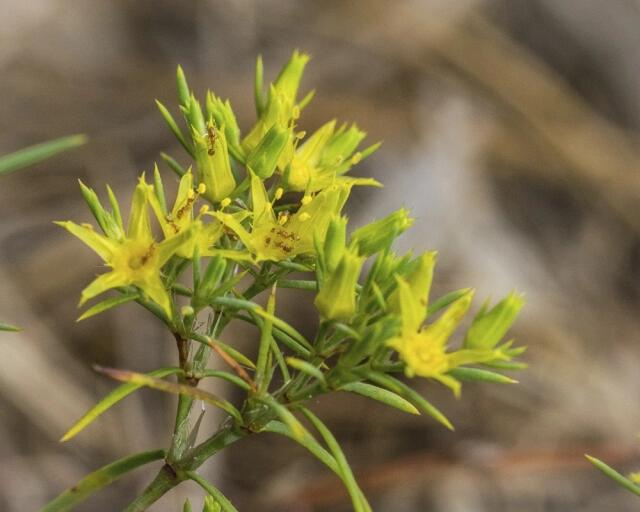
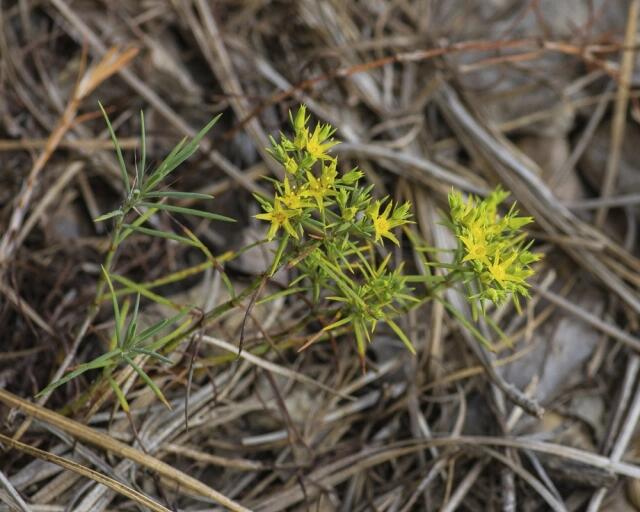
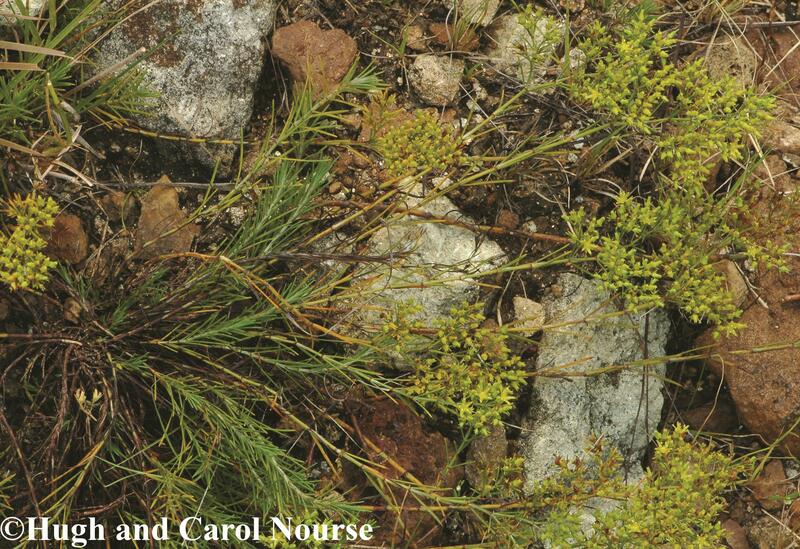
Perennial herb, branching from a woody crown with wiry, sprawling stems up to 18 inches (45 cm) long. Its leaves are up to 1.2 inches (3 cm) long, opposite, needle-like, sharply pointed, leathery, bluish-green, evergreen; at the base of each pair of leaves, there are 2 short, narrowly lance-shaped stipules, sometimes deeply divided into two segments. The flower clusters are held at the ends of the branches. The flowers are very small, often concealed by bracts, each with 5 yellow or brownish, stiff, leathery sepals about 0.1 inch (3 mm) long (there are no petals); each sepal is conspicuously 3-veined and is tipped with a sharp, triangular spine; a stamen is attached to each sepal. Fruits are 2 mm long, oval, hairless.
There are several other nailwort species in Georgia; most have oval or rounded leaves and pointed, but not spine-tipped, sepals. Yellow Nailwort is the only nailwort species in Georgia with both needle-like leaves and spine-tipped sepals.
Silverling (Paronychia argyrocoma, Special Concern) occurs on sandstone cliffs and rocky mountaintops in northern Georgia. For more information, see: http://beta.floranorthamerica.org/Paronychia_argyrocoma
Pineland Nailwort (Paronychia patula, Special Concern) occurs in dry pinelands, sandhills, and sandy river banks in southwest Georgia. For more information, see: https://georgiabiodiversity.org/portal/profile?group=plants&es_id=21271
Rugel’s Nailwort (Paronychia rugelii, Special Concern) occurs in Longleaf Pine-Turkey Oak sandhills in southwest Georgia. For more information, see: http://beta.floranorthamerica.org/Paronychia_rugelii.
Shallow, rocky soil over magnesium-rich, ultramafic (serpentine) rock.
Yellow Nailwort is an evergreen, perennial herb with bisexual flowers that produce nectar at the base of the flower. Another species of nailwort, Rocky Mountain Nailwort (Paronychia pulvinata), is pollinated by ants but it is not known if ants visit other Paronychia species. It is possible that the spiny tips of the sepals attach to animal fur and aid in seed dispersal.
Surveys are best conducted during flowering (mid-August–early October) when the plants are most conspicuous, but the needle-like, evergreen leaves are identifiable all year.
Georgia, Alabama, North Carolina, Virginia, Maryland, District of Columbia, West Virginia, Rhode Island, Missouri, Arkansas, Oklahoma, and Texas.
Logging, clearing, herbiciding, and development of habitat. Invasion by exotic pest plants.
| Threat 1 | Threat 2 | Threat 3 | |
|---|---|---|---|
| General Threat | Agriculture & aquaculture | Residential & commercial development | None |
| Specific Threat | Wood & pulp plantations | Housing & urban areas | None |
Paronychia virginica is ranked S1 by the Georgia Department of Natural Resources, indicating that the species is critically imperiled in Georgia. It is listed by the State of Georgia as Endangered. Only one population is known in Georgia; it occurs in a powerline right-of-way through an ultramafic (serpentine) glade.
Hand clear or use prescribed fire to create sunny openings. Protect serpentine glades and outcrops from logging, clearing, development, and herbicide use. Eradicate exotic pest plants. Use well timed mowing to reduce woody plant encroachment in powerline rights-of-way.
Chafin, L.G. 2007. Field guide to the rare plants of Georgia. State Botanical Garden of Georgia and University of Georgia Press, Athens.
Core, E.L. 1941. The North American species of Paronychia. American Midland Naturalist 26(2): 369-397. https://www.jstor.org/stable/2420966
Hartman, R.L., J.W. Thieret, and R.K. Rabeler. 2005. Paronychia virginica species account. Flora of North America, Vol. 5. Oxford University Press, New York. http://beta.floranorthamerica.org/Paronychia_virginica
NatureServe. 2020. Paronychia virginica species account. NatureServe Explorer. Arlington, Virginia. https://explorer.natureserve.org/Taxon/ELEMENT_GLOBAL.2.136412/Paronychia_virginica
Rohrer, W.L. 1997. Biosystematic study of the rare plant Paronychia virginica Sprengel (Caryophyllaceae) employing morphometric and allozyme analyses. M.S. Thesis, Virginia Polytechnic Institute and State University, Blacksburg. https://vtechworks.lib.vt.edu/handle/10919/46520
Schori, A. 2001. Conservation and research plan Paronychia argyrocoma (Michx.) Nutt. (Silverling). New England Wild Flower Society, Framingham, Massachusetts. https://tinyurl.com/ycl6mslz
Weakley, A.S. 2015. Flora of the southern and mid-Atlantic States. University of North Carolina Herbarium, University of North Carolina, Chapel Hill. http://www.herbarium.unc.edu/flora.htm
Linda G. Chafin
L. Chafin, July 2008: original account
K. Owers, Feb. 2010: added pictures
L. Chafin, Jun. 2020: updated original account