


Loading profile. Please wait . . .
Isoetes tegetiformans Rury
Mat-forming Quillwort




Federal Protection: Listed Endangered
State Protection: Endangered
Global Rank: G1
State Rank: S1
Element Locations Tracked in Biotics: Yes
SWAP 2015 Species of Greatest Conservation Need (SGCN): Yes
SWAP 2025 Species of Greatest Conservation Need (SGCN): Yes
2025 SGCN Priority Tier: Highest Conservation Concern
Element Occurrences (EOs) in Georgia: 15
Habitat Summary for element in Georgia: Vernal pools on granite outcrops
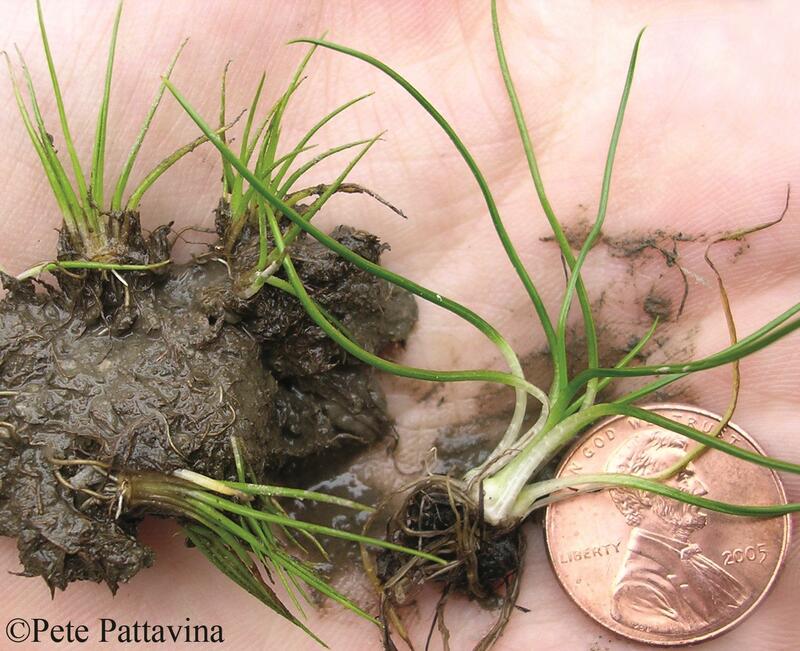
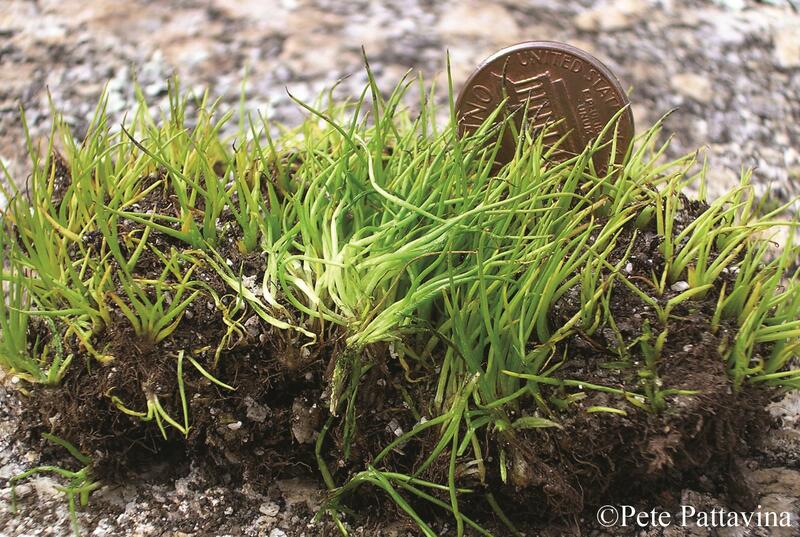
Perennial herb forming dense mats in granite outcrop pools. Stems are brown, horizontal at or just below the soil surface, often pushing up small hummocks of soil; the stems bear stout, coiled roots near the leaf bases and slender, straight roots near the end of the stem. Leaves are usually less than 1.2 inches (3 cm) tall, rarely up to 2.75 inches (7 cm) tall, very narrow and pointed, in clusters of 4 - 8 leaves along the top of the horizontal stem; leaves are hollow except for 4 cross partitions. Spores are produced in a chamber (sporangium) in the flared leaf base, the chamber completely covered by a translucent membrane (velum). Dozens of tiny, brown female spores may be seen with 30x magnification; minute, dust-sized male spores, which occur on separate leaves, are also present but are indistinguishable without much higher magnification.
Quillworts are distinguished from flowering, wetland plants by their spongy leaves with conspicuous cross-walls and by the presence of sporangia in the flared base of the leaves. Piedmont quillwort (Isoetes piedmontana) occurs in muddy seeps and ephemeral pools in erosion pits on granite outcrops. Its leaves are 2¾ - 6 inches (7 - 15 cm) long and have brown to black bases; the sporangia contain larger, distinctly dimpled megaspores that are only partially covered by the velum.
Twelve quillwort species are state-listed or considered of Special Concern in Georgia. Information about each of these species may be found at these links:
Boom's Quillwort (Isoetes boomii) https://www.georgiabiodiversity.org/portal/profile?group=plants&es_id=17134
Appalachian Quillwort (Isoetes appalachiana) http://explorer.natureserve.org/servlet/NatureServe?searchName=Isoetes+appalachiana
Glade Quillwort (Isoetes butleri) http://www.efloras.org/florataxon.aspx?flora_id=1&taxon_id=250076861
Florida Quillwort (Isoetes flaccida) https://www.georgiabiodiversity.org/portal/profile?group=plants&es_id=19963
Georgia Quillwort (Isoetes georgiana) https://www.georgiabiodiversity.org/portal/profile?group=plants&es_id=16950
Winter Quillwort (Isoetes hyemalis) https://www.georgiabiodiversity.org/portal/profile?group=plants&es_id=17363
Rush Quillwort (Isoetes junciformis) https://www.georgiabiodiversity.org/portal/profile?group=plants&es_id=18998
Black-footed Quillwort (Isoetes melanopoda) http://www.efloras.org/florataxon.aspx?flora_id=1&taxon_id=250076862
Black-spored Quillwort (Isoetes melanospora) https://www.georgiabiodiversity.org/portal/profile?group=plants&es_id=22510
Broxton Rocks Quillwort (Isoetes "snowii," undescribed) https://bioone.org/journals/castanea/volume-83/issue-2/17-122/Interesting-Provocative-and-Enigmatic--Morphological-Observations-on-Southeastern-Quillworts/10.2179/17-122.full
Mat-forming Quillwort (Isoetes tegetiformans) https://www.georgiabiodiversity.org/portal/profile?group=plants&es_id=20422
Mountain Bog Quillwort (Isoetes valida) https://www.jstor.org/stable/1547604?seq=1#metadata_info_tab_contents
Shallow pools formed by natural erosion on granite outcrops.
Quillworts are seedless, non-flowering plants that reproduce by spores. Mat-forming quillwort also reproduces by forming new plants along a horizontal stem that lies at or just below the soil surface. Spores are produced in chambers at the base of the leaves from May to October, about 2 - 3 weeks following a rain. Spores usually remain near the parent plant but may be dispersed by flowing water or insects. Some leaves produce megaspores, which crack open to expose tiny egg-producing structures; other leaves produce dust-like microspores, which develop sperm-producing structures. Egg and sperm unite and form new plants.
Plants are usually visible October–May, except during droughts, and typically reach their fullest height in April–May.
Isoetes tegetiformans is endemic to the Piedmont of Georgia.
Quarrying of granite outcrops, trash dumping, off-road vehicle use, horseback riding, cattle trampling, and commercial and residential development of woodlands surrounding granite outcrops. Within the pools, the exotic species Weak Buttercup (Ranunculus pusillus) and native species Water-starwort (Callitriche heterophylla) are competing with Black-spored Quillwort and associated rare species; in areas surrounding the outcrops, Japanese Honeysuckle (Lonicera japonica) and Chinese Privet (Ligustrum sinense) are the biggest threats.
| Threat 1 | Threat 2 | Threat 3 | |
|---|---|---|---|
| General Threat | Invasive & other problematic species, genes & diseases | Residential & commercial development | Natural system modifications |
| Specific Threat | None | None | None |
Fifteen populations have been documented, 12 of which have been confirmed in the last 20 years. Only three of these are on conservation lands.
Protect granite outcrops from quarrying, trash dumping, and off-road vehicle use. Direct foot traffic away from rare plant sites and rock pools. Create no-impact buffer zones and limit development around outcrops. Eradicate exotic pest plants.
Brunton, D.F. 2015. Key to the quillworts (Isoetes: Isoetaceae) of the southeastern United States. American Fern Journal 105(2): 86-100. https://www.jstor.org/stable/44076059?seq=1#metadata_info_tab_contents
Chafin, L.G. 2007. Field guide to the rare plants of Georgia. State Botanical Garden of Georgia and University of Georgia Press, Athens.
GADNR. 2020. Element occurrence records for Isoetes tegetiformans. Georgia Department of Natural Resources, Wildlife Resources Division, Social Circle, Georgia.
Haefner, K. D. and R. D. Bray. 2005. Taxonomic reassessment of North American granite outcrop Isoetes species with emphasis on vegetative morphology and I. piedmontana (Pfeiffer) Reed sensu lato. Castanea 70: 204-221. https://bioone.org/journals/Castanea/volume-70/issue-3/04-29.1/Taxonomic-Reassessment-of-North-American-Granite-Outcrop-Isoetes-Species-with/10.2179/04-29.1.full
Musselman, L.J. 2001. Georgia quillworts. Tipularia, Journal of the Georgia Botanical Society 16: 2-19.
NatureServe. 2019. Isoetes tegetiformans comprehensive report. NatureServe Explorer. Arlington, Virginia. http://explorer.natureserve.org/servlet/NatureServe?searchName=Isoetes+tegetiformans
Patrick, T.S., J.R. Allison, and G.A. Krakow. 1995. Protected plants of Georgia. Georgia Department of Natural Resources, Natural Heritage Program, Social Circle.
Rury, P.M. 1978. A new and unique mat-forming Merlin's grass (Isoetes) from Georgia. American Fern Journal 68(4): 99-108. https://www.jstor.org/stable/1546480?seq=1#metadata_info_ tab_contents
Rury, P.M. 1985. New locations for Isoetes tegetiformans in Georgia. American Fern Journal 75(3): 102-104. https://www.jstor.org/stable/1546267?seq=1#metadata_info_tab_contents
Snyder, L.H., Jr. and J.G. Bruce. 1986. Field guide to the ferns and other pteridophytes of Georgia. University of Georgia Press, Athens.
Taylor, W.C., N.T. Luebke, D.M. Britton, R.J. Hickey, D.F. Brunton. 1993. Isoëtes tegetiformans species account. Flora of North America, Vol. 2. Oxford University Press, New York. http://www.efloras.org/florataxon.aspx?flora_id=1&taxon_id=250076859
USFWS. 2019. Mat-forming quillwort (Isoetes tegetiformans) species accounts and related documents. U.S. Fish and Wildlife Service, Washington, D.C. https://ecos.fws.gov/ecp0/profile/speciesProfile?sId=887
Weakley, A.S. 2015. Flora of the southern and mid-Atlantic States. University of North Carolina Herbarium, University of North Carolina, Chapel Hill. http://www.herbarium.unc.edu/flora.htm
Linda G. Chafin and Daniel F. Brunton
Linda Chafin and Daniel Brunton, Dec. 2008: original account
K. Owers, Feb. 2010: added photos
L. Chafin, Mar. 2020: updated original account