


Loading profile. Please wait . . .
Matelea floridana (Vail) Woods.
Florida Milkvine




Federal Protection: No US federal protection
State Protection: No Georgia state protection
Global Rank: G2G3
State Rank: S1
Element Locations Tracked in Biotics: Yes
SWAP 2015 Species of Greatest Conservation Need (SGCN): Yes
SWAP 2025 Species of Greatest Conservation Need (SGCN): Yes
2025 SGCN Priority Tier: Highest Conservation Concern
Element Occurrences (EOs) in Georgia: 4
Habitat Summary for element in Georgia: Open bluff forests
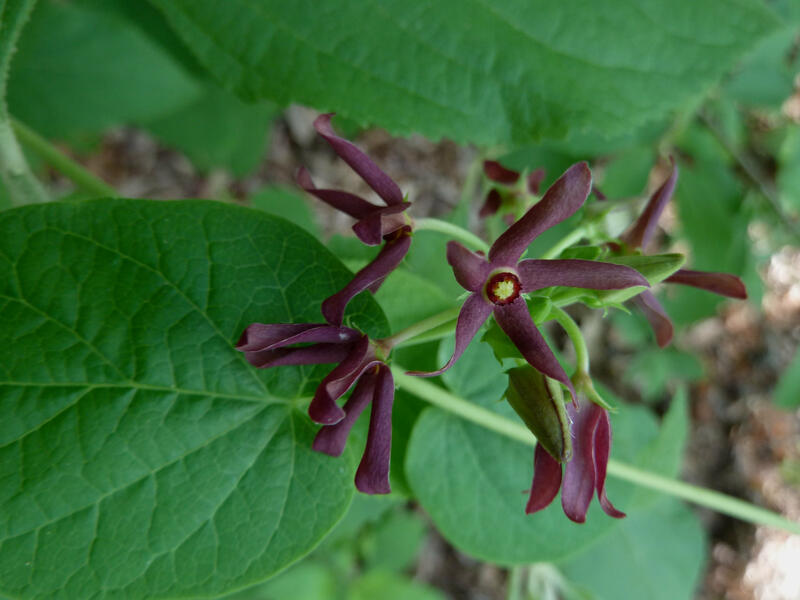
Perennial herbaceous vine with slender, non-woody, twining stems up to several meters long, green tinged with maroon, and covered with a mixture of short and long hairs, some with glandular tips. The leaf blades are up to 7 inches (18 cm) long, but usually much shorter especially near the tips of the stems, opposite, heart-shaped, finely hairy on both surfaces, with entire, bristly margins. Flower clusters are held on 0.5-inch stalks that arise from the leaf axils, each with 3 to many flowers. The flowers are about 0.5 inch (1.0-1.5 cm) wide, more or less flat when fully open, with 5 maroon to yellowish-green, spreading lobes. In the center of each flower, there is a cream-colored band surrounding a fleshy, black, five-lobed ring (the corona) bearing 5 pairs of tiny, upright teeth. The pale, five-sided structure in the center is the column or gynostegium, composed of styles, stigmas, and stamens fused together. Fruits are spiny, pointed, yellowish-green pods up to 3.5 inches long and 0.5 inch wide (9 cm long and 1.3 cm wide). Seeds, about 50 per pod, are brown, flat, and tipped with a tuft of white, silky hairs. All parts of the plant exude a milky latex when broken.
All of Georgia’s milkvines have nearly identical stems and heart-shaped leaves; flowers or fruits must be present and considered along with location and habitat data in order to make a positive field identification.
The most common milkvine found throughout Georgia is Eastern Anglepod (Gonolobus suberosus, synonym Matelea gonocarpa/gonocarpus). Its flowers are yellowish-green with a dark brown star surrounding the corona and column. Its fruits are smooth, five-angled, and not spiny.
Florida Milkvine closely resembles Carolina Milkvine (Matelea carolinensis), which also has maroon to greenish flowers and spiny pods. The differences between the two are technical and require magnification. Florida Milkvine is known in Georgia only from four southwest counties: Clay, Worth, Thomas, and Grady. Carolina Milkvine has not been documented from southwest Georgia; it is known in Georgia from the mountains, Piedmont, and several Fall Line and coastal counties.
Deceptive Spiny-pod (Matelea decipiens) has maroon flowers with narrow, upturned lobes (i.e. the flowers are not flat) and spiny pods; it occurs in north Georgia and one Fall Line county (Houston); it has not been documented in southwest Georgia.
Florida Milkvine plants with yellowish-green flowers can be confused with four yellow- or green-flowered milkvine species, all of which have spiny pods and all of which are rare in Georgia.
Alabama Milkvine (Matelea alabamensis, Threatened) has pale green flowers with a network of dark green veins and green star on top of the central column; it occurs in both southeast and southwest Georgia in pine-hardwood forests on upper slopes and in ravines in southwest Georgia. For more information, see: https://georgiabiodiversity.org/portal/editprofile?group=plants&es_id=16946
Yellow Milkvine (Matelea flavidula) flowers are pale green or yellowish-green with a less conspicuous network of veins than M. alabamensis; the yellow ring (corona) surrounding the central column appears to be broken into 5 segments, and the top of the column is green without a conspicuous star pattern. It occurs in moist forests with high-nutrient soils in southwest Georgia. For more information, see: http://explorer.natureserve.org/servlet/NatureServe?searchName=Matelea+flavidula
Limerock Milkvine (Matelea obliqua) flowers are rose, maroon, green, or cream-colored with narrow, pointed petals that are frequently curved upward; in Georgia, it occurs only in northwestern counties in moist, limestone-based hardwood forests. For photos and more information, see: https://www.georgiabiodiversity.org/portal/profile?group=plants&es_id=20585 AND https://www.wildflower.org/plants/result.php?id_plant=MAOB2
Trailing Milkvine (Matelea pubiflora) leaves are only up to 2 inches long and its flowers are very hairy; it occurs in southeast Georgia in open, dry, sandy scrub or sand ridge habitat. For more information, see: https://www.georgiabiodiversity.org/portal/profile?group=plants&es_id=22014
Beech-Magnolia bluff forests and rich, moist ravine and riparian forests.
Florida Milkvine is a perennial, herbaceous vine that reproduces sexually. Little is known about its reproduction in the wild; no studies of pollination on wild Matelea plants have been published but plants in experimental plots were pollinated by small flies. Matelea flowers must be cross-pollinated in order to produce fruit. Fruit set is low compared to the number of flowers, possibly due to the fact that flies are inefficient pollinators, carrying only a small amount of pollen and showing no preference for any particular group of plants. Matelea seeds are wind-dispersed.
Flowers May–July, fruits August–October.
North and peninsular Florida and southwest Georgia.
Matelea floridana is ranked S1 by the Georgia Department of Natural Resources, indicating that it is critically imperiled in Georgia. There are four populations of Florida Milkvine documented in four southwest Georgia counties. Two populations are owned by public utilities, and two are owned by private conservation organizations.
| Threat 1 | Threat 2 | Threat 3 | |
|---|---|---|---|
| General Threat | Residential & commercial development | Agriculture & aquaculture | Energy production & mining |
| Specific Threat | None | None | None |
Matelea floridana is ranked S1 by the Georgia Department of Natural Resources, indicating that it is critically imperiled in Georgia. There are four populations of Florida Milkvine documented in four southwest Georgia counties. Two populations are owned by public utilities, and two are owned by private conservation organizations.
Avoid logging in rich hardwood-dominated ravines and in riparian zones. Eradicate exotic pest plants from known sites and monitor for re-invasion. Monitor populations for reproduction and recruitment. Research causes of low reproduction.
Drapalik, D.J. 1969. A biosystematics study of the genus Matelea in the southeastern United States. Dissertation. University of North Carolina, Chapel Hill. Accessed 29 May 2019. http://www.herbarium.unc.edu/Collectors/Drapalik_files/KIC%20Document-rotate.pdf
GADNR. 2020. Element occurrence records for Matelea floridana. Georgia Department of Natural Resources, Wildlife Resources Division, Social Circle, Georgia.
Kral, R. 1983. A report on some rare, threatened, or endangered forest-related vascular plants of the South. U.S. Dept. of Agriculture Forest Service Technical Publication R8-TP2, Athens, Georgia.
NatureServe. 2019. Species profile for Matelea floridana. NatureServe Explorer: An online encyclopedia of life, Version 7.1. NatureServe, Arlington, Virginia. Accessed 29 May 2019. http://explorer.natureserve.org/servlet/NatureServe?searchName=Matelea+floridana.
Ollerton, J. and S. Liede. 1997. Pollination systems in the Asclepiadaceae: a survey and preliminary analysis. Biological Journal of the Linnean Society 62:593-610. https://academic.oup.com/biolinnean/article/62/4/593/2661065
Weakley, A.S. 2015. Flora of the southern and mid-Atlantic States. University of North Carolina Herbarium, University of North Carolina, Chapel Hill. http://www.herbarium.unc.edu/flora.htm
Linda G. Chafin
Linda G. Chafin, March 2020: original account
