



Loading profile. Please wait . . .
Himantopus mexicanus (Müller, 1776)
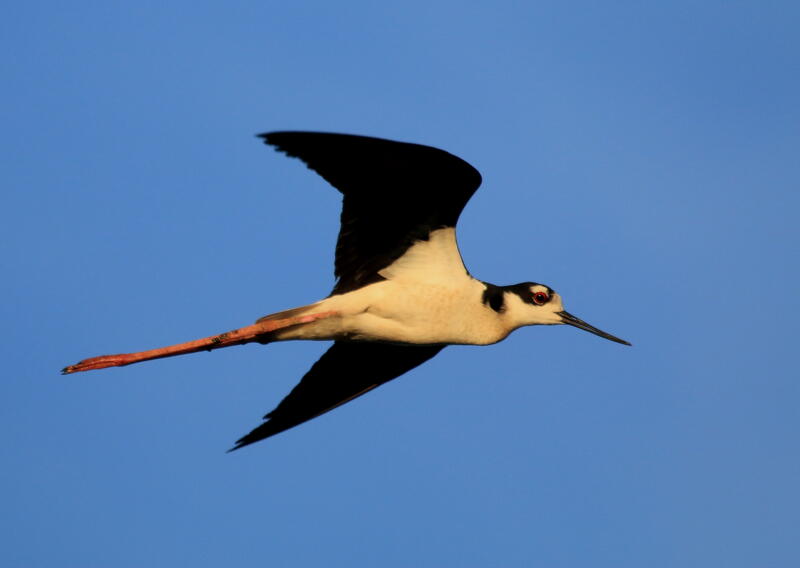
Black-necked Stilt




Federal Protection: No US federal protection
State Protection: No Georgia state protection
Global Rank: G5
State Rank: S2
Element Locations Tracked in Biotics: Yes
SWAP 2015 Species of Greatest Conservation Need (SGCN): Yes
SWAP 2025 Species of Greatest Conservation Need (SGCN): Yes
2025 SGCN Priority Tier: Moderate Conservation Concern
Element Occurrences (EOs) in Georgia: 7
Habitat Summary for element in Georgia: Shallow ponds; lagoons, beach, managed impoundments, dredge spoil island/impoundments
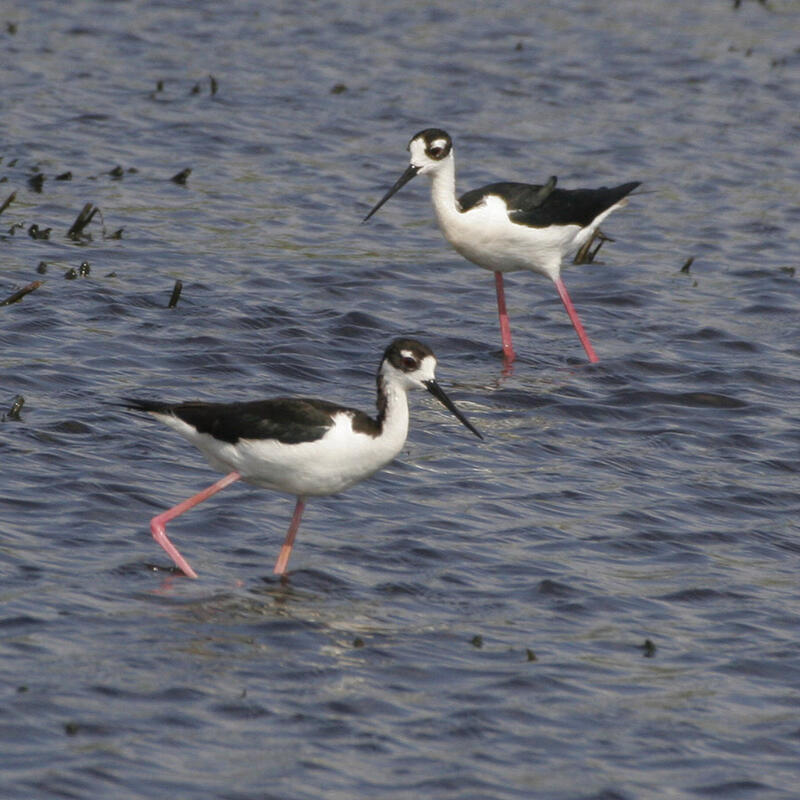
A beautiful, elegant bird, the black-necked stilt can often be seen gracefully striding through shallow wetlands and flooded fields in search of food. Overall shape is very slender with a long needle-like bill. Striking black and white plumage: glossy black back, hindneck, and crown with white underparts, rump, and forehead. The iris is a brilliant red. Females may appear browner on the back. Wings are black, long, and pointed. Legs are pale pinkish to red. Immatures are similar to adults but with scalloping on the browner back and a white trailing edge on the wings. Stilts are 33-43 cm (13-17 in) in length with a 68-71 cm (27-28 in) wingspan and weigh 136-220 g (4.9-7.9 oz).
None, the combination of black-and-white plumage, slender shape, and extremely long pink to reddish legs are unmistakable.
This species inhabits shallow salt, brackish, and freshwater wetlands including the edges of lakes and ponds, flooded pastures, sewage ponds, and impoundments.
Prey items include aquatic invertebrates, particularly crustaceans, other arthropods, and mollusks, small fishes, amphibians, and rarely plant seeds.
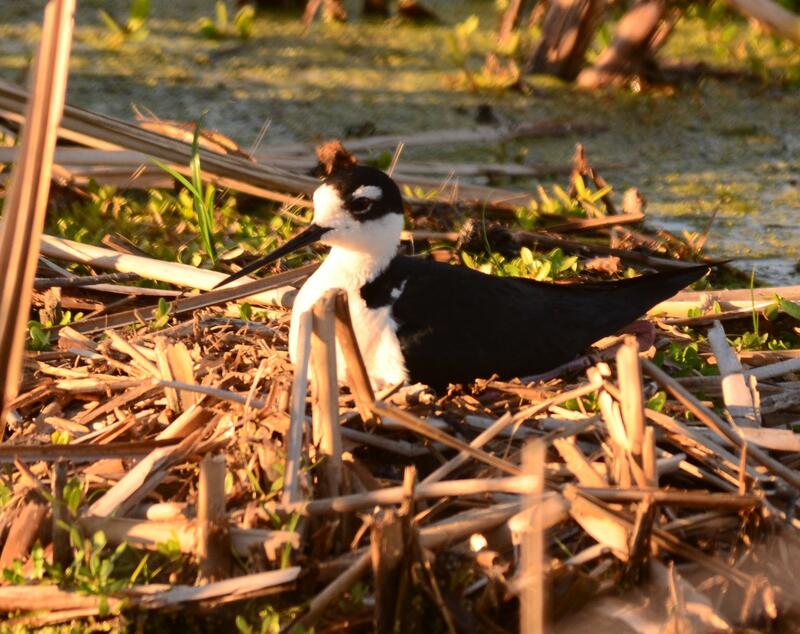
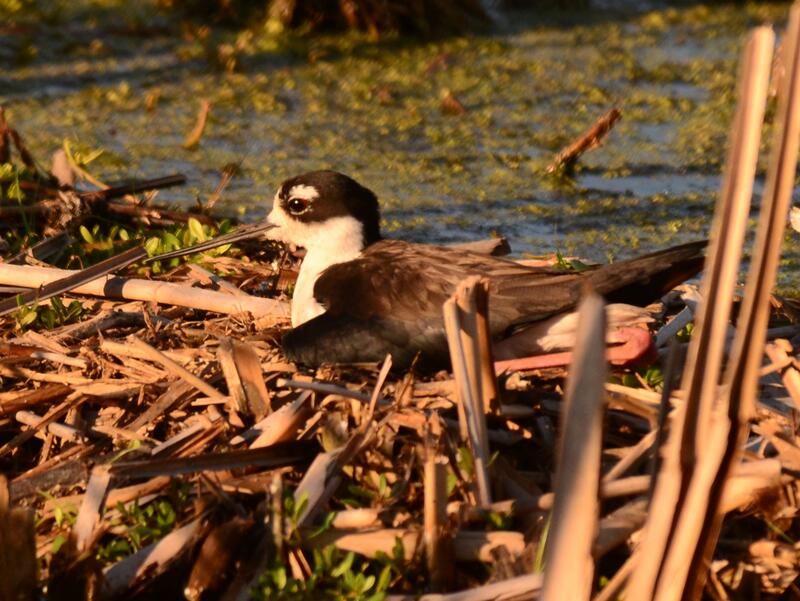
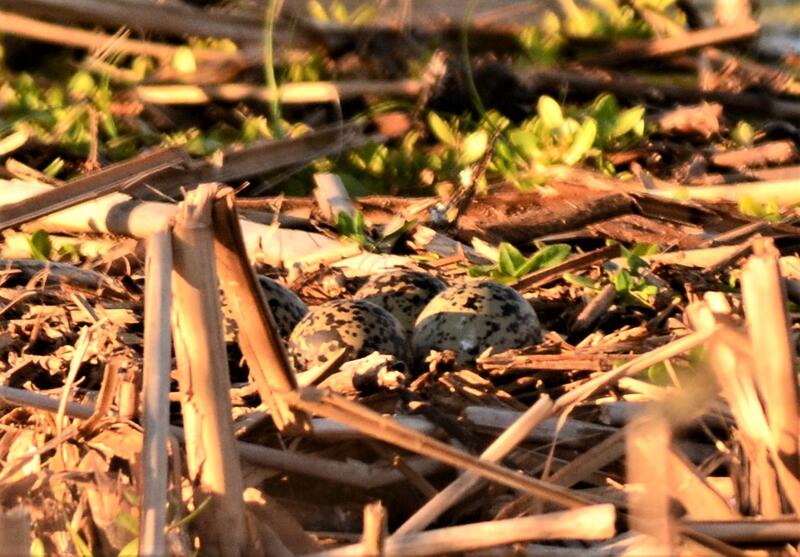
Nest site selection in Georgia begins in late spring with mated pairs typically choosing the site together--usually on small islands, clumps of vegetation over water, or sometimes a floating mat. They often nest semi-colonially in close proximity (<20 m) to other pairs. The nest normally consists of a scrape made in the substrate that is regularly lined with plant material, shells, pebbles, and sometimes even mud chips. Usually four eggs (range 2-5) are laid and incubated by both adults for 21-24 days. Eggs are olive-grey with brown speckles. Newly hatched chicks are precocial, capable of moving from the nest site to a brooding territory less than 2 hours after hatching. Young often remain with their parents for several months. The stilt is a staunch defender of its nesting territory, aggressively attacking conspecifics and other bird species that get too close to its nest or young. An incubating stilt will remain on its nest as an avian predator approaches, but its mate, and often other stilts from nearby, will mob the intruder. When a ground predator (including humans) comes close, one or more of several different distraction displays are used to draw it away from the nest site.
Feeding can occur day or night with prey being captured using both visual and tactile methods. Visual foraging includes pecking or jabbing at prey on the surface of mud or water while standing still or walking slowly, plunging the head underwater to catch food in the water column, herding small fish into shallows to trap them, and catching flying insects out of the air. Tactile feeding includes sweeping the bill and head side to side with a scythe-like motion in wet mud or water while walking or running and immersing the head and neck under water while feeding in the soft mud bottom.
A combination of ground and aerial surveys would be needed over multiple years to obtain an accurate picture of the abundance and population trends of stilts in Georgia.
The black-necked stilt has a complex and disjunct distribution. In the U. S. it breeds at scattered sites along the Atlantic Coast from Delaware Bay to south Florida, along the western half of the Gulf Coast, and in scattered areas throughout the West from Washington and Montana southward to California and Texas. It is a year-round resident in much of Mexico, the West Indies, parts of Central America, a large portion of South America, and the Hawaiian Islands.
Stilts once bred as far north as New Jersey, but during the early 19th century their population plummeted along the Atlantic Coast due to shooting and likely habitat loss. By the mid-1800s this bird had been extirpated as a breeder north of Georgia. This species has recolonized much of its former range and now regularly breeds as far north as Delaware. Habitat loss and degradation are the two greatest threats. The use of man-made habitats such as settling, evaporation, and sewage ponds by stilts makes them particularly vulnerable to environmental contaminants, especially selenium. Another potential threat is rising sea levels that will reduce foraging and breeding habitat.
| Threat 1 | Threat 2 | Threat 3 | |
|---|---|---|---|
| General Threat | Pollution | Natural system modifications | Climate change & severe weather |
| Specific Threat | Industrial & military effluents | Other ecosystem modifications | Storms & flooding |
Within Georgia the black-necked stilt population appears to be slowly rebounding from historical losses from shooting and habitat destruction. While still uncommon, this bird has been found breeding at various locations along the state’s coast. Barrier island sites include Ossabaw, St. Catherines, Sapelo, Black Beard, Little St. Simons, and Jekyll Islands. Mainland sites include Onslow island (Savannah River), a dredge spoil island at Kings Bay Naval Submarine Base, Harris Neck NWR, a wetland near Ridgeville, and Butler and Rhetts Islands at Altamaha WMA.
The United States Shorebird Conservation Plan estimates that there are approximately 150,000 black-necked stilts breeding in the United States. The Breeding Bird Survey (BBS) suggests that this species has increased annually by almost 1.7% per year in the U. S. and nearly 1.4% in the Eastern BBS Region from 1966-2015. Trends in Georgia are unknown. At present there are no surveys in place that adequately track stilt populations in the state.
Bailey, H. B. 1883. Memoranda of a collection of eggs from Georgia. Bulletin of the Nuttall Ornithological Club 8:37-43.
Beaton, G., P. W. Sykes, Jr. and J. W. Parrish, Jr. 2003. Annotated Checklist of Georgia Birds. 5th edition. Georgia Ornithological Society Occasional Publication No. 14.
Burleigh, T. D. 1958. Georgia Birds. University of Oklahoma Press, Norman.
https://www.allaboutbirds.org/guide/Black-necked_Stilt.
https://www.audubon.org/field-guide/bird/black-necked-stilt.
Rush, S. A. 2010. Black-necked Stilt (Himantopus mexicanus). Pp. 166–167 in T. M. Schneider, G. Beaton, T. S. Keyes, and N. A. Klaus, eds. The Breeding Bird Atlas of Georgia. University of Georgia Press, Athens.
Robinson, J. A., J. M. Reed, J. P. Skorupa and L.W. Oring. 1999. Black-necked Stilt (Himantopus mexicanus), version 2.0. In The Birds of North America (P. G. Rodewald, editor). Cornell Lab of Ornithology, Ithaca, NY.
Sauer, J. R., D. K. Niven, J. E. Hines, D. J. Ziolkowski, Jr., K. L. Pardieck, J. E. Fallon, and W. A. Link. 2017. The North American Breeding Bird Survey, Results and Analysis 1966-2015. Version 2.07.2017 U.S.G.S. Patuxent Wildlife Research Center, Laurel, MD.
Sibley, D. A. 2003. The Sibley Guide to Birds. A. A. Knopf, New York, NY.
Tomkins, I. R. 1950. A Georgia breeding record of the Black-necked Stilt. Oriole 15:30-31.
Scott A. Rush and Andy Day
S. Rush, 2010: Breeding Bird Atlas species account
A. Day, November 2019: modified and edited text
T. Schneider, November 2019: added photos