

Loading profile. Please wait . . .
Carya laciniosa (Michx. f.) G. Don
Shellbark Hickory




Federal Protection: No US federal protection
State Protection: No Georgia state protection
Global Rank: G5
State Rank: S2?
Element Locations Tracked in Biotics: Yes
SWAP 2015 Species of Greatest Conservation Need (SGCN): Yes
SWAP 2025 Species of Greatest Conservation Need (SGCN): No
2025 SGCN Priority Tier:
Element Occurrences (EOs) in Georgia: 4
Habitat Summary for element in Georgia: Bottomland forests
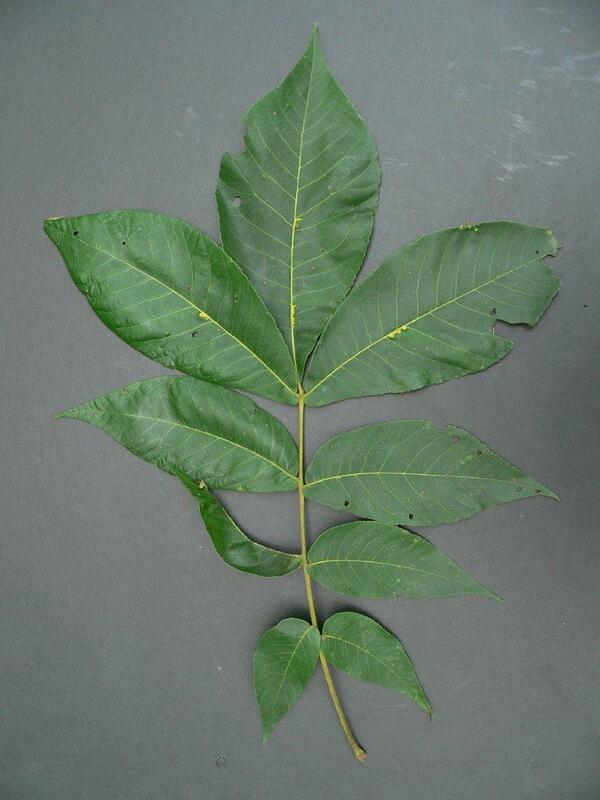
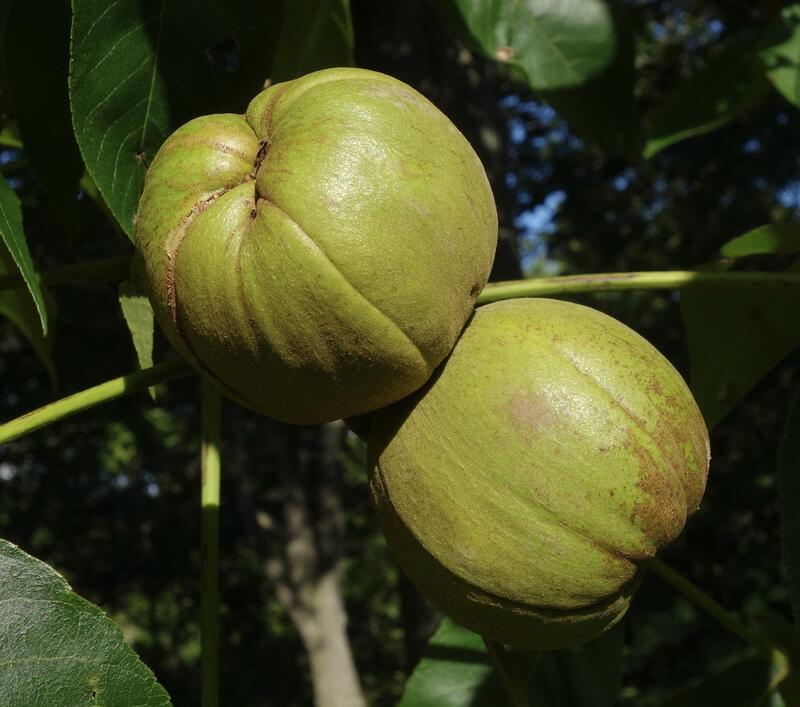
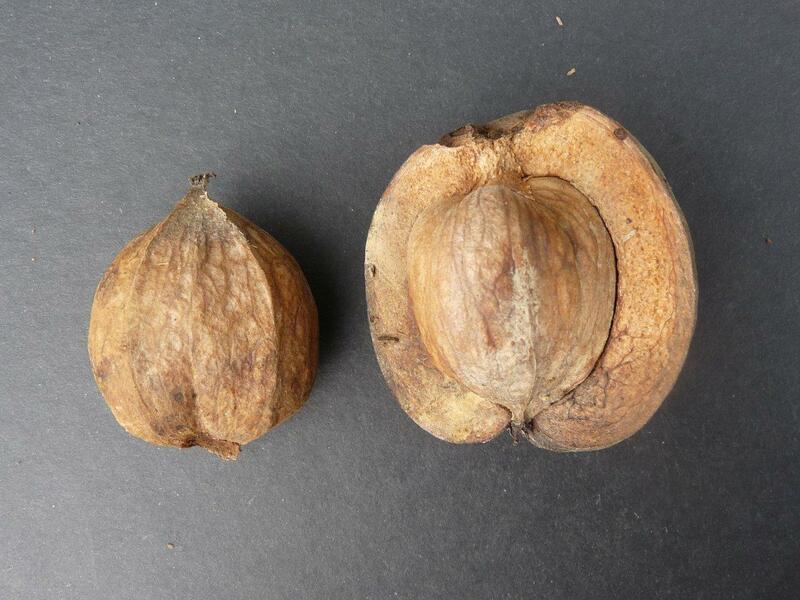
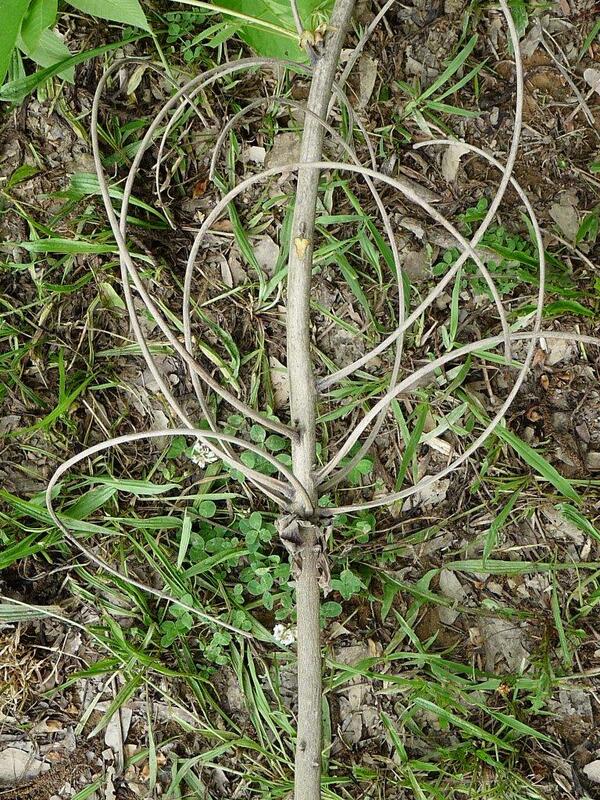
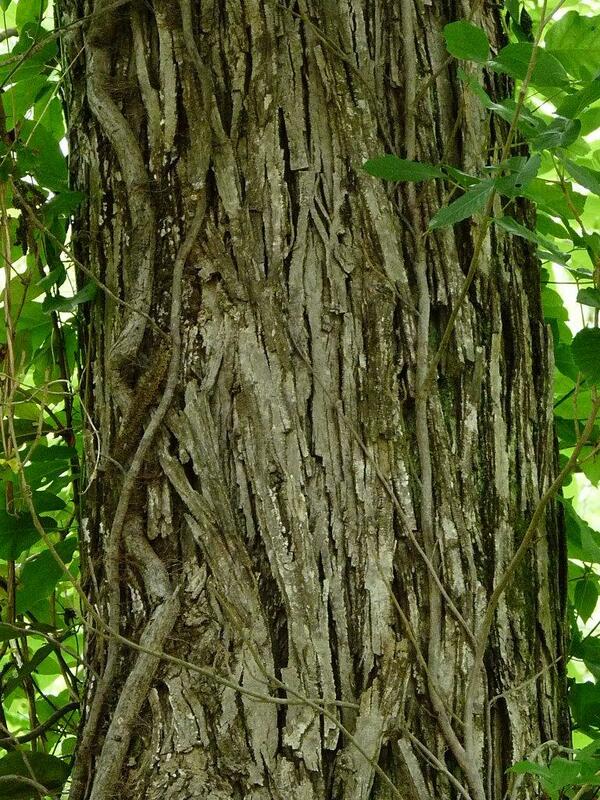
Large tree up to 135 feet (41 meters) tall, with gray bark partially peeling off in narrow, vertical segments that lie flat against the trunk at both ends (rather than curving outward). Older twigs are stout, hairy, and scaly, light tan to pale rusty-brown with raised, orange dots (lenticels). The leaves are alternate and compound with 5 - 11 (usually 7 - 9) leaflets; the leaf stalks are up to 2.4 - 5 inches (6 - 13 cm) long. Leaflets are 3.5 - 8 inches long and 1.2 - 4 inches wide (9 - 20 cm long and 3 - 10 cm wide), oval to elliptic in shape, hairy and scaly on both surfaces, with toothed margins. Female and male flowers are held in separate clusters on the same tree (monoecious), and near each other on the same twig. Female flowers are in small groups of 2 - 6 urn-shaped flowers, and male flowers are in narrow, dangling catkins up to 8 inches (20 cm) long. The fruits are about 2 inches long and wide (4.5 - 6 cm long and 4 - 5 cm wide), round to oval, with a thick, 4-segmented husk, green, turning brown or tan when mature, minutely hairy but without tiny bumps. When mature, the husk splits open to the base to reveal a 4-angled, thick-shelled, slightly flattened nut that encases a sweet, edible seed (“nut meat”).
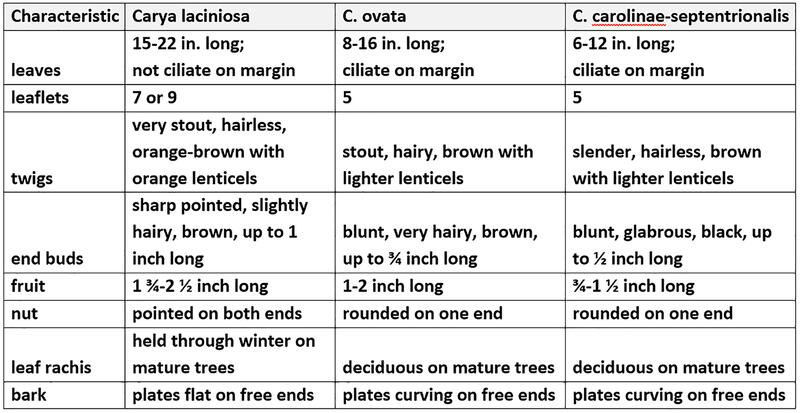
Two other hickory species have shaggy bark and are easily confused with Shellbark Hickory. See the summary chart, provided by Richard Ware, Georgia Botanical Society, at the end of this profile.
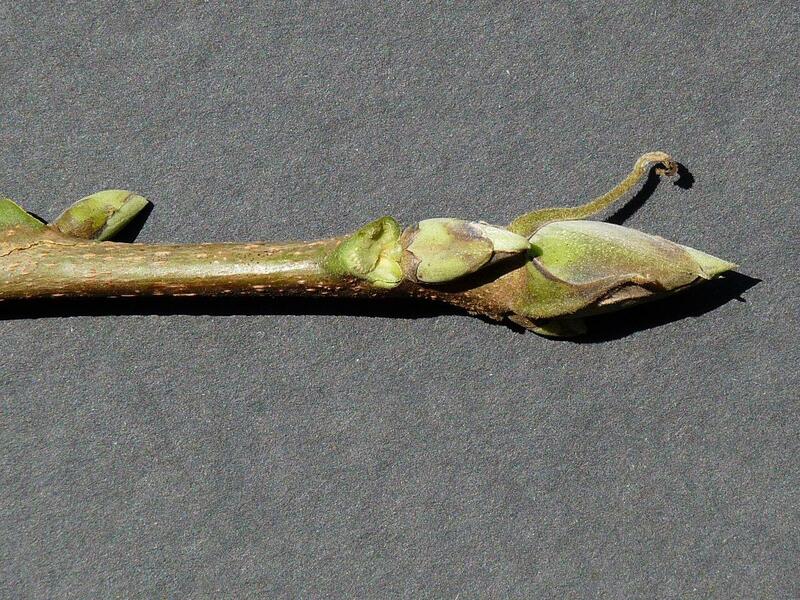
Shellbark Hickory differs from the more common Shagbark Hickory (Carya ovata) in several ways. The shaggy plates on the bark of Shellbark are flat on both ends; Shagbark plates curve outwards on the ends. Shellbark leaves are larger (15 - 22 inches) and have 7 or 9 leaflets, instead of 5. In the fall, Shellbark leaflets drop to the ground but the leaf rachis (the stalk-like structure that holds the leaflets) remains on the twig throughout the winter; the Shagbark leaf rachis drops along with the leaflets, leaving the twigs completely bare in the winter. Shellbark twigs are very stout, hairless, and orange-brown with orange lenticels; Shagbark twigs are less stout (though not slender), hairy, and brown with tan lenticels. The end buds on Shellbark twigs are brown, sharply pointed, slightly hairy, and up to 1 inch long; Shagbark’s end buds are blunt, very hairy, brown, and up up to 0.75 inch long. Shellbark fruit are larger, 1.8 - 2.5 inches long; Shagbark fruits are 1 - 2 inches long. Shellbark nuts (inside the fruit husk) are pointed at both ends; Shagbark nuts are rounded at one end, pointed at the other.
Shellbark Hickory also differs from Carolina Shagbark Hickory (Carya carolinae-septentrionalis) in several ways. The shaggy plates on the bark of Shellbark are flat on both ends; Carolina Shagbark plates curve outwards on the ends. Shellbark leaves are larger (15 - 22 inches) and have 7 or 9 leaflets, instead of Carolina’s 5 leaflets. In the fall, Shellbark leaflets drop to the ground but the leaf rachis (the stalk-like structure that holds the leaflets) remains on the twig throughout the winter; the Carolina Shagbark leaf rachis drops along with the leaflets, leaving the twigs completely bare in the winter. Shellbark twigs are very stout, hairless, orange-brown with orange lenticels; Carolina’s are slender, hairless, and brown with tan lenticels. The end buds on Shellbark twigs are sharply pointed, slightly hairy, brown, and up to 1 inch long; Carolina Shagbark’s end buds are blunt, hairless, black, and up to 0.5 inch long. Shellbark fruit are larger, 1.8-2.5 inches long; Carolina Shagbark fruits are 0.75 - 1.5 inches long. Shellbark nuts (inside the fruit husk) are pointed at both ends; Carolina Shagbark nuts are rounded at one end, pointed at the other.
Carya myristiciformis (Nutmeg Hickory) occurs in non-riverine swamps and flatwoods over calcareous bedrock in Floyd County, Georgia. For more information, see https://www.georgiabiodiversity.org/portal/profile?group=plants&es_id=16635
In Georgia, Carya laciniosa occurs only in the Cumberland Plateau and Ridge & Valley ecoregions in northwest Georgia, in rich deciduous forests on slopes over limestone bedrock and in bottomland forests with circumneutral soils along streams.
Shellbark Hickory is a large, long-lived, slow-growing winter-deciduous tree with a deep taproot. Its close-grained wood is hard, heavy, strong, and flexible and has been used for making furniture, veneer, drum sticks, and handles of tools and sporting goods. Shellbark Hickory is shade-tolerant but reproduces poorly in heavily shaded sites. Like most trees, it forms mycorrhizal associations with fungi, specifically the ectotrophic mycorrhiza, Laccaria ochropurpurea. It readily sprouts from the crown after cutting or fire.
Shellbark Hickory is monoecious, i.e. the female and male reproductive structures are in separate flowers held on the same tree. In this species, the flowers of both sexes occur on the same twig but present very differently–the pistillate (female) flowers are in small groups of urn-shaped flowers, and the staminate (male flowers) are held in long, drooping catkins. Flowers of both sexes emerge in mid-spring before the leaves develop. The flowers are self-fertile but are usually cross-pollinated by the wind and produce crops of large nuts with sweet, edible meat each year. The nuts are attacked by the pecan weevil (Curculio caryae) and the hickory shuckworm (Laspeyresia caryana). Other insect visitors include the hickory bark beetle (Scolytus quadrispinosus ), which feeds on the cambium, and the hickory spiral borer (Agrilus arcuatus torquatus), which feed on leaves and inner bark and can be very destructive to seedlings. The large number of insects that feed on the foliage make Shellbark Hickory trees very attractive to a wide range of insect-eating birds. Shellbark Hickory nuts have sweet meat (seeds) that are eaten by ducks, quail, wild turkeys, squirrels, chipmunks, deer, bear, foxes, raccoons, and white-footed mice. The spaces beneath the loose bark plates provide winter refuge for some insects and summer roosting habitat for bats.
Shellbark Hickory can be identified year-round. In the winter, its shaggy bark resembles Carolina Shagbark and Shagbark Hickories, but several winter-visible traits distinguish Shellbark. The plates or strips of Shellbark’s bark tend to lie flat against the trunk for their whole length rather than curving up at the ends as do the Shagbarks’. Shellbark twigs are tan to pale rusty-brown with orange-ish lenticels, whereas the other two species have dark reddish-brown twigs with pale tan lenticels. The fallen leaves of both Shagbark species turn black, whereas fallen Shellbark leaves turn brown when dry. The leaf stalk and leaf rachis of Shellbark Hickory tend to remain on the twigs throughout the winter unlike the Shagbark species. Shellbark Hickory fruits are considerably larger than those of all other hickories.
Georgia, west to Texas, north to Iowa and New York. It is rare or uncommon throughout its range.
Shellbark Hickory is threatened by logging in bottomlands; its slow growth and relatively late sexual maturity (40 years) means that it is not readily replaced once cut. Dam construction and conversion of floodplain wetlands to agriculture and silviculture have destroyed its habitat. Invasion of floodplains by Chinese Privet limits reproduction by competing with its seedlings, and its saplings are heavily browsed by deer.
Shellbark Hickory is ranked S2 by the Georgia Department of Natural Resources, indicating that it is imperiled in the state. It is known from two natural populations in two counties in northwest Georgia, one of which is protected on state-owned conservation land. It is also found in other areas as a landscape tree.
Protect bottomlands and floodplains from logging, stream impoundment and other hydrological alterations. Eradicate invasive species from floodplains. Reduce the size of Georgia’s deer herd.
Burns, R.M. and B.H. Honkala. 1990. Carya laciniosa (Michx. f.) Lould., Shellbark Hickory. Silvics of North America: Vol. 2–Hardwoods, U.S. Forest Service, Agriculture Handbook 654. Southern Research Station, United States Department of Agriculture. Accessed 15 August 2019. https://www.srs.fs.usda.gov/pubs/misc/ag_654/volume_2/carya/laciniosa.htm
GADNR. 2019. Element occurrence records for Carya laciniosa. Georgia Department of Natural Resources, Wildlife Resources Division. Social Circle, Georgia.
Hilty, J. 2019. Species account for Carya laciniosa. Illinois Wildflowers. Accessed 10 August 2019. https://www.illinoiswildflowers.info/trees/plants/kn_hickory.htm
NatureServe. 2019. Species account for Carya laciniosa. NatureServe Explorer: an online encyclopedia of life, Version 7.1. NatureServe, Arlington, Virginia. Accessed 10 August 2019. http://explorer.natureserve.org/servlet/NatureServe?searchName=Carya+laciniosa
Stone, D.E.. 1997. Species account for Carya laciniosa. Flora of North America North of Mexico, vol. 3. Accessed 10 August 2019. http://www.efloras.org/florataxon.aspx?flora_id=1&taxon_id=233500318
Weakley, A.S. 2015. Flora of the southern and mid-Atlantic States. University of North Carolina Herbarium, University of North Carolina, Chapel Hill. http://www.herbarium.unc.edu/flora.htm
Linda G. Chafin
Linda G. Chafin, 28 October 2019: original account.