


Loading profile. Please wait . . .
Penstemon dissectus Ell.
Dissected Beardtongue




Federal Protection: No US federal protection
State Protection: Rare
Global Rank: G2
State Rank: S2
Element Locations Tracked in Biotics: Yes
SWAP 2015 Species of Greatest Conservation Need (SGCN): No
SWAP 2025 Species of Greatest Conservation Need (SGCN): Yes
2025 SGCN Priority Tier: Highest Conservation Concern
Element Occurrences (EOs) in Georgia: 42
Habitat Summary for element in Georgia: Altamaha Grit outcrops and adjacent pine savannas; rarely sandridges
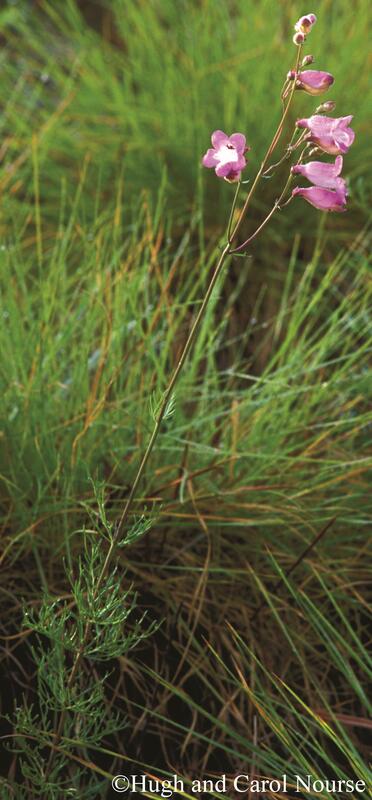
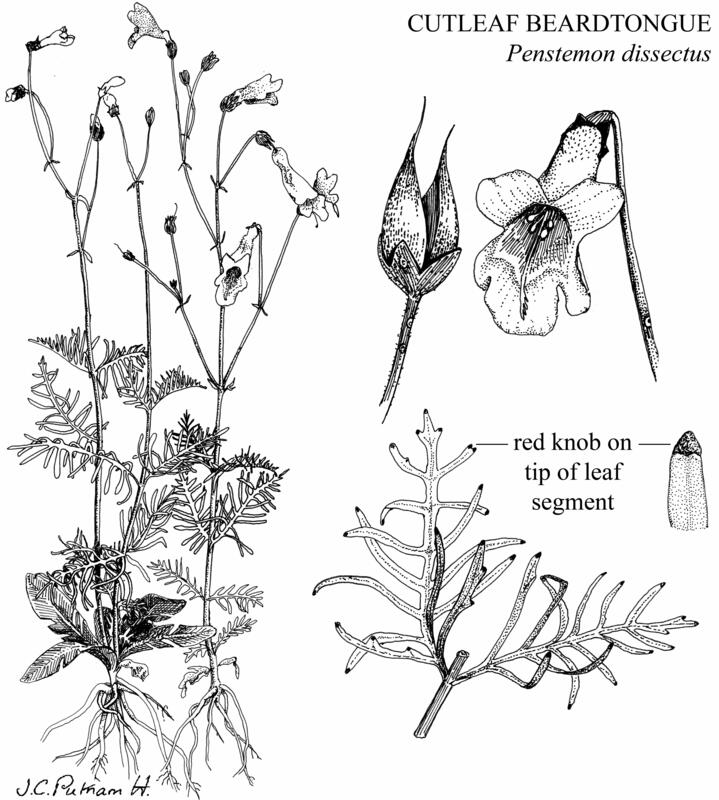
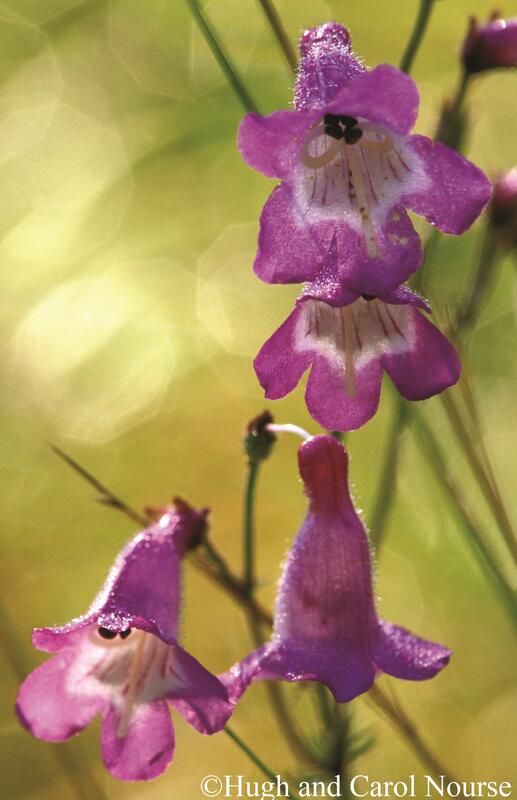
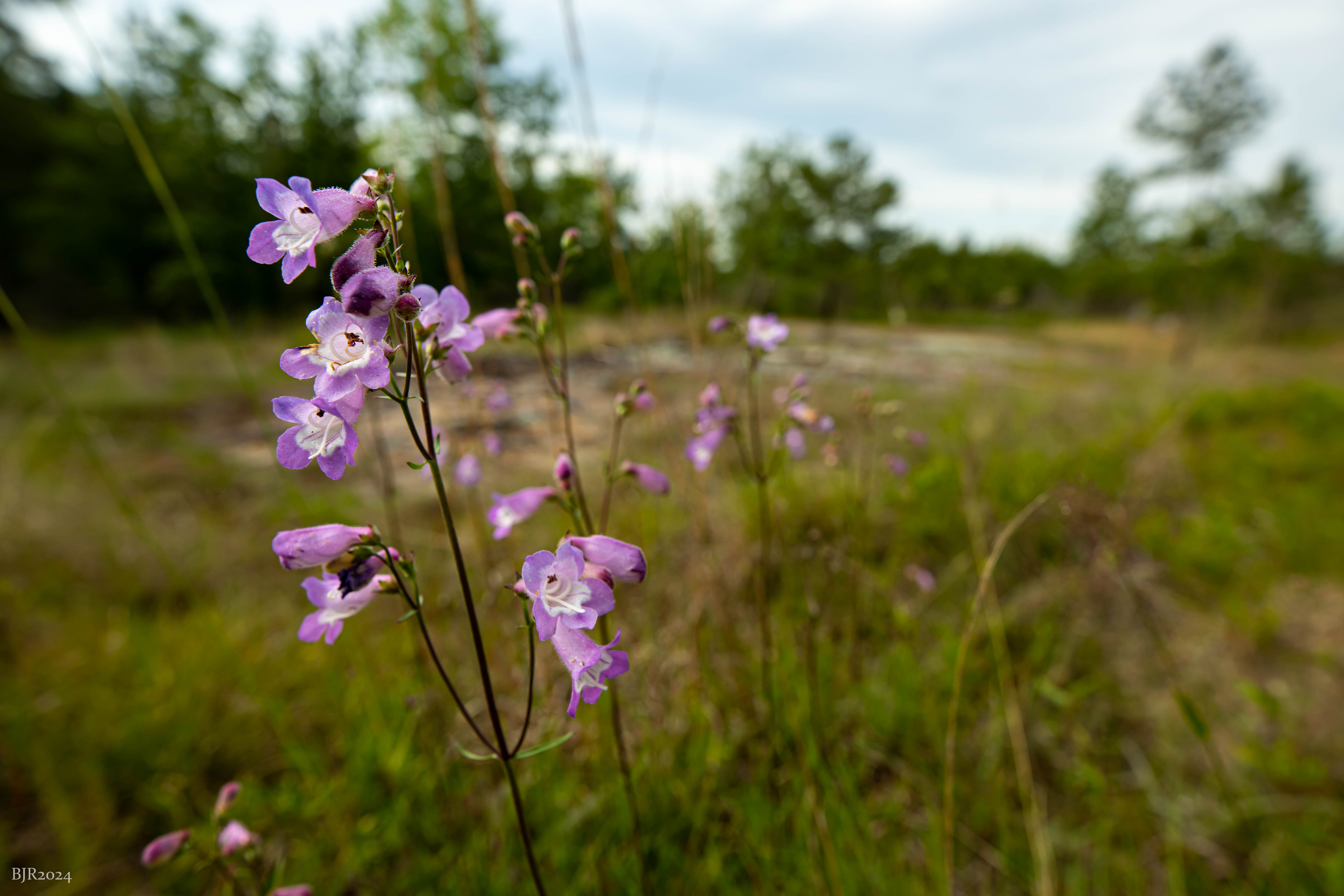
Perennial herb with stems 12 - 16 inches (30 - 40 cm) tall. Its leaves are 0.6 - 2.4 inches (1.5 - 6 cm) long, opposite, in widely spaced pairs, each leaf divided into many narrow segments, the tip of each segment with a tiny red knob. Flower clusters are open and branching, held at the top of the stem. Flowers are about 1 inch (2.5 - 3 cm) long, with an inflated tube, a 2-lobed upper lip and 3-lobed lower lip; they are dark pink with a purple-streaked white throat; the “beard tongue” (a sterile stamen with a tuft of yellow hairs on the tip) extends beyond the flower opening. Fruits are 0.4 inch (1 cm) long, slightly woody, with a pointed beak, splitting into four segments.
This is the only Penstemon species in the southeastern U.S. with deeply dissected leaves.
False Foxgloves (Agalinis spp.) have pink, bell-shaped flowers with five spreading lobes and narrow, undissected leaves.
Penstemon calycosus (Long-sepal Beardtongue) occurred on limestone ledges in Dade County but hasn't been seen in more than a century. For more information, see: https://www.illinoiswildflowers.info/savanna/plants/ls_penstemon.htm
Small’s Beardtongue (Penstemon smallii, Special Concern) occurs in circumneutral soils in woodlands and glades and on cliffs, rocky slopes, bluffs, and road banks in the Southern Blue Ridge. For more information, see: https://georgiabiodiversity.org/portal/profile?group=plants&es_id=16885
Penstemon pallidus (Eastern White Beardtongue) occurs on limestone and shale barrens in northwest Georgia and the Atlanta area. For more information, see: https://www.illinoiswildflowers.info/prairie/plantx/pale_penstemon.htm
Altamaha Grit outcrops, surrounding Longleaf Pine woodlands, and roadsides and rights-of-way through these habitats, in the Coastal Plain.
Cutleaf Beardtongue is a perennial herb that reproduces sexually by seed. The genus Penstemon (meaning “almost stamen”) is named for the staminode, the bristly, sterile, fifth stamen or “beard tongue” in each flower. The beard tongue, which is usually exserted and showy, attracts insects and also increases contact between fertile flower parts and visiting insect pollinators – the weight of the pollinator pressing down on the staminode brings the anthers and stigmas into contact with the insect. Cutleaf Beardtongue is probably pollinated by a variety of bees and bee-flies. Its seeds are dispersed by wind, gravity, and small animals.
Surveys are best conducted during flowering (late April–May) and fruiting (late May–August). The leaves are identifiable throughout the growing season but are hard to spot among dense Wire Grass or other herb layer species.
Cutleaf Beardtongue occurs only in Georgia.
Logging and clearing around Altamaha Grit outcrops, off-road-vehicle use on outcrops, fire suppression in Longleaf Pine woodlands.
| Threat 1 | Threat 2 | Threat 3 | |
|---|---|---|---|
| General Threat | Natural system modifications | Agriculture & aquaculture | Energy production & mining |
| Specific Threat | None | None | None |
Penstemon dissectus is ranked S2 by the Georgia Department of Natural Resources, indicating that it is imperiled in Georgia. Although there are more than 30 populations, only seven occur on conservation lands. Many occur on roadsides where they are subject to herbicides and mowing.
Protect Altamaha Grit outcrops and surrounding woodlands from logging, clearing, conversion to pasture and developments, and off-road vehicles. Apply prescribed fire every 2 - 3 years.
Chafin, L.G. 2007. Field guide to the rare plants of Georgia. State Botanical Garden of Georgia and University of Georgia Press, Athens.
GADNR. 2020. Element occurrence records for Penstemon dissectus. Georgia Department of Natural Resources, Wildlife Resources Division, Social Circle, Georgia.
Kral, R. 1983. A report on some rare, threatened, or endangered forest-related vascular plants of the South. Technical Publication R8-TP2. United States Forest Service, Atlanta.
NatureServe. 2019. Penstemon dissectus comprehensive report. NatureServe Explorer. Arlington, Virginia. http://explorer.natureserve.org/servlet/NatureServe?searchName= Penstemon+dissectus
Patrick, T.S., J.R. Allison, and G.A. Krakow. 1995. Protected plants of Georgia. Georgia Department of Natural Resources, Natural Heritage Program, Social Circle.
Radford, A.E., H.E. Ahles, and C.R. Bell. 1968. Manual of the vascular flora of the Carolinas. University of North Carolina Press, Chapel Hill.
Walker-Larsen J. and L.D. Harder. 2001. Vestigial organs as opportunities for functional innovation: the example of the Penstemon staminode. Evolution 55: 477-487. https://onlinelibrary.wiley.com/doi/abs/10.1111/j.0014-3820.2001.tb00782.x
Weakley, A.S. 2015. Flora of the southern and mid-Atlantic States. University of North Carolina Herbarium, University of North Carolina, Chapel Hill. http://www.herbarium.unc.edu/flora.htm
Wolfe, A.D., C.P. Randle, S.L. Datwyler, J.J. Morawetz, N. Arguedas, and J. Diaz. 2006. Phylogeny, taxonomic affinities, and biogeography of Penstemon (Plantaginaceae) based on ITS and cpDNA sequence data. American Journal of Botany 93: 1699-1713. https://bsapubs.onlinelibrary.wiley.com/doi/pdf/10.3732/ajb.93.11.1699
Linda G. Chafin
L. Chafin, Jul, 2008: original account
K. Owers, Feb. 2010: added pictures
L. Chafin, Mar. 2020: updated original account