


Loading profile. Please wait . . .
Alasminota holstonia (I. Lea, 1838)
Tennessee Heelsplitter




Federal Protection: No US federal protection
State Protection: No Georgia state protection
Global Rank: G3
State Rank: S1
Element Locations Tracked in Biotics: Yes
SWAP 2015 Species of Greatest Conservation Need (SGCN): Yes
SWAP 2025 Species of Greatest Conservation Need (SGCN): Yes
2025 SGCN Priority Tier: High Conservation Concern
Element Occurrences (EOs) in Georgia: 8
Habitat Summary for element in Georgia: Small to large creeks; Occurs often in small creeks and medium sized rivers and spring runs. Sandy substrates, may be mixed with some gravel or mud
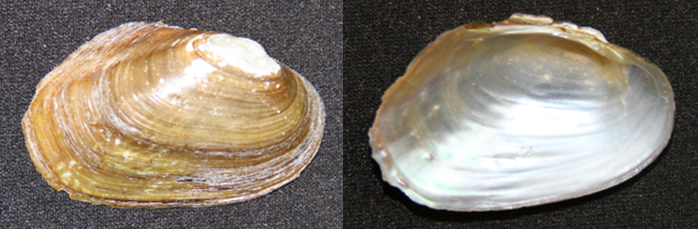
Medium sized, thin shelled mussel to 75 mm in length. Shell surface slightly rough with distinctive growth rests forming dark rings in the shell surface. General shell shape is oval, however, the posterior end comes to a blunt point below the midline of the shell. Shell color yellow, greenish-brown, or brown, darkening with age. Rays are seldom present and never well defined. Umbo protruding slightly above the hinge line. Beak sculpture consists of several thick, weakly double-looped bars on non-eroded individuals. Pseudocardinal teeth are small, reduced, and nearly parallel with the hinge line. Two pseudocardinal teeth in the left valve, one in the right valve. Lateral teeth are mostly absent and represented by a slight thickening of the shell along the hinge line. Interdental projection present in left valve. The nacre on the inside of the shell is usually white or blue-white.
Four additional species present in the Tennessee River Basin could potentially be confused for Lasmigona holstonia though close examination can usually provide a positive identification. Villosa iris (Rainbow), Villosa vanuxemensis (Maintain Creekshell), and Villosa taeniata (Painted Creekshell) could potentially be confused for this species. Unlike these three species, L. holstonia lacks defined pseudocardinal or lateral teeth. Its shell is also thinner and generally rougher looking than these villosa species and usually has dark growth rests on the shell. All three Villosa species usually have rays on the shell, unlike L. holstonia which lacks rays, and Villosa vanuxemensis usually has a purple nacre contrasting with L. holstonia’s white nacre. Another species which could be confused for L. holstonia is Strophitus undulatus (Creeper). Two key features of this species which differentiates it from L. holstonia are the lack of an interdental projection in the left valve, and a more pronounced indentation just anterior of the umbo.
Small to large creeks; Occurs often in small creeks and medium sized rivers and spring runs. Sandy substrates, may be mixed with some gravel or mud.
The diets of unionids are poorly understood but are believed to consist of algae and/or bacteria. Some studies suggest that diets may change throughout the life of a unionid with juveniles collecting organic materials from the substrate through pedal feeding and then developing the ability to filter feed during adulthood (Vaughn and Hakenkamp, 2001).
Like nearly all unionids, L. holstonia has an obligate parasitic life cycle. Larval mussels, known as glochidia, develop in water tube present in the gills of the female mussel and are released when disturbed by an appropriate host fish. L. holstonia’s host infection strategy is similar to that of other Anodontine mussels consisting of passive entanglement of host fish in mucus strands containing mature glochidia. Glochidia attach to the gills, fins, and skin of the host fish and encyst as an ectoparasite. Typical glochidia infestation appears to be minimally invasive to the host fish and is not fatal. Glochidia remain attached to the host for several weeks to several months before dropping off as juvenile mussels. These juveniles hopefully land in a new, suitable location and burrow into the substrate where they feed on detritus using their foot and eventually grow into filter-feeding, adult mussels. Unlike most unionid groups, Anodontine mussels typically have glochidia with hooks which may allow them to more effectively cling to the skin and fins of host fish as these species do not entice host fish to take a mouthful of glochidia. Among several other species, the glochidia of L. holstonia are known to utilize adhesive larval threads to attach to facilitate entanglement of host species (Haag 2012). L. holstonia is considered to be a host generalist with successful transformation of juvenile mussels recorded for fish species in the families Centrarchidae and Cottidae as well as partial transformations (interrupted by host fish mortality in the study) on species in the family Cyprinidae (Steg 1998). L. holstonia is a long-term brooder and has been found gravid between September and May (Pinder et al. 2002).
This species is known to burrow >20 cm deep into the substrate and surveys conducted during the mature gravidity period (Late July through Early September) are most likely to detect the species while individuals are at the surface to spawn.
Lasmigona holstonia is known to occur in the Tennessee and Ohio River Drainages in Alabama, Tennessee, Georgia, North Carolina, and Virginia. This species occurs in the headwaters of the Tennessee River above the confluence with the Paint Rock River (Williams et al. 2008) and a few records are known from the Duck and Caney Fork in the Upper Cumberland River System (Parmalee and Bogan 1998). L. holstonia is only known from the New River system in Virginia (Pinder et al. 2003). In Georgia, Lasmigona holstonia is known only from the Upper Tennessee River Basin in the Chickamauga Creek system. This species was previously recognized from the Upper Mobile Basin in the Coosa and Tallapoosa Rivers, however, individuals from the Mobile Basin were subsequently recognized as a separate species (Lasmigona etowaensis) due to genetic differences (Williams et al. 2008)
Threats to L. holstonia include pollution, eutrophication, and sedimentation due to stream access by cattle and proximity of poultry production facilities in the vicinity of the South Chickamauga Creek system (SCCHMP 2012). Additional threats include impoundments such as Dallas Lake and Nickajack Lake and the potential for impacts from viral disease known to cause mass mortality in other freshwater mussel species elsewhere in the Tennessee Basin.
| Threat 1 | Threat 2 | Threat 3 | |
|---|---|---|---|
| General Threat | Natural system modifications | Pollution | Pollution |
| Specific Threat | Other ecosystem modifications | Domestic & urban waste water | Agricultural & forestry effluents |
Conservation of L. holstonia in Georgia will primarily rely on habitat protection in the South Chickamauga Creek watershed in the form of drainage area, riparian, and water resource management. Flow modifications in the form of dam construction, drainage structures, and course alterations are a primary concern for mussel species in the Southeastern US. Further research is needed to assess the potential for impacts of disease which is causing mussel mortality elsewhere in the Tennessee River Basin. Further research into the specific life history, host fish, and habitat requirements, and distribution of this species are still needed to guide management efforts.
Haag, W. R. (2012). North American freshwater mussels: natural history, ecology, and conservation. Cambridge University Press.
Steg, M. B. (1998). Identification of Host Fishes and Experimental Culture of Juveniles for Selected Freshwater Mussel Species in Virginia (Master's thesis, Virginia Polytech Institute, Blacksburg, Virginia). Retrieved from http://hdl.handle.net/10919/45441
Limestone Valley RC & D Council (2012) South Chickamauga Creek Headwaters Management Plan. Retrieved from https://epd.georgia.gov/document/document/south-chickamauga-creek-middle-tennessee-river/download
Parmalee, P. W., & Bogan, A. E. (1998). Freshwater mussels of Tennessee. University of Tennessee Press.
Pinder, M. J., Wilhelm, E. S., & Jones, J. W. (2002). Status survey of the freshwater mussels (Bivalvia: Unionidae) in the New River drainage, Virginia. Walkerana, 13(29/30), 189-223.
Vaughn C.C. and C.C. Hakenkamp. 2001. The functional role of burrowing bivalves in freshwater ecosystems. Freshwater Biology 46:1431-1446.
Williams, J.D., A.E. Bogan, and J.T. Garner. 2008. Freshwater mussels of Alabama and the Mobile Basin in Georgia, Mississippi, and Tennessee. The University of Alabama Press, Tuscaloosa.
Matthew Rowe
1/7/2021