


Loading profile. Please wait . . .
Tsuga caroliniana Engelm.
Carolina Hemlock




Federal Protection: No US federal protection
State Protection: Endangered
Global Rank: G3
State Rank: S1
Element Locations Tracked in Biotics: Yes
SWAP 2015 Species of Greatest Conservation Need (SGCN): Yes
SWAP 2025 Species of Greatest Conservation Need (SGCN): Yes
2025 SGCN Priority Tier: Highest Conservation Concern
Element Occurrences (EOs) in Georgia: 4
Habitat Summary for element in Georgia: Rocky bluffs
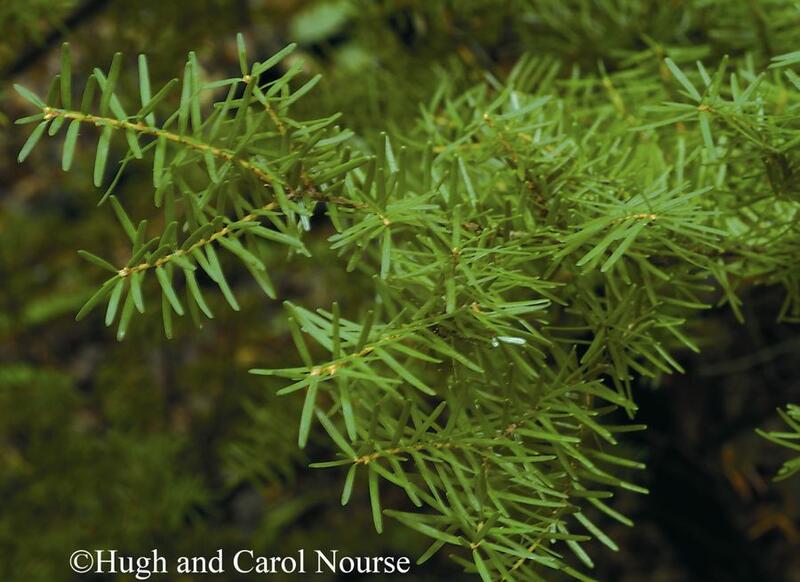
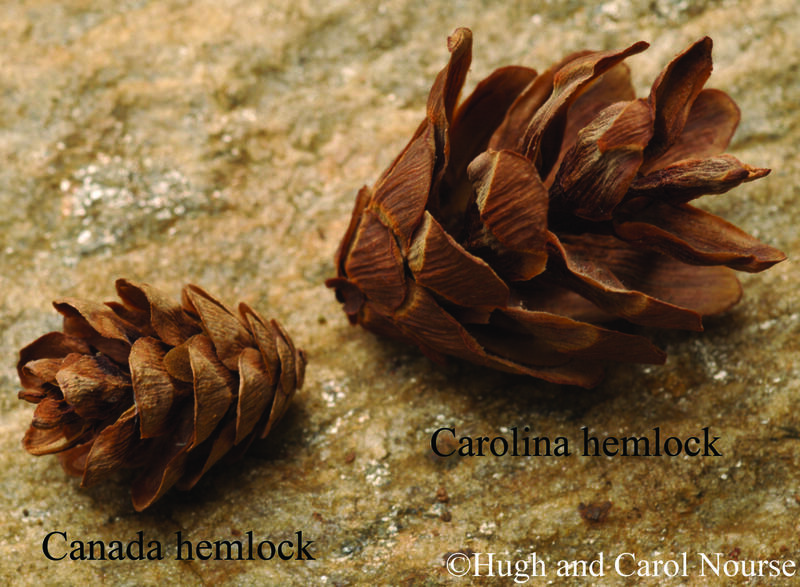
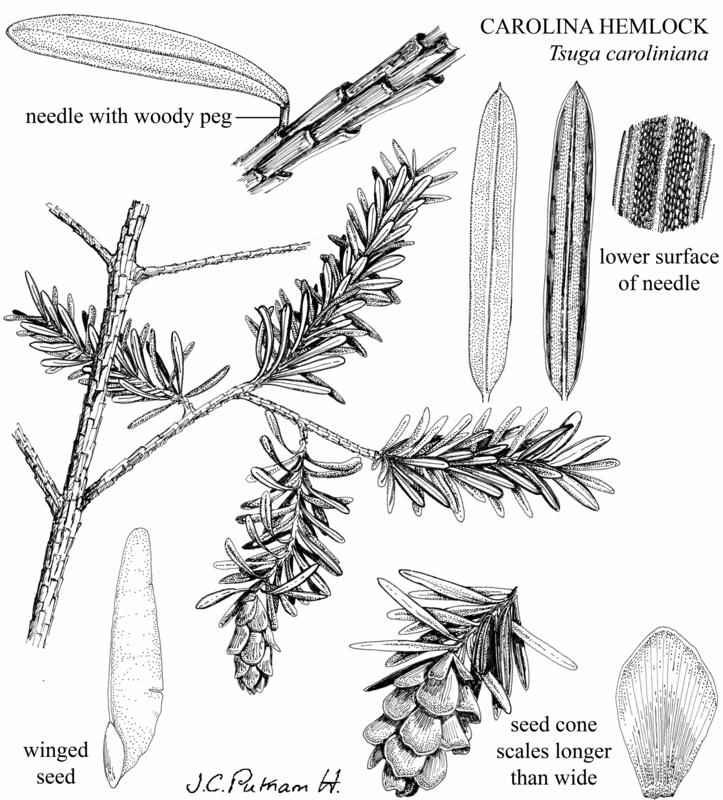
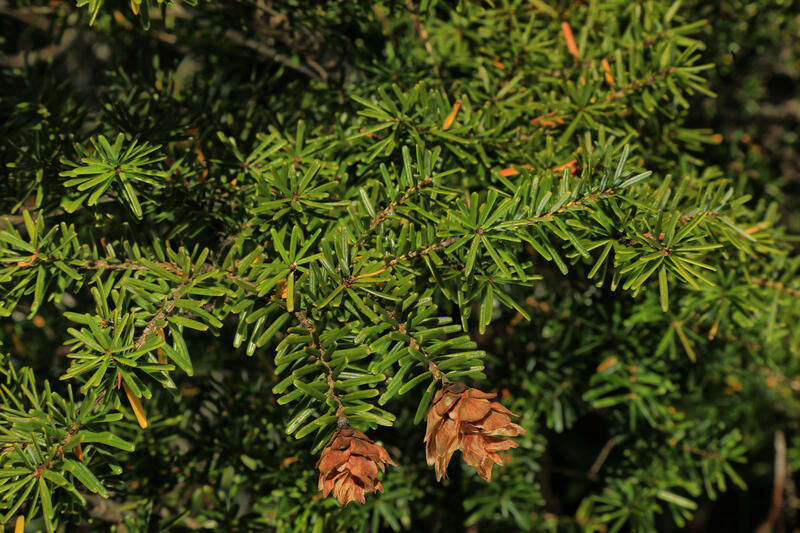
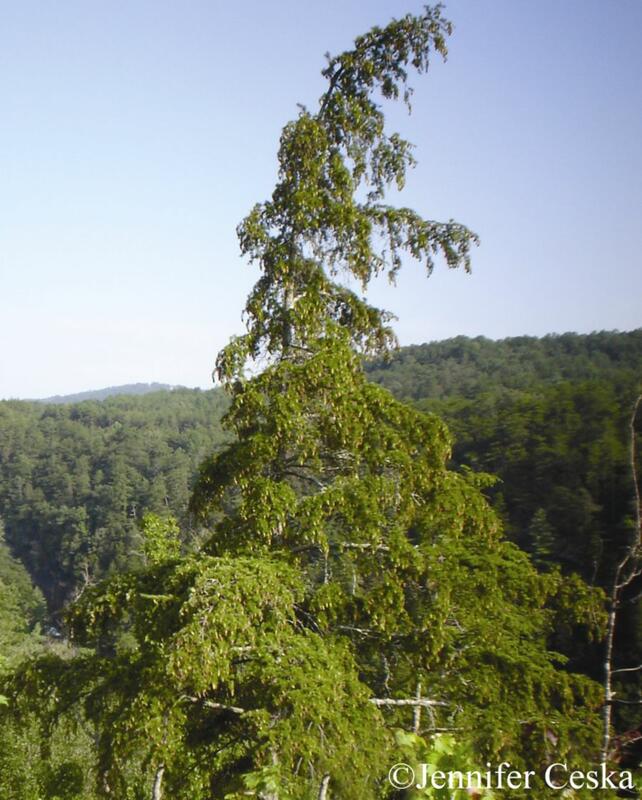
Evergreen tree usually 40 - 70 feet (12 - 21 meters) tall with scaly, reddish-brown bark on young twigs and dark, deeply furrowed ridges on older trunks. Branches held horizontally or drooping in flattened sprays. The needles are 0.4 - 0.8 inch (1 - 2 cm) long, flat, bristling in all directions from the twigs, shiny green above with two narrow white lines beneath, borne singly on tiny woody “pegs.” Seed cones are 1 - 1.5 inches (2.5 - 4 cm) long (see the cone on the right in photo below), with rounded, spreading scales. Pollen cones, which are less than 0.2 inch (0.5 cm) long, occur singly in the angles between needles and twigs and consist mostly of numerous anthers.
Canada Hemlock (Tsuga canadensis) is a common species in north Georgia. Its needles are arranged in two parallel rows on either side of the twig, spreading in only one plane. Its seed cones are smaller, less than 0.8 inch (2 cm) long. In Georgia, all other members of the pine family are true pines, with much longer needles in bunches of 2 - 5.
None in Georgia.
Dry slopes, ridgelines, and rocky cliffs with Table Mountain and Virginia Pines, and moist, high-elevation ravines with Canada Hemlock.
Carolina Hemlock is a slow-growing, coniferous, evergreen tree. It reproduces almost entirely by sexual means; it does not sprout from the base and only rarely layers. Carolina Hemlock begins to produce cones at about 20 years, with peak production beginning at 25 - 30 years. Pollen cones, which are less than 0.2 inch (0.5 cm) long, occur singly in the angles between needles and twigs and consist of numerous anthers; they appear March - April. Seed cones, initially light green and erect, are also solitary, and develop at the tips of twigs March - April. After fertilization, which occurs in the spring, the seed cones take two growing seasons to mature. The seeds ripen in late summer of the second year after fertilization and are released during the following fall and winter. The winged seeds are dispersed by wind. The empty cones persist on the twigs after seeds are released until the following spring when they fall to the ground without breaking. Carolina Hemlock is very shade tolerant. It is not tolerant of fire; its seedlings and saplings are killed by fire.
Surveys may be conducted all year.
Appalachian Mountains of Georgia, South Carolina, North Carolina, Tennessee, and Virginia.
Hemlock Woolly Adelgid (Adelges tsugae), an exotic insect pest that was accidentally introduced to this country from Asia, attacks and kills both Carolina and Canada hemlocks. Clearing and logging. Carolina Hemlock is not fire tolerant.
| Threat 1 | Threat 2 | Threat 3 | |
|---|---|---|---|
| General Threat | Energy production & mining | Invasive & other problematic species, genes & diseases | Climate change & severe weather |
| Specific Threat | None | None | None |
Carolina Hemlock is ranked S1 by the Georgia Department of Natural Resources, indicating that the species is critically imperiled in Georgia. It is listed as Endangered by the State of Georgia. Four populations with fewer than 12 trees are known, all in Tallulah Gorge State Park; all of these trees are vulnerable to fatal infestation by Hemlock Woolly Adelgid.
Georgia’s plants are the southernmost populations of this species. Plants occurring at the periphery of a species’ range are thought to be of special conservation importance. Peripheral populations are usually smaller and less genetically diverse within the population, but genetically divergent from centrally located populations. These genetic differences may confer special survival traits that plants in other portions of the species’ range lack, such as the ability to survive changes in the climate or the arrival of a new pathogen. Peripheral populations may be in the process of evolving into a new species. They are especially deserving of conservation action.
Support research on eradicating Hemlock Woolly Adelgid and fund treatment efforts. Support efforts to preserve genetic material of Georgia’s Carolina Hemlocks. Avoid logging and clearing on mountain slopes and in high-elevation habitats.
Chafin, L.G. 2007. Field guide to the rare plants of Georgia. State Botanical Garden of Georgia and University of Georgia Press, Athens.
Coladonato, M. 1993. Tsuga caroliniana. In: Fire Effects Information System. U.S. Department of Agriculture, Forest Service, Rocky Mountain Research Station, Fire Sciences Laboratory. https://www.fs.fed.us/database/feis/plants/tree/tsucar/all.htmlhttp://www.fs.fed.us/database/feis/
GADNR. 2020. Element occurrence records for Tsuga caroliniana. Georgia Department of Natural Resources, Wildlife Resources Division, Social Circle, Georgia.
Gleason, H.A. and A. Cronquist. 1991. Manual of vascular plants of northeastern United States and adjacent Canada, 2nd edition. New York Botanical Garden, New York.
Hymphrey, L.D. 1989. Life history traits of Tsuga caroliniana Engelm. (Carolina Hemlock) and its role in community dynamics. Castanea 54(3): 172-190. https://www.jstor.org/stable/4033374?seq=1#metadata_info_tab_contents
Kirkman, L.K., C.L. Brown, and D.J. Leopold. 2007. Native trees of the southeast. Timber Press, Portland, Oregon.
NatureServe. 2020. Tsuga caroliniana species account. NatureServe Explorer. NatureServe, Arlington, Virginia. https://explorer.natureserve.org/Taxon/ELEMENT_GLOBAL.2.145577/Tsuga_caroliniana
Peattie, D.C. 1966. Natural history of trees of eastern and central North America, 2nd edition. Bonanza Books, New York.
Potter, K.M., A.R. Campbell, S.A. Josserand, C.D. Nelson, and R.M. Jetton. 2017. Population isolation results in unexpectedly high differentiation in Carolina Hemlock (Tsuga caroliniana), an imperiled southern Appalachian endemic conifer. Tree Genetics and Genomes 13:105-125. https://link.springer.com/article/10.1007/s11295-017-1189-x
Radford, A.E., H.E. Ahles, and C.R. Bell. 1968. Manual of the vascular flora of the Carolinas. University of North Carolina Press, Chapel Hill.
Taylor, R.J. 1993. Tsuga caroliniana species account. Flora of North America, Vol. 2. Oxford University Press, New York. http://beta.floranorthamerica.org/Tsuga_caroliniana
Weakley, A.S. 2015. Flora of the southern and mid-Atlantic States. University of North Carolina Herbarium, University of North Carolina, Chapel Hill. http://www.herbarium.unc.edu/flora.htm
Linda G. Chafin
L.Chafin, Jan. 2009: original account.
D.Weiler, Jan. 2010: pictures added.
L. Chafin, June 2020: updated original account.