

Loading profile. Please wait . . .
Ctenium floridanum (A.S. Hitchc.) A.S. Hitchc.
Florida Orange-grass




Federal Protection: No US federal protection
State Protection: No Georgia state protection
Global Rank: G2
State Rank: S1
Element Locations Tracked in Biotics: Yes
SWAP 2015 Species of Greatest Conservation Need (SGCN): Yes
SWAP 2025 Species of Greatest Conservation Need (SGCN): Yes
2025 SGCN Priority Tier: Highest Conservation Concern
Element Occurrences (EOs) in Georgia: 11
Habitat Summary for element in Georgia: Moist pine barrens
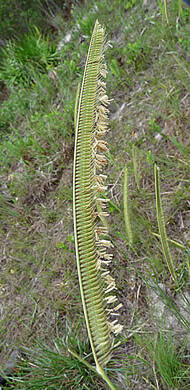
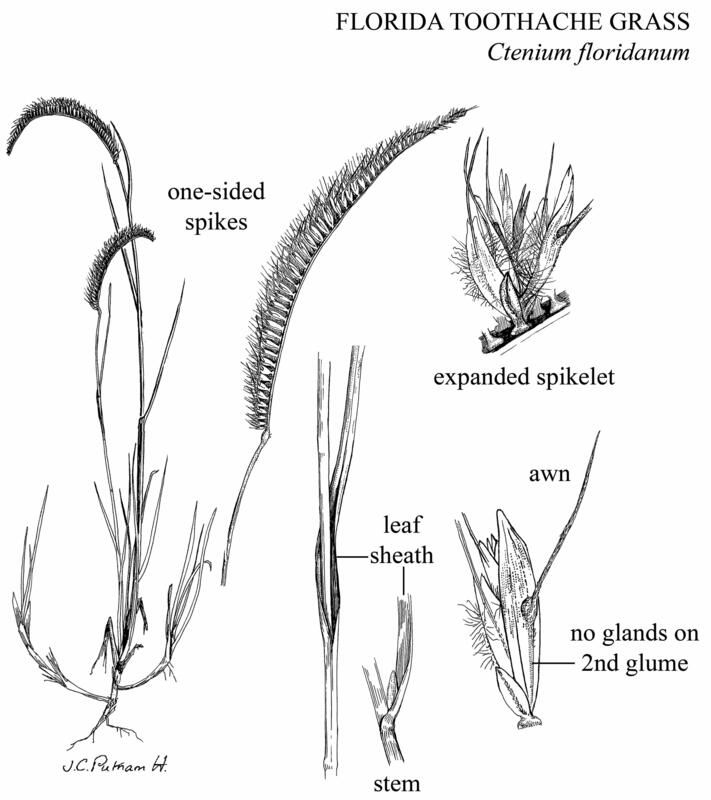
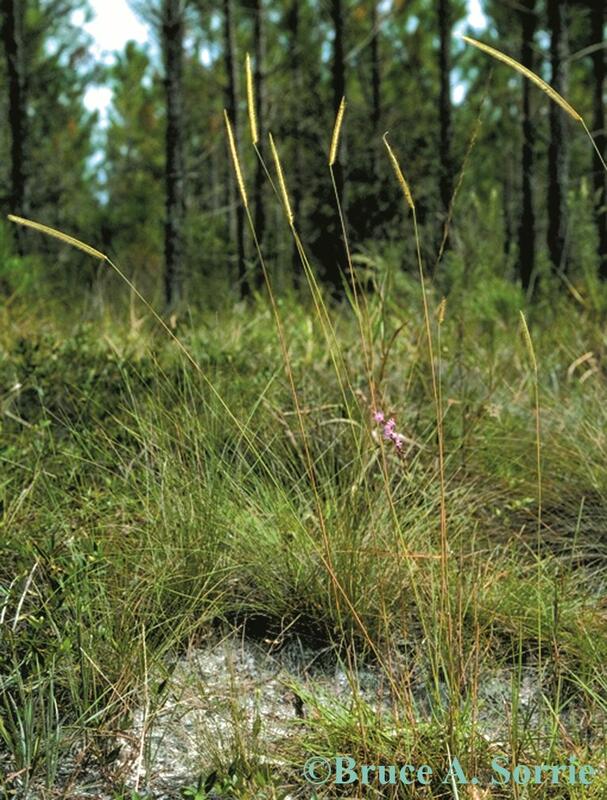
A perennial grass with flowering stems (culms) that are usually 2 - 3 feet (60 - 100 cm) tall; the stems emerge in a row from more-or-less straight underground stems (rhizomes). The basal leaves are up to 15 inches (up to 39 cm) long and 0.2 inch (0.5 cm) wide, bright green on both surfaces, with roughly hairy veins on the lower surface. Stem leaves are shorter than the basal leaves, few in number, scattered along the stem, and have strongly inrolled margins. Flower clusters are narrow spikes held singly at the top of the stem, or rarely in groups of 2 or 3; as the clusters dry out in the fall they curl and spiral; the spikelets are held only along one side of the spike. Each spikelet has 2 differently sized glumes and 2 florets. There is a sterile or staminate-only floret both below and above each fertile floret. The upper (second) glume of the spikelet (see drawing) has a slender, pointed bristle (awn) that angles slightly upward; the upper glume is usually lacking a row of glands; if a row of glands is present, it is low and inconspicuous.
Common Toothache Grass (Ctenium aromaticum) grows in dense clumps in wet savannas and flatwoods and lacks long rhizomes. Its leaves are two-toned: bright green above and pale blue-green below; the second glume of the spikelet has a conspicuous row of glands and an awn that angles strongly outward from the glume. These two species of Toothache Grass are the only grass species in Georgia with a one-sided, comb-like spike at the tip of the flowering stem.
More than thirty species of grasses are rare in Georgia.
Sandhills and other dry or moist (not wet) pinelands.
Florida Orange Grass (aka Florida Toothache Grass) reproduces vegetatively, sending up new shoots from underground stems. It also flowers, depending on the wind for cross-pollination, and produces seed, although nothing is known about seed dispersal or germination. The bristle attached to the upper glume probably aids in seed dispersal by sticking to fur and feathers.
Surveys are best conducted during flowering and fruiting (summer through early fall); however, the dried, curling spikes held at the tips of stems that rise in a row from the linear rhizome are recognizable through the fall and following winter.
Southeastern Georgia and northeastern Florida.
Fire suppression, clearcutting, plowing fire breaks and other soil disturbances, conversion of habitat to developments and pine plantations.
| Threat 1 | Threat 2 | Threat 3 | |
|---|---|---|---|
| General Threat | Natural system modifications | Residential & commercial development | Agriculture & aquaculture |
| Specific Threat | None | None | None |
Ctenium floridanum is ranked S1 by the Georgia Department of Natural Resources, indicating that the species is critically imperiled in Georgia. Eleven populations have been documented in Georgia, but only five have been confirmed since 2000 and only one occurs in a conservation area.
Burn sandhills and flatwoods every 2 - 3 years during the growing season. Avoid clearcutting, bedding, plowing fire lanes, and other soil disturbances.
Barkworth, M.E. 2007. Species account for Ctenium floridanum. Flora of North America, Vol. 25. http://beta.floranorthamerica.org/Ctenium_floridanumhttp://herbarium.usu.edu/webmanual
Chafin, L.G. 2007. Field guide to the rare plants of Georgia. State Botanical Garden of Georgia and University of Georgia Press, Athens.
Chafin, L.G. 2000. Field guide to the rare plants of Florida. Florida Natural Areas Inventory, Tallahassee.
GADNR. 2020. Element occurrence records for Ctenium floridanum. Georgia Department of Natural Resources, Wildlife Resources Division, Social Circle, Georgia.
Kral, R. 1983. A report on some rare, threatened, or endangered forest-related vascular plants of the South. Technical Publication R8-TP2. United States Forest Service, Atlanta.
NatureServe. 2019. Ctenium floridanum comprehensive report. NatureServe Explorer. Arlington, Virginia. http://explorer.natureserve.org/servlet/NatureServe?searchName=Ctenium%20floridanum
Weakley, A.S. 2015. Flora of the southern and mid-Atlantic States. University of North Carolina Herbarium, University of North Carolina, Chapel Hill. http://www.herbarium.unc.edu/flora.htm
Linda G. Chafin
L. Chafin, April 2007: original account
K. Owers, Jan. 2010: updated status and ranks, added pictures
L. Chafin, Feb 2020: updated original account.