


Loading profile. Please wait . . .
Listera smallii Wieg.
Appalachian Twayblade




Federal Protection: No US federal protection
State Protection: No Georgia state protection
Global Rank: G4
State Rank: S2
Element Locations Tracked in Biotics: Yes
SWAP 2015 Species of Greatest Conservation Need (SGCN): No
SWAP 2025 Species of Greatest Conservation Need (SGCN): Yes
2025 SGCN Priority Tier: High Conservation Concern
Element Occurrences (EOs) in Georgia: 5
Habitat Summary for element in Georgia: Moist rhododendron thickets
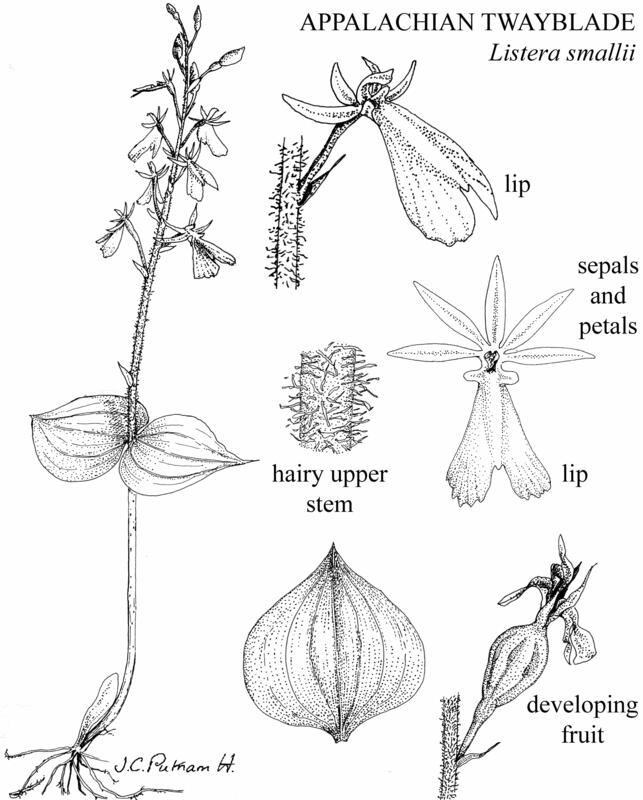
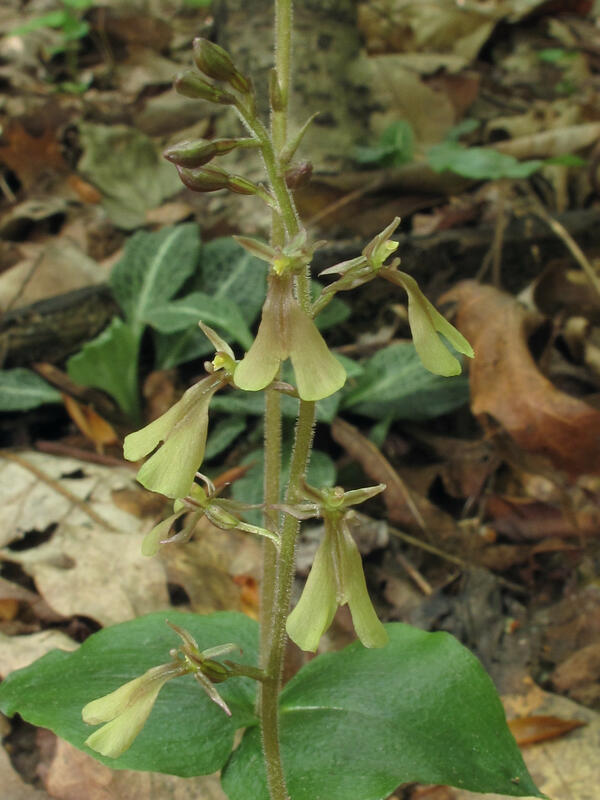
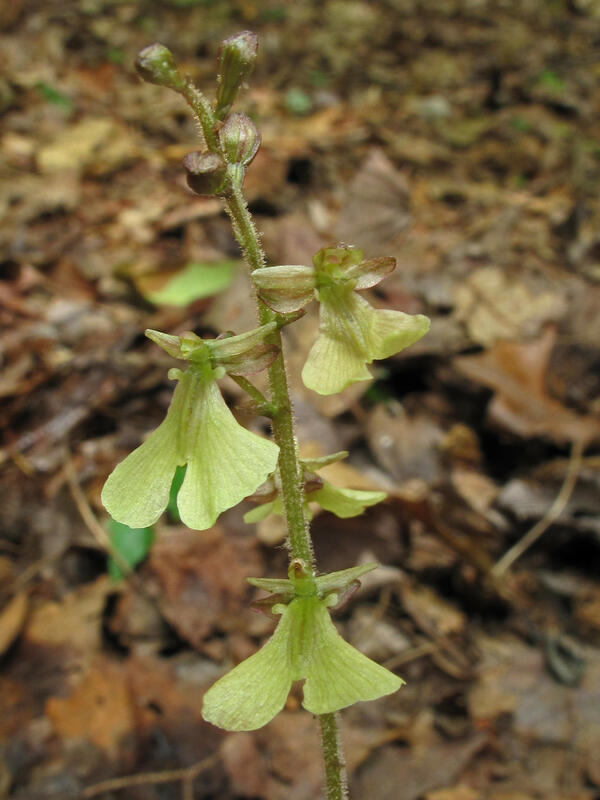
Perennial herb with a succulent stem up to 8 inches (20 cm) tall (rarely to 14 inches / 35 cm), hairless below the leaves, glandular-hairy above the leaves. Leaves are 0.8 - 1.6 inch (2 - 4 cm) long and 0.6 - 1.4 inches (1.5 - 3.5 cm) wide, broadly oval with pointed tips, dark green, in a single pair at mid-stem. Flowers are usually 5 - 15 per plant, greenish-brown, purplish, or pinkish-tan, and have 2 lateral petals and 3 similar sepals, each less than 0.2 inch (4 mm) long and 1 mm wide, pointed backwards. The much larger lip petal is about 0.4 inch (1 cm) long, with 2 toothed lobes separated by a deep notch with a small tooth at its base. Fruits are oval capsules, less than 0.2 inch (5 mm) long.
Lily-leaved Twayblade (Liparis liliifolia) flowers have a broadly rounded lip without a notch. It has 2 large, basal leaves and no stem leaves.
Southern Twayblade (Listera australis, Special Concern) occurs in 11 counties in the Piedmont and Coastal Plain in floodplains and bottomland forests with circumneutral soils, also upland such as the Monticello glades. It resembles Appalachian Twayblade except the lip petal is elongated and divided into 2 very narrow, pointed segments.
Shady Rhododendron maximum or Rhododendron catawbiense thickets with moist, acid soils near streams; also in sphagnous mountain bogs.
Appalachian Twayblade is a perennial herb that reproduces sexually; its flowers must be cross-pollinated in order to set fruit. All Listera species have two small nectaries – one on the lip and one in the interior of the flower – that attract small flying insects such as flies and gnats. When an insect visits the interior of the flower, a small drop of glue is deposited on its back; a packet of pollen is then dropped on the glue and fixed to the back of the insect. The pollen packet is then brushed off onto a subsequently visited flower. Twayblade fruits contain relatively few seeds, compared to other orchids. The seeds are minute and dust-like, and are dispersed by gravity and wind. The tiny seeds contain no stored food reserves, and must land on a patch of soil containing a specific fungus that provides nutrients for germination and subsequent plant growth.
Surveys are best conducted during flowering (June–July). Plants go dormant soon after fruiting.
Georgia, South Carolina, North Carolina, Tennessee, Virginia, West Virginia, Kentucky, Maryland, New Jersey, and Pennsylvania.
Logging and other clearing, ditching and draining of wetlands, digging by feral hogs, stream impoundment.
| Threat 1 | Threat 2 | Threat 3 | |
|---|---|---|---|
| General Threat | Biological resource use | Invasive & other problematic species, genes & diseases | Natural system modifications |
| Specific Threat | None | None | None |
Listera smallii is ranked S2 by the Georgia Department of Natural Resources, indicating that it is imperiled in Georgia. Five populations have been observed, all in the Chattahoochee National Forest, but only one has been confirmed in recent years.
Avoid logging on slopes and in wetlands; protect mountain bogs and wetlands from clearing and draining. Avoid impounding and bank-clearing of small mountain streams.
Ackerman, J.D. and M.R. Mesler. 1979. Pollination biology of Listera cordata (Orchidaceae). American Journal of Botany 66(7): 820-824. https://www.jstor.org/stable/pdf/2442469.pdf?ab_segments=0%252Fbasic_SYC-5055%252Ftest&refreqid=excelsior%3A62cab4b45623cbe249d4dc0b3f8afa3f
Brown, P.M. and S.N. Folsom. 2004. Wild orchids of the southeastern United States, north of peninsular Florida. University Press of Florida, Gainesville.
Chafin, L.G. 2007. Field guide to the rare plants of Georgia. State Botanical Garden of Georgia and University of Georgia Press, Athens.
Magrath, L.K. and R.A. Coleman. Listera smallii species account. 2003. Flora of North America, Vol. 26. Oxford University Press, New York. http://www.efloras.org/florataxon.aspx?flora_id=1&taxon_id=118722
GADNR. 2020. Element occurrence records for Listera smallii. Georgia Department of Natural Resources, Wildlife Resources Division, Social Circle, Georgia.
Godfrey, R.K. and J.W. Wooten. 1979. Aquatic and wetland plants of southeastern United States, Vol. 1, monocotyledons. University of Georgia Press, Athens.
Luer, C.A. 1975. The native orchids of the United States and Canada, excluding Florida. New York Botanical Garden, New York.
Massey, J.R., D.K.S. Otte, T.A. Atkinson, and R.D. Whetstone. 1983. Atlas and illustrated guide to the threatened and endangered vascular plants of the mountains of North Carolina and Virginia, Technical Report SE-20. Department of Agriculture, Southeastern Forest Experiment Station, Asheville, North Carolina. https://www.fs.usda.gov/treesearch/pubs/684
NatureServe. 2019. Listera smallii comprehensive report. NatureServe Explorer. Arlington, Virginia. http://explorer.natureserve.org/servlet/NatureServe?searchName=Listera+smallii
Radford, A.E., H.E. Ahles, and C.R. Bell. 1968. Manual of the vascular flora of the Carolinas. University of North Carolina Press, Chapel Hill.
Weakley, A.S. 2015. Flora of the southern and mid-Atlantic States. University of North Carolina Herbarium, University of North Carolina, Chapel Hill. http://www.herbarium.unc.edu/flora.htm
Linda G. Chafin
L. Chafin, May 2007: original account
K. Owers, Feb. 2010: added pictures
L. Chafin, Mar. 2020: updated original account