


Loading profile. Please wait . . .
Crataegus aemula Beadle
Rome Hawthorn




Federal Protection: No US federal protection
State Protection: No Georgia state protection
Global Rank: G2
State Rank: S2?
Element Locations Tracked in Biotics: Yes
SWAP 2015 Species of Greatest Conservation Need (SGCN): Yes
SWAP 2025 Species of Greatest Conservation Need (SGCN): Yes
2025 SGCN Priority Tier: Highest Conservation Concern
Element Occurrences (EOs) in Georgia: 5
Habitat Summary for element in Georgia: Upland hardwood forests; creek flats
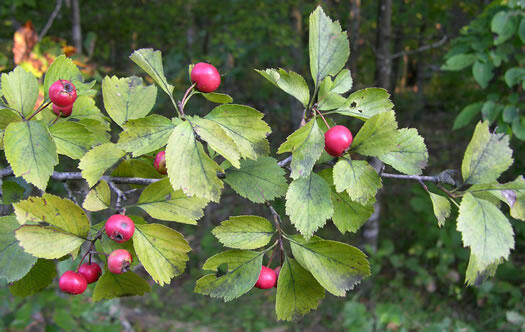
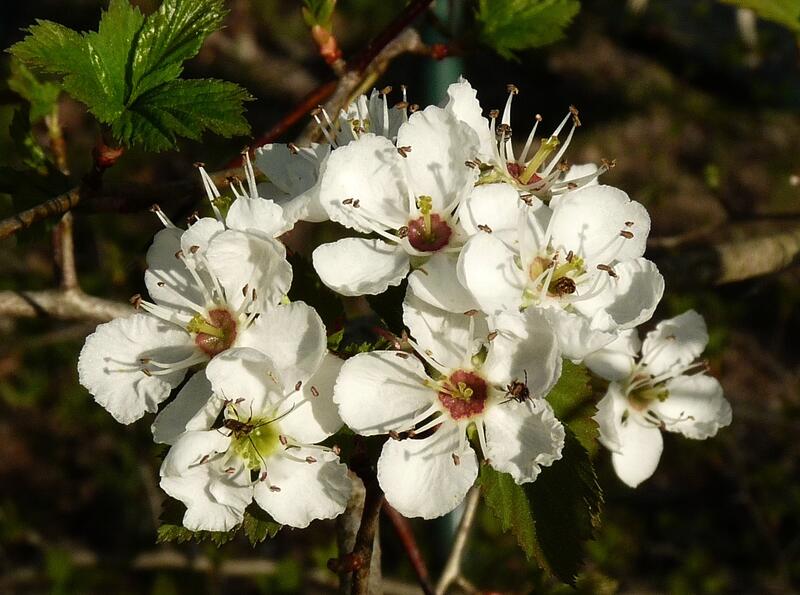
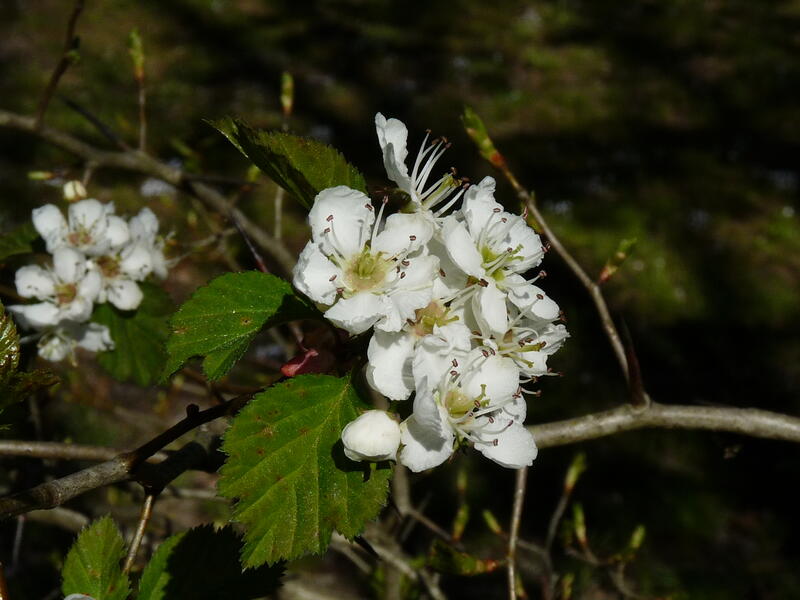
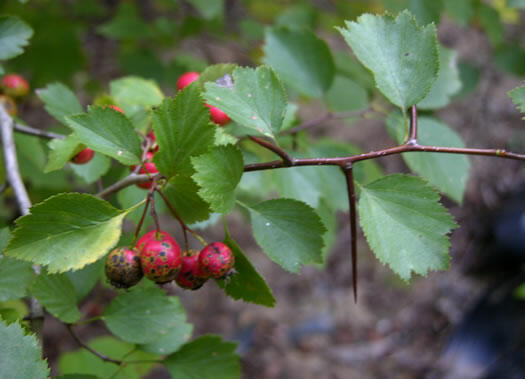
Shrub or small tree, up to 16 feet (5 m) tall with a single, slender trunk up to 2.75 inches (7 cm) in diameter and occasionally with compound thorns; the crown has a twiggy look. Bark is smooth to slightly furrowed or scaly. Twigs of the current season are reddish-green and hairy in early spring, becoming reddish-brown and smooth. Thorns on twigs are more or less straight and slender, up to 2 inches (5 cm) long, chestnut brown to gray. Leaf stalk is 0.2 - 0.6 inch (0.5 - 1.5 cm) long, hairy in the spring with tiny stalked glands. Leaf blade is 1 - 2 inches (3 - 5 cm) long and up to 0.6 inch (1.5 cm) wide, pale green or yellowish-green, and thin-textured; elliptic, oval, or nearly round in outline, with toothed margins, 2 - 4 very shallow lobes, and 4 or 5 veins per side; the base is usually rounded; the upper blade surface is sparsely hairy when young then becoming smooth, the lower surface is smooth or sparsely hairy. Flower clusters have 5 - 10 flowers. Flowers are 0.5 - 0.7 inch (1.4 - 1.8 cm) wide, with 5 white petals, 5 deeply toothed sepals, 3 - 5 styles, 10 - 15 stamens with purple anthers, and a sparsely hairy hypanthium. Fruits are apple-like pomes less than 0.5 inch (1 - 1.4 cm) across, bright red when mature (September–October), with persistent sepals. Seeds are 3-5 in number, shallowly grooved on one surface, flat on the other surface.
Crataegus species, of which there are about 35 in Georgia, are easily confused. This species is distinguished by its overall appearance (twiggy crown, slender trunk with smooth to scaly, unmottled bark); leaf stalks (mostly without glands); leaves (thin-textured, yellow-green, mostly hairless, usually with rounded bases); and red fruits that are less than 0.5 inch (1 - 1.4 cm) in diameter.
There are 8 rare species of Crataegus in Georgia:
Crataegus aemula (Rome Hawthorn) occurs in upland hardwood and pine-hardwood forests over sandstone, limestone, or circumneutral clay soils in northwest Georgia. For more information, see: https://www.georgiabiodiversity.org/portal/profile?group=plants&es_id=20903
Crataegus aprica (Sunny Hawthorn) occurs in open,sandy, rocky dry sites in lower elevation mountains and perhaps Piedmont. For more information, see: http://beta.floranorthamerica.org/Crataegus_aprica
Crataegus brachyacantha (Blueberry Hawthorn) occurs in open pinelands in southwest Georgia. For more information, see: http://beta.floranorthamerica.org/Crataegus_brachyacantha
Crataegus calpodendron (Pear Hawthorn) occurs in moist, calcareous forests in northwest Georgia, the Piedmont, and upper Coastal Plain. For more information, see: http://beta.floranorthamerica.org/Crataegus_calpodendron
Crataegus dispar (Aiken Hawthorn) occurs in dry, upland pine or pine-oak forests in well drained
clay or sandy soils in the upper Coastal Plain. For more information, see: http://beta.floranorthamerica.org/Crataegus_dispar
Crataegus mendosa (Albertville Hawthorne) occurs in rocky woods, glades, hardwood forests, mixed pine-hardwood forests, and upland wooded hills over calcareous substrates and well-drained clays in Georgia's Piedmont and Coastal Plain. For more information, see: http://beta.floranorthamerica.org/Crataegus_mendosa
Crataegus mollis (Downy Hawthorn) occurs in moist forests, alluvial forests, wooded uplands over basic or calcareous soils in Georgia's Piedmont and northwestern counties. For more information, see: http://beta.floranorthamerica.org/Crataegus_mollis
Crataegus triflora (Three-flower Hawthorn) occurs in hardwood forests on rocky, limestone slopes in northwest Georgia and in Black Belt prairies in the upper Coastal Plain. For more information, see: https://www.georgiabiodiversity.org/portal/profile?group=plants&es_id=21985
Upland hardwood and pine-hardwood forests over sandstone, limestone, or circumneutral clay soils in northwest Georgia.
Hawthorns typically reproduce sexually, attracting pollinators such as bees and beetles by their showy flowers and nectar. However, Crataegus aemula may be capable of producing fertile seeds without fertilization, i.e. seeds are produced clonally from maternal tissue. Hawthorn fruits are eaten by birds that then disperse the seeds; seed germination is improved if the seed passes through a bird’s digestive tract and if the seed has been through one cold winter. Crataegus aemula has been shown to be triploid and may have originated as a hybrid between C. iracunda and C. collina.
Lance (2014) describes this species as “…prone to misidentification, yet having a distinguishing combination of characters if flowers, foliage, and fruit are all used. This means return trips to see the plant in different seasons…foliage and semi-bushy growth habit are not particularly conspicuous during the summer,” but it is one of small number of “hawthorns that can be considered rather fine-textured [with] smallish leaves and twiggy crown…” and with “light green to yellow-green foliage color.” Crataegus aemula flowers in April and produces fruits that mature in September and October.
Crataegus aemula occurs in Floyd and Walker counties in northwest GA and in adjacent northeast Alabama; a disjunct population occurs in McCormick County, South Carolina. It is imperiled throughout its range.
The habitat where Rome Hawthorn occurs is threatened by logging and development. The three documented populations in Georgia are protected by conservation easement and ownership but other populations may occur on privately owned land.
| Threat 1 | Threat 2 | Threat 3 | |
|---|---|---|---|
| General Threat | Pollution | Climate change & severe weather | None |
| Specific Threat | None | None | None |
Crataegus aemula is ranked S2 by the Georgia Department of Natural Resources, indicating that it is imperiled in the state. There are three populations in Georgia. One occurs on a college campus, another on land protected by a conservation easement, and the third on a roadside in a state-owned wildlife management area.
Land owners and managers should be made aware of the location of these populations to protect against inadvertent impacts such as road widening or clearing. Populations should be monitored annually.
GADNR. 2019. Element occurrence records for Crataegus aemula. Georgia Department of Natural Resources, Wildlife Resources Division. Social Circle, Georgia.
Lance, R. 2014. Haws: a guide to the hawthorns of the southeastern United States. Published by the author and available from www.florramontivaga.com.
Lance, R. 2006. The hawthorns of Georgia. Tipularia 21: 15-39.
NatureServe. 2019. Species account for Crataegus aemula. NatureServe Explorer: an online encyclopedia of life, Version 7.1. NatureServe, Arlington, Virginia. Accessed 8 June 2019. https://explorer.natureserve.org/Taxon/ELEMENT_GLOBAL.2.134232/Crataegus_aemula
Phipps, J.B. 2015. Species account for Crataegus aemula. Flora of North America North of Mexico, vol. 9. http://beta.floranorthamerica.org/Crataegus_mollis
Weakley, A.S. 2015. Flora of the southern and mid-Atlantic States. University of North Carolina Herbarium, University of North Carolina, Chapel Hill.
Linda G. Chafin
Linda G. Chafin, 2 November 2019: original account