Loading profile. Please wait . . .
Anemone berlandieri Pritz.
Glade Windflower




Federal Protection: No US federal protection
State Protection: No Georgia state protection
Global Rank: G4G5
State Rank: S1S2
Element Locations Tracked in Biotics: Yes
SWAP 2015 Species of Greatest Conservation Need (SGCN): Yes
SWAP 2025 Species of Greatest Conservation Need (SGCN): Yes
2025 SGCN Priority Tier: High Conservation Concern
Element Occurrences (EOs) in Georgia: 7
Habitat Summary for element in Georgia: Granite outcrop ecotones; openings over basic rock
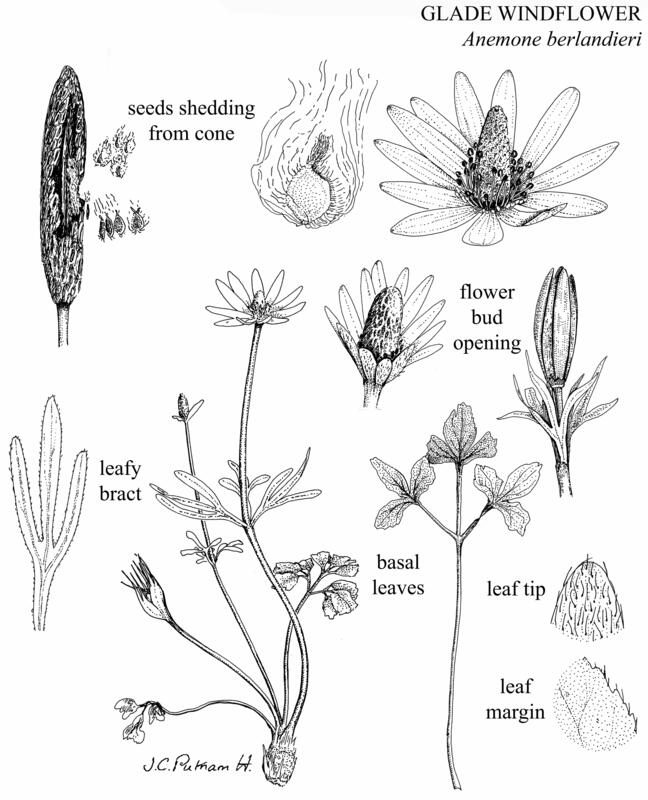
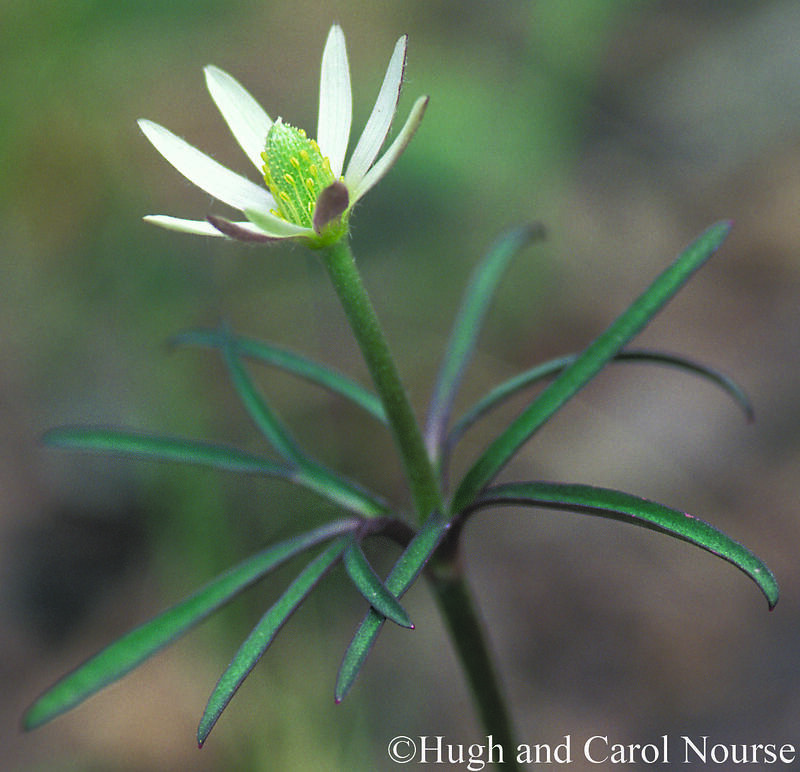
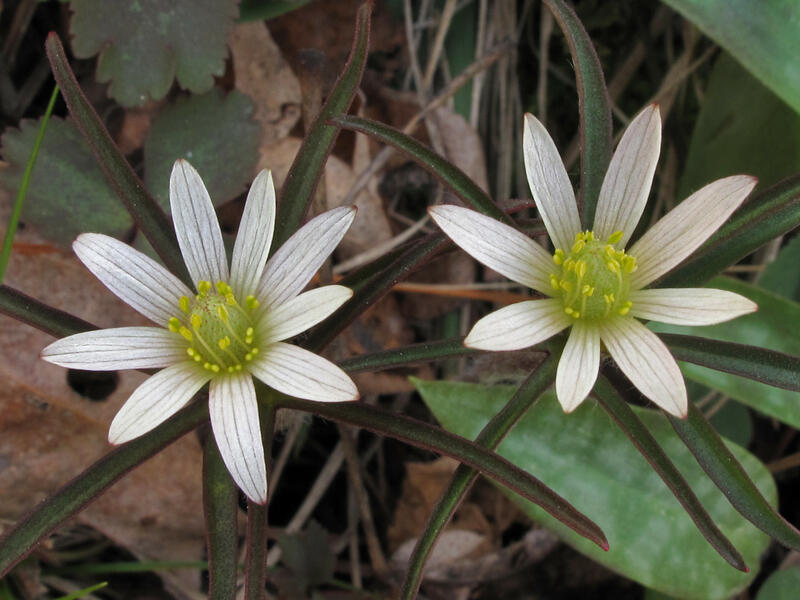
Perennial herb with a round, underground tuber. Stems are up to 20 inches (10 - 50 cm) tall, hairy both above and below the leafy bracts. Three leaf-like bracts are attached just above the middle of the stem, each bract with 3 or more narrow segments. True leaves are basal only, each with 3 leaflets, and rising from the tuber on long, hairy leaf stalks (up to 8 inches [3 - 20 cm] long); the leaf stalk is often buried in the leaf litter and appears to arise several inches from the plant; each leaflet is deeply 3-lobed and toothed. Flowers are less than 2 inches (5 cm) wide, solitary at the top of the stem, with 10 - 20 narrow, petal-like sepals (there are no petals); sepals are white or blue on the upper surface, pink or tan on the lower surface; at the center of the flower, a thimble-shaped “cone” of densely packed pistils is surrounded by 60 - 70 stamens; each pistil will develop into a tiny, seed-like fruit. Fruits are less than ⅛ inch long, oval, densely hairy.
Tall Anemone (or Thimbleweed, Anemone virginiana) usually has a branched stem and several flowers on each plant. Its leaves are conspicuously veined with sharply pointed teeth, and its flowers are greenish to white. It occurs throughout north Georgia in forests over rich, basic soils.
The rare species Carolina Anemone (Anemone caroliniana) is also similar, see below.
Carolina Anemone (Anemone caroliniana, Special Concern) has leafy bracts at or below the middle of the stem; the stem is hairy only above the bracts (sometimes slightly hairy below the bracts). Its sepals are blue, purple, or white. It occurs in sunny openings in seepage swamps over clayey Iredell soils in the Piedmont, and in wet meadows in the Coastal Plain. For more information, see: https://georgiabiodiversity.org/portal/profile?group=plants&es_id=15723
Edges of Piedmont granite outcrops, openings in upland forests in the Coastal Plain and lower Piedmont.
Glade Windflower is a perennial herb, producing basal leaves and a single stem with a solitary flower in early spring or late winter, and dying back to an underground tuber by late summer. There is little life history information published about this species, but a closely related species, Canada Windflower (Anemone canadensis), is cross-pollinated by insects which are rewarded only with pollen since the flowers do not produce nectar. The flowers of Glade Windflower are likely pollinated by beetles and bees; after pollination the receptacle elongates, lifting the fruits well above the sepals. The fruits are densely hairy, an adaptation to wind dispersal.
Surveys are best conducted during flowering (late February–early April) and fruiting (March–April). Basal leaves emerge in mid-winter and persist through fruiting time. Flowers quickly go to seed and the fruiting 'cone' breaks apart soon after.
Georgia, Florida, South Carolina, North Carolina; west to Texas and north to Kansas.
Quarrying of granite outcrops, development, trash dumping, and off-road vehicle use. Invasion by exotic pest plants such as Japanese honeysuckle (Lonicera japonica) and Chinese privet (Ligustrum sinense).
| Threat 1 | Threat 2 | Threat 3 | |
|---|---|---|---|
| General Threat | Human intrusions & disturbance | Residential & commercial development | Invasive & other problematic species, genes & diseases |
| Specific Threat | None | None | None |
Anemone berlandieri is ranked S1S2 by the GA Department of Natural Resources, indicating that it is imperiled in the state. Seven populations have been documented in 7 Georgia counties, only 4 on conservation lands.
Protect granite outcrops from quarrying, trash dumping, and off-road vehicle use. Create buffers and limit development around outcrops. Restrict foot traffic to designated trails. Eradicate exotic pest plants.
Chafin, L.G. 2007. Field guide to the rare plants of Georgia. State Botanical Garden of Georgia and University of Georgia Press, Athens.
Dutton, B.E., C.S. Keener, B.A. Ford. 1997. Anemone berlandieri species account. Flora of North America, Vol. 3, Oxford University Press, New York. http://www.efloras.org/florataxon.aspx?flora_id=1&taxon_id=233500050
GADNR. 2019. Element occurrence records for Anemone berlandieri . Georgia Department of Natural Resources, Wildlife Resources Division. Social Circle, Georgia.
Joseph, C. and M. Heimburger. 1966. Cytotaxonomic studies on new world species of Anemone (section Eriocephalus) with tuberous rootstocks. Canadian Journal of Botany 44: 899-928. https://www.nrcresearchpress.com/doi/abs/10.1139/b66-105
Keener, B. R., A.R. Diamond, L. J. Davenport, P. G. Davison, S. L. Ginzbarg, C. J. Hansen, C. S. Major, D. D. Spaulding, J. K. Triplett, and M. Woods. 2020. Anemone berlandieri species account. Alabama Plant Atlas, Alabama Herbarium Consortium and The University of West Alabama. http://floraofalabama.org/Plant.aspx?id=3022
Keener, C.S. 1975. Studies in the Ranunculaceae of the southeastern United States. I. Anemone L. Castanea 40: 36-44. https://www.jstor.org/stable/4032838?seq=1#metadata_info_tab_contents
Molano-Flores, B. and S.D. Hendrix. 1999. Effects of population size and density on the reproductive output of Anemone canadensis L. (Ranunculaceae). International Journal of Plant Sciences 160(4): 759-766. https://www.journals.uchicago.edu/doi/abs/10.1086/314161
NatureServe. 2019. Anemone berlandieri comprehensive report. NatureServe Explorer. Arlington, Virginia. http://explorer.natureserve.org/servlet/NatureServe?searchName=Anemone+berlandieri
Weakley, A.S. 2015. Flora of the southern and mid-Atlantic States. University of North Carolina Herbarium, University of North Carolina, Chapel Hill. http://www.herbarium.unc.edu/flora.htm
Linda G. Chafin
L. Chafin, Oct. 2007: original account.
K. Owers, Jan. 2010: updated status and ranks, added pictures.
L. Chafin, Jan 2020: updated account.