

Loading profile. Please wait . . .
Rhynchospora decurrens Chapman
Swamp-forest Beaksedge




Federal Protection: No US federal protection
State Protection: No Georgia state protection
Global Rank: G3G4
State Rank: S2?
Element Locations Tracked in Biotics: Yes
SWAP 2015 Species of Greatest Conservation Need (SGCN): Yes
SWAP 2025 Species of Greatest Conservation Need (SGCN): Yes
2025 SGCN Priority Tier: High Conservation Concern
Element Occurrences (EOs) in Georgia: 11
Habitat Summary for element in Georgia: Swamps
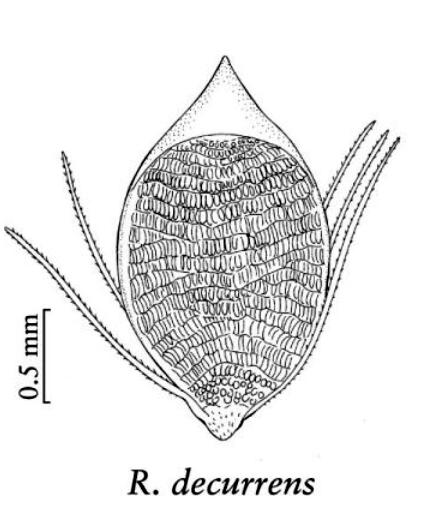
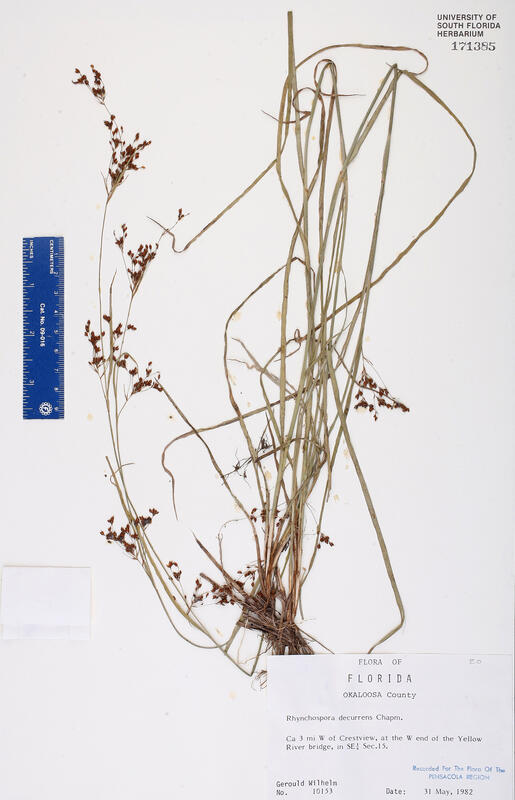
Perennial, clump-forming sedge with a leafy, more or less erect flowering stem up to 4 feet (1.2 meters) tall; the angles on the stem are rounded so that it is nearly round in cross-section. Leaf blades are shorter than the top of the flowering stem and about 1/10 inch (2-4 mm) wide, flexible, smooth, soft, lax and drooping, flat for most of their length but with 3-angled tapering tips. Flower clusters are held at the tops of the stems, consisting of 4-6 smaller, loose clusters of spikelets held at the tips of thread-like, spreading or drooping, branches; narrow, leafy bracts extend beyond the clusters. Spikelets are about 3 mm long, oval or spindle-shaped, chestnut-brown, with 3-4 flowers. Fruits are seed-like achenes, 2 or 3 per spikelet, 1.5-1.8 mm long including the triangle-shaped tubercle (the tiny cap on top of the fruit) and 0.9 mm wide; 6 minutely barbed bristles arise from the base of the fruit and do not extend beyond the tubercle (they are easily detached and six may not always be present). The body of the fruit is vivid chestnut-brown, oval in outline, two-sided, covered with a fine horizontal pattern of wrinkles and pits. The name decurrens refers to a pale, narrow, wire-like margin that flows from the base of the tubercle to the base of the fruit body. (10-20x magnification is required to see details of the achene.)
Rhynchospora decurrens closely resembles R. mixta, with which it grows in swamp forests, in its overall appearance. They are separated by technical differences in the appearance of the fruit. The fruits of R. mixta are pale chestnut in color; their 6 bristles are longer than those of R. decurrens, extending beyond the top of the tubercle. The pale, wire-like margin that characterizes the fruit of R. decurrens is not present on the fruits of R. mixta.
Fifteen species of Rhynchospora are rare in Georgia. For more information, see:
Northern White Beaksedge (Rhynchospora alba) http://beta.floranorthamerica.org/Rhynchospora_alba
Bearded Beaksedge (Rhynchospora crinipes) https://www.georgiabiodiversity.org/portal/profile?group=plants&es_id=20946
Georgia Beaksedge (Rhynchospora culixa) https://www.georgiabiodiversity.org/portal/profile?group=plants&es_id=17285
Decurrent Beaksedge (Rhynchospora decurrens) https://www.georgiabiodiversity.org/portal/profile?group=plants&es_id=21032
Fernald's Beakrush (Rhynchospora fernaldii) https://www.georgiabiodiversity.org/portal/profile?group=plants&es_id=20462
Harper's Beaksedge (Rhynchospora harperi) https://www.georgiabiodiversity.org/portal/profile?group=plants&es_id=17092
Many-bristled Beaksedge (Rhynchospora macra) https://www.georgiabiodiversity.org/portal/profile?group=plants&es_id=19539
Feather-bristle Beaksedge (Rhynchospora oligantha) http://beta.floranorthamerica.org/Rhynchospora_oligantha
Clonal Thread-leaved Beak (Rhynchospora pleiantha) https://www.georgiabiodiversity.org/portal/profile?group=plants&es_id=19634
Spotted Beaksedge (Rhynchospora punctata) https://www.georgiabiodiversity.org/portal/profile?group=plants&es_id=20475
Long-beak Beaksedge (Rhynchospora scirpoides)
Solitary Beaksedge (Rhynchospora solitaria) https://www.georgiabiodiversity.org/portal/profile?group=plants&es_id=21235
Chapman's Beakrush (Rhynchospora stenophylla) http://beta.floranorthamerica.org/Rhynchospora_stenophylla
Thorne’s Beaksedge (Rhynchospora thornei) https://www.georgiabiodiversity.org/portal/profile?group=plants&es_id=22487
Torrey's Beaksedge (Rhynchospora torreyana) http://beta.floranorthamerica.org/Rhynchospora_torreyana
Swamp forests and river marshes in the Coastal Plain, especially along blackwater rivers.
Rhynchospora decurrens is a perennial herb that reproduces sexually as well as vegetatively by forming clumps from lateral offshoots and by the spread of rhizomes. All beaksedge flowers are wind-pollinated; their fruits are dispersed by water and gravity, and also by animals, assisted by the tiny, barbed bristles at the base of the fruit which attach to fur and feathers.
Mature fruits are essential for identification of this species, and surveys should be conducted during the late summer and early fall when they are present. A 10-20x hand lens is required to see details of the achene.
Georgia, west to Louisiana and north to North Carolina. It is rare throughout its range.
Rhynchospora decurrens habitat is threatened by logging, pollution, ditching, draining, and conversion to pine plantations or agriculture. Swamp forests and marshes are invaded by exotic species such as Chinese Privet.
| Threat 1 | Threat 2 | Threat 3 | |
|---|---|---|---|
| General Threat | Biological resource use | Human intrusions & disturbance | Natural system modifications |
| Specific Threat | None | None | None |
Rhynchospora decurrens is ranked S2? by the Georgia Department of Natural Resources, indicating that it is likely imperiled in the state but that there is not enough information to make a definitive ranking. Rhynchospora decurrens has been documented in Georgia 11 times in 10 Coastal Plain counties since 1947; only one of these populations, last seen in 1976, occurred on conservation land. Only four populations have been seen since 2000.
Protect swamp forests, river marshes, and other riparian habitats from logging, ditching, draining, and conversion. Prevent pollution into rivers and streams. Monitor sites frequently for exotic plant invasion and eradicate these when found.
GADNR. 2019. Element occurrence records for Rhynchospora decurrens. Georgia Department of Natural Resources, Wildlife Resources Division. Social Circle, Georgia.
Flora of North America. 2003. Species account for Rhynchospora decurrens. Flora of North America North of Mexico, vol. 23. Accessed 24 November 2019. http://www.efloras.org/florataxon.aspx?flora_id=1&taxon_id=242101826
Godfrey, R.K., and J.W. Wooten. 1979. Aquatic and wetland plants of southeastern United States: monocotyledons. University of Georgia Press, Athens.
NatureServe. 2019. Species account for Rhynchospora decurrens. NatureServe Explorer: an online encyclopedia of life, Version 7.1. NatureServe, Arlington, Virginia. Accessed 24 November 2019. http://explorer.natureserve.org/servlet/NatureServe?searchName=Rhynchospora%20decurrens
Weakley, A.S. 2015. Flora of the southern and mid-Atlantic States. University of North Carolina Herbarium, University of North Carolina, Chapel Hill.
Linda G. Chafin
Linda G. Chafin, 24 November 2019: original account