


Loading profile. Please wait . . .
Carex roanensis F.J. Herm.
Roan Mountain Sedge




Federal Protection: No US federal protection
State Protection: No Georgia state protection
Global Rank: G3
State Rank: S1
Element Locations Tracked in Biotics: Yes
SWAP 2015 Species of Greatest Conservation Need (SGCN): No
SWAP 2025 Species of Greatest Conservation Need (SGCN): Yes
2025 SGCN Priority Tier: High Conservation Concern
Element Occurrences (EOs) in Georgia: 1
Habitat Summary for element in Georgia: Boulderfields and exposed granite ledges
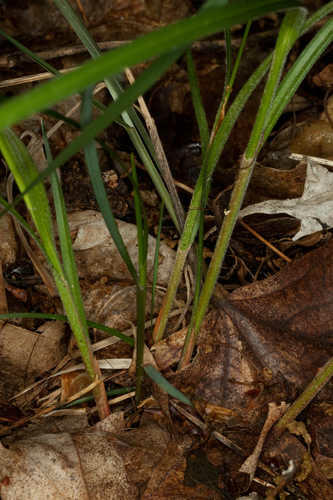
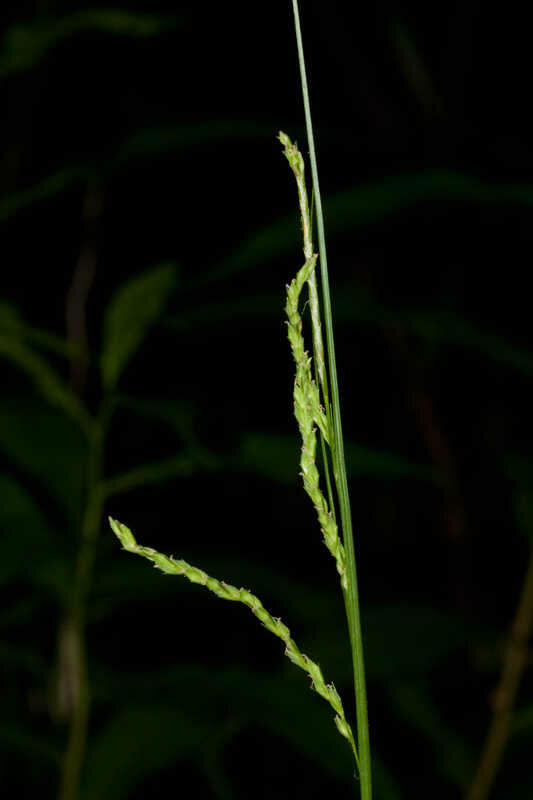
Perennial, grass-like, herb forming dense clumps of leaves and stems. Flowering stems are 16 - 35 inches (40 - 90 cm) tall, erect, hairless except on leaf sheaths, triangular in cross-section, maroon at the base. Leaf blades 5 - 18 inches (12 - 45 cm) long and less than 0.2 inch (2.7 - 4.5 mm) wide, very hairy on the lower surface, smooth to slightly hairy on the upper surface. The leaf sheath that encircles the stem is very hairy and maroon, with a ligule less than 0.27 (1.3 - 7 mm) long. The topmost flower/fruit spike is 0.8 - 2 inches (2 - 5 cm) long, solitary, held at the tip of an erect stalk, with both female and male flowers. Lower flower/fruit spikes are 2 - 3 in number, held on a nodding or arching stalk that is 0.3 - 1.7 inch (8 - 42 mm) long; below the stalk is a leafy bract consisting of a blade and sheath--the sheath is up to 0.9 inch (1 - 23 mm) long. Each spike is 0.8 - 2.4 inches (2 - 6.1 cm) long and has 2 - 7 flowers/fruits; the scales beneath each flower/fruit are translucent with a broad green midrib and a pointed tip. Each fruit is loosely enclosed in a sac (perigynium) that is about 0.1 inch (2.6 - 3.6 mm) long, densely hairy, olive-green with 5 - 8 conspicuous veins. Fruits are about 0.1 inch (2.5 mm) long, brown with dark red spots, with a definite stalk at the base. Magnification of at least 10x is needed to examine the spikes and fruits.
Many sedges look alike; Roan Mountain sedge is distinguished by the combination of reddish-purple leaf sheaths and stem bases, the leafy bract with a measurable sheath, the topmost spike with both female and male flowers, a very hairy perigynia, and brown, stalked fruit with red spots.
Ribbed Sedge (Carex virescens), found in similar habitats, can be separated from C. roanensis only with careful observation and measurements. Many of the traits are overlapping but, taken together, can be diagnostic. Ribbed Sedge also has male and female flowers in the top spike, hairy perigynia, and hairy, purplish sheaths, but its fruits are not red-spotted nor distinctly stalked, and the leafy bract below the flower stalk has no or a very short (<2 mm) sheath.
Forty-five species of Carex are rare in Georgia, see: https://georgiabiodiversity.org/portal/element_lists?group=plant
Detailed information about these rare Carex species is provided on this website:
Acid-Loving Sedge (C. acidicola): https://georgiabiodiversity.org/portal/profile?group=plants&es_id=34933
Baltzell's Sedge (C. baltzellii): https://georgiabiodiversity.org/portal/profile?group=plants&es_id=15974
Granite Dome Sedge (C. biltmoreana): https://georgiabiodiversity.org/portal/profile?group=plants&es_id=19146
Lime-fleeing Sedge (C. calcifugens): https://georgiabiodiversity.org/portal/profile?group=plants&es_id=33655
Velvet Sedge (C. dasycarpa): https://georgiabiodiversity.org/portal/profile?group=plants&es_id=15939
Cypress-knee Sedge (C. decomposita): https://georgiabiodiversity.org/portal/profile?group=plants&es_id=21206
Meager Sedge (C. exilis): https://georgiabiodiversity.org/portal/profile?group=plants&es_id=34936
Wretched Sedge (C. misera): https://georgiabiodiversity.org/portal/profile?group=plants&es_id=16740
Radford’s Sedge (C. radfordii): https://georgiabiodiversity.org/portal/profile?group=plants&es_id=15374
Roan Mountain Sedge (C. roanensis): https://georgiabiodiversity.org/portal/profile?group=plants&es_id=21034
Thorne's Sedge (C. thornei): https://georgiabiodiversity.org/portal/profile?group=plants&es_id=34939
Moist to somewhat drier forests on steep, rocky mountain slopes such as boulderfields and rocky ledges, also cove forests and northern hardwood forests. Often found with Beech, Red Maple, Sugar Maple, Tulip Poplar, Yellow Buckeye, White Ash, White Pine, Chestnut Oak, Northern Red Oak, White Oak, and Basswood. Carex roanensis is usually found in areas with a sparse herbaceous layer such as trailsides or in natural clearings.
Roan Mountain Sedge, like most sedges, is wind-pollinated. Nothing has been published about seed dispersal or other aspects of reproduction for this species.
Since mature fruits are essential for identification, surveys must be conducted when fruits are present (mid-June – early-July).
Georgia, Alabama, Tennessee, North Carolina, Virginia, Kentucky, West Virginia, and Pennsylvania.
Logging, development, trail- and road-building, and recreation activities.
| Threat 1 | Threat 2 | Threat 3 | |
|---|---|---|---|
| General Threat | Climate change & severe weather | Residential & commercial development | Agriculture & aquaculture |
| Specific Threat | None | None | None |
Carex roanensis is ranked S1 by the Georgia Department of Natural Resources, indicating that it is critically imperiled in the state. Only one population has been documented in Georgia; it occurs in the Chattahoochee National Forest. It has not been seen since the 1980s.
Protect high elevation forests from clearing, logging, and development. In recreation areas, direct foot, horse, and off-road vehicle traffic away from populations. Conduct targeted surveys to locate more populations.
Churchill, J. A. and K. Wurdack. 1986. Carex roanensis rediscovered. Castanea 51(2): 149-51. https://www.jstor.org/stable/4033362?seq=1#metadata_info_tab_contents
CPC. 2007. National Collection plant profile: Carex roanensis. Center for Plant Conservation. https://web.archive.org/web/20111026080421/http://www.centerforplantconservation.org/Collection/CPC_ViewProfile.asp?CPCNum=786
GADNR. 2019. Element occurrence record for Carex roanensis. Georgia Department of Natural Resources, Wildlife Resources Division, Social Circle, Georgia.
Hermann, F.J. 1947. A new species of Carex from Tennessee. Castanea 12(4): 113-115. https://www.jstor.org/stable/4031086?seq=1#metadata_info_tab_contents
NatureServe. 2019. Carex roanensis comprehensive report. NatureServe Explorer. Arlington, Virginia. http://explorer.natureserve.org/servlet/NatureServe?searchName=Carex%20roanensis
Smith, T.W., J.T. Donaldson, T.F. Wieboldt, G.L. Kauffman, and M.J. Waterway. 2006. The geographic and ecological distribution of the Roan Mountain Sedge. Castanea 71(1): 45-53. https://bioone.org/journals/Castanea/volume-71/issue-1/05-8.1/The-Geographic-and-Ecological-Distribution-of-the-Roan-Mountain-Sedge/10.2179/05-8.1.full
Smith, T.W., and M.J. Waterway. 2008. Evaluating the taxonomic status of the globally rare Carex roanensis and allied species using morphology and amplified fragment length polymorphisms. Systematic Botany 33: 525-535. https://www.ingentaconnect.com/content/aspt/sb/2008/00000033/00000003/art00007
Waterway, M.J. 2003. Carex roanensis species account. Flora of North America. Vol. 23, Magnoliophyta: Commelinidae (in part), Cyperaceae (part 1). Oxford University Press, New York. http://www.efloras.org/florataxon.aspx?flora_id=1&taxon_id=242357433
Weakley, A.S. 2015. Flora of the southern and mid-Atlantic States. University of North Carolina Herbarium, University of North Carolina, Chapel Hill. http://www.herbarium.unc.edu/flora.htm
Linda G. Chafin
L. Chafin, Oct. 2007: original account.
K. Owers, Jan. 2010: updated status and ranks, added picture.
Z. Abouhamdan, April 2016: updated link.
L. Chafin, Jan 2020: updated original account.