


Loading profile. Please wait . . .
Sciurus niger niger Linnaeus, 1758
Southeastern Fox Squirrel




Federal Protection: No US federal protection
State Protection: No Georgia state protection
Global Rank: G5T5
State Rank: SNR
Element Locations Tracked in Biotics: No
SWAP 2015 Species of Greatest Conservation Need (SGCN): Yes
SWAP 2025 Species of Greatest Conservation Need (SGCN): No
2025 SGCN Priority Tier:
Element Occurrences (EOs) in Georgia: 7
Habitat Summary for element in Georgia: Pine forests; pine savannas
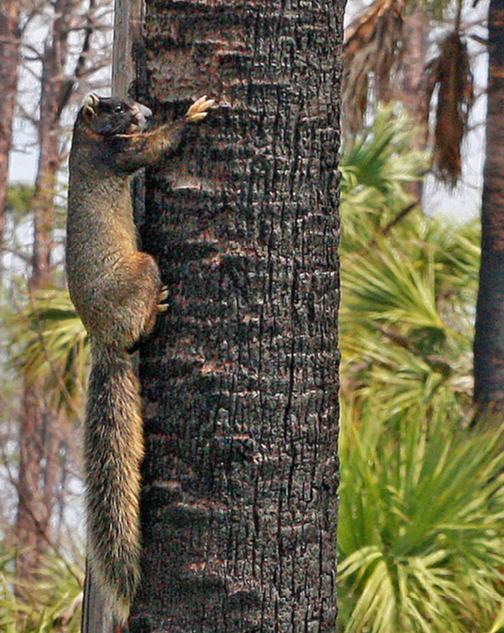
Sherman’s fox squirrel is a subspecies of the fox squirrel (Sciurus niger) and is highly variable in color from mostly black to gray to brown to silver. Most individuals have variations of silver and black fur on the back, with a tan underside. They can also exhibit a range of color morphs with black bellies, completely black melanistic, and agouti. They possess a long and bushy tail. The ears and snout are typically white on a primarily black face. Total length is 600-700 mm (23.6-27.6 in) and mass is 900-1200 g (2-2.6 lbs). Individuals can be identified due to specific variable morphological features and coloring.
The gray squirrel (Sciurus carolinensis), which is often sympatric with fox squirrels across their range, is smaller, frequently only 500 mm, and exhibits many differences in morphology and ecology. Sherman’s fox squirrel is similar in appearance to the other subspecies of fox squirrel throughout its range. One closely related species is the mangrove (or Big Cypress) fox squirrel (Sciurus niger avicinni), which occupies areas south of Sherman’s fox squirrel in Florida. The southern fox squirrel (Sciurus niger niger) occurs throughout Georgia, South Carolina, and North Carolina. The delineations between the ranges of the fox squirrel subspecies were originally determined by morphological measurements and pelage coloration. Recent range maps indicate that Sciurus niger shermani may reach up into southeastern Georgia towards Savannah, giving way to S. n. niger northward. However, recent research has revealed no genetic structure in fox squirrels in North and Central Florida, indicating that S. n. niger, S. n. bachmani (Bachman’s fox squirrel), and S. n. shermani may not be genetically distinct subspecies. It is possible these subspecies should be identified and managed as a single subspecies, although they may still deserve recognition as separate management units, based on slight morphological variation. Another recent study found no evident genetic or ecological differences between S. n. niger and S. n. shermani in Georgia, though more investigation is needed to determine the validity of all subspecies of S. niger in Georgia and Florida.
Preferred and primary habitat is mature longleaf pine savannas, turkey oak sandhills, and pine flatwoods in a fire-maintained system. This species also utilizes mixed hardwoods, mature pine, cypress domes and sloughs, and other various habitats with pines and oaks, pastures and agricultural lands, and urbanized areas, such as parks and golf courses. In forested regions, they select areas with mature pine habitats with interspersed hardwoods. The average male home range size is 105 acres and may overlap with other male home ranges. Females have smaller home ranges (41 acres) and are mutually exclusive.
The majority of the diet consists of longleaf pine seeds and turkey oak acorns, but they also consume live oak acorns, fungi, fruit, insects, nuts, staminate pine cones, and buds. They are considered a key dispersal agent of oak trees by moving and burying acorns.
Sherman’s fox squirrel nests are made in Spanish moss, pine needles, twigs, and leaves. Some nests are also within tree cavities. When using tree cavities, they utilize existing cavities either formed naturally or by other species. Turkey oak (Qurcus laevis) and longlife pine (Pinus palustis) are the predominant tree species to contain Sherman’s fox squirrel nests. This species uses multiple nests, each serving as refuge or to assist in raising young. This species typically breeds twice each year. Winter breeding occurs between October and February, and summer breeding from April to August. Juvenile squirrels are weaned at about 90 days and reach sexual maturity at 9 months. Captive fox squirrels can live up to ten years, but life span in the wild is presumed to be considerably shorter.
Southeastern fox squirrels are notoriously difficult to capture, with live-trapping success reported as <1%. Typically, capture includes prebaiting a box trap (either on the ground or elevated in a tree) with food and allowing traps to remain “open” or ready to capture during multiple consecutive days. This method can result in trap-happy or trap-shy animals, as well as potentially cause injury or stress to the captured animal. Passive methods, such as line-transect surveys, point counts, nest counts, time area counts, and nest box monitoring, have been used to avoid the problems of live-capture. However, these methods are not typically effective to survey populations. Camera trapping has been found to be significantly more effective and cost-efficient than live-trapping, point counts, or line transects per squirrel detection.
Fox squirrels are less common throughout Georgia than gray squirrels, but are distributed statewide. However, these animals are less common due to their higher habitat specificity and patchy distribution. Sherman’s fox squirrels range from central Florida through north Florida into central Georgia. They live at low densities, estimated to be about 2.5-3.7 individuals per km2.
Fox squirrels were previously hunted in Florida, but have been protected from hunting since 1995. In Georgia, both fox and gray squirrels are legally hunted species. The major threat to fox squirrels is habitat degradation and loss, often caused by land-use change and fire suppression. Approximately 97% of historical longleaf pine has been lost in the Southeast, causing drastic loss of available habitat for many species. Road mortality is a cause for concern in some areas, as fox squirrels are slightly slower in gait than gray squirrels.
This subspecies is likely rare in Georgia, due to the small range that is currently estimated. However, if combined with the Southern fox squirrel this subspecies is likely relatively stable. They are uncommon in some areas, due to insufficient habitat and degraded quality of existing habitat in areas of forestry and agriculture. However, in protected intact forests, southeastern fox squirrels (including Sherman’s and Southern fox squirrels) seem to persist successfully.
Habitat management is important to provide adequate quality habitat for Sherman’s fox squirrel. Frequent prescribed fire, such as a 2-3 year rotation, can help maintain open herbaceous understory in the longleaf pine forest and prevent encroachment of hardwoods. However, removal of hardwood trees is not beneficial due to their use of hardwood resources. Uneven-aged forests with single hardwoods or small hardwood patches allowed to persist are likely to provide quality habitat for Sherman’s fox squirrels. It may be favorable for the state of Georgia to regard the extant fox squirrels throughout the state as one subspecies, due to no evident genetic or ecological differences between S. n. niger and S. n. shermani.
Endries, M.B., B. Stys, G. Mohr, G. Kratimenos, S. Langley, K. Root, and R. Kautz. 2009. Wildlife habitat conservation needs in Florida. Fish and Wildlife Research Institute Technical Report TR-15.
Florida Natural Areas Inventory. 2001. Field guide to the rare animals of Florida.
Florida Fish and Wildlife Conservation Commision. 2011. Sherman’s Fox Squirrel Biological Status Review Report. Florida Fish and Wildlife Conservation Commission. Tallahassee, Florida.
Greene, D.U. 2015. Conservation of fox squirrels in Florida. PhD Dissertation. University of Florida. Gainesville, Florida.
Greene, D.U., R.A. McCleery, L.M. Wagner, and E.P. Garrison. 2016. A comparison of four survey methods for detecting fox squirrels in the southeastern United States. Journal of Fish and Wildlife Management 7:99-106.
Greene, D.U. and R.A. McCleery. 2017. Multi-scale responses of fox squirrels to land-use changes in Florida: Utilization mimic historic pine savannas. Forest Ecology and Management 391:42-51.
Greene D.U. and R.A. McCleery. 2017. Reevaluating fox squirrel (Sciurus niger) population declines in the southeastern United States. Journal of Mammalogy 98:502-512.
Guynn, D., J. Edwards, S. Guynn, and J. Barnes. Southern Fox Squirrel Fact Sheet. South Carolina Department of Natural Resources.
Kantola, A.T. and S.R. Humphrey. 1990. Habitat use by Sherman’s fox squirrel (Sciurus niger shermani) in Florida. Journal of Mammalogy. 71:411-419.
Pekins, M.W., L.M. Conner, and M.B. Howze. 2007. The importance of hardwood trees in the longleaf pine forest ecosystem for Sherman’s fox squirrels. Forest Ecology and Management 255:1618-1625.
Tye, C.A., D.U. Green, W.M. Giuliano, and R.A. McCleery. 2015. Using camera-trap photographs to identify fox squirrels (Sciurus niger) in the Southeastern United States. Wildlife Society Bulletin 39:645-650.
K. Engebrestsen
K. Engebretsen, December 2017
K. Torrey, November 2018
S. Krueger, Jan. 2020: proofread for final