Loading profile. Please wait . . .
Desmognathus auriculatus (Holbrook, 1838)
Southern Dusky Salamander




Federal Protection: No US federal protection
State Protection: No Georgia state protection
Global Rank: G5
State Rank: S2
Element Locations Tracked in Biotics: Yes
SWAP 2015 Species of Greatest Conservation Need (SGCN): Yes
SWAP 2025 Species of Greatest Conservation Need (SGCN): Yes
2025 SGCN Priority Tier: Moderate Conservation Concern
Element Occurrences (EOs) in Georgia: 17
Habitat Summary for element in Georgia: Mucky areas usually in or near moving water
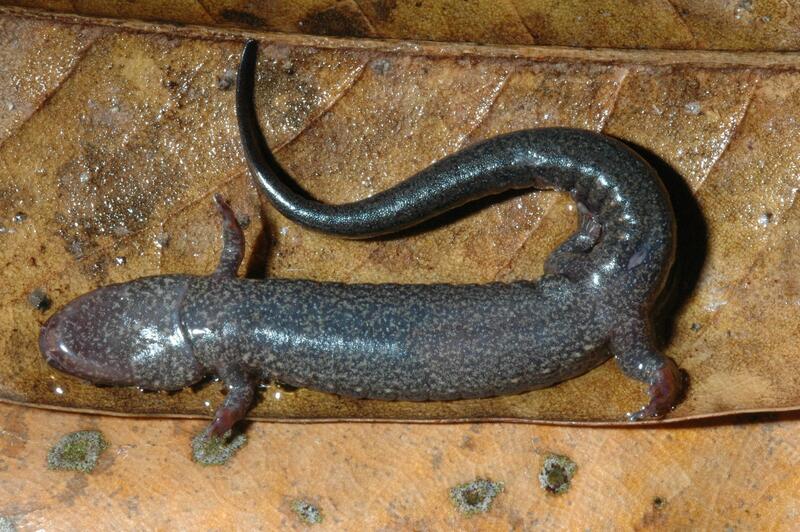
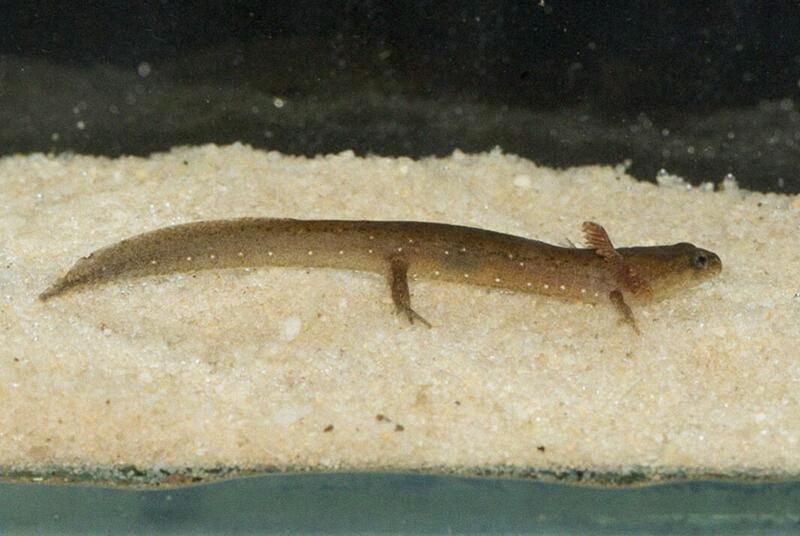
Holbrook’s southern dusky salamander (7.5-12.5 cm or 3-5 inches total length) is black to very dark olive brown over its entire body with some degree of reddish pigmentation often present. The sides are uniformly black, and the belly is dark throughout, but may also be densely peppered with small whitish, silvery flecking. Rather than a reliance on these physical traits that have typically been used by researchers in the past to differentiate the southern dusky from other dusky salamanders, such as dark coloration or the presence or absence of lateral spots resembling “portholes,” some authors advocate using the presence of a laterally compressed, distinctly dorsally keeled tail and the presence of 4-6 costal grooves (deep, vertical groove on the side of a salamander’s body indicating the position of a rib) between adpressed limbs (all other dusky species within the range have ≤ 3 costal grooves) as the most diagnostic characters for the southern dusky. The pale diagonal line from the eye to the angle of the jaw, diagnostic for all dusky salamanders (genus Desmognathus), appears as a reddish-brown oblong spot in the southern dusky. It was this conspicuous trait that was chosen in the naming of this species when first described – as this spot resembled an ear, the specific epithet, “auriculatus” roughly translates to “having the nature of a little ear.” Juveniles and larvae are coal black on their backs, sides, and belly.
The southern dusky salamander is sympatric (overlapping geographic distribution) in the upper and mid- Coastal Plain with the spotted dusky salamander (D. conanti) (6.4-12.7 cm or 2.5-5 inches), in the western Coastal Plain of Georgia with the Apalachicola dusky salamander (D. apalachicolae) (8.3-10 cm or 3.25-4 inches), and within a narrow contact zone in the eastern Georgia Coastal Plain with the Carolina swamp dusky salamander (D. valtos). However, these four species are not known to be syntopic (occupying the same microhabitats) as recent surveys have revealed a general trend of habitat partitioning between the locally abundant, ravine/seepage-dwelling dusky salamanders (D. conanti and D. apalachicolae) and blackwater swamp-dwelling D. auriculatus, and D. valtos (8.3-12.3 cm or 3.25-4.8 inches) likely inhabits specific microhabitats and has other niche preferences that separate it from the southern dusky salamander where they are known to co-occur Different habitat preferences and differences in physical traits of these dusky salamanders in theory make species identification relatively simplistic, but in reality, habitat types do not always conform to typical categories and dusky salamanders can display a bewildering array of variation in appearance. Nonetheless, typical appearance of females, juveniles, and larvae of D. conanti and D. apalachicolae include alternating or paired blotches along the back, and both species (including males) are light in color along their sides and belly. In contrast to the dark coloration of the back, sides, and belly and the distinctly keeled tail of D. auriculatus, the Apalachicola dusky salamander has a nearly immaculate belly that is finely stippled with dark specks and a tail that is round in cross-section, narrowing to the end; the spotted dusky salamander has a cream-yellowish tan belly with irregular dark brown mottling and a tail that is triangular in cross-section. The greatest difference in physical traits between D. auriculatus and D. valtos is that the latter has a proportionally longer torso and a thick, girthy, long tail (≤ 106% of the snout-to-vent length) that is typically less keeled than D. auriculatus, but still flattened at the end.
The southern dusky salamander has a broad distribution that spans multiple regions with differing geology. Wetlands comprising suitable habitat for the species originated as depression relics from either formerly submerged tidal systems (such as estuaries and salt marshes behind ancient barrier islands and dune systems), as the product of underground dissolution of karst formations, or with the development of drainage networks in areas of limited slope. Unlike D. conanti and D. apalachicolae, D. auriculatus is not found in any Coastal Plain ravine of classic gully-erosion origin as they are apparently competitively excluded from 1st and 2nd order ravine habitats by the spotted dusky and Apalachicola dusky salamanders. Instead, prime habitat for the southern dusky salamander includes areas with shallow water and organic muck on the margins of blackwater branches and creeks, cypress and gum ponds that are rain-filled, and large sloughs within coastal lowlands that are drained by sluggish streams during rainy periods. Microhabitats for metamorphosed juveniles and adults include soupy-mucky parts of the floodplain under logs, leaf packs, or other organic debris that typically collect in mucky depressions, as well as at the edge of muck in depressions fed by spring-seepage, under cover objects (such as logs) at the water’s edge in peat-bottomed gum swamps, and in mucky potholes in the bed of drying blackwater creeks.
Adult and juvenile salamanders are known to consume larval and adult insects (including aquatic beetle larvae, horse and crane fly larvae), spiders, beetles, as well as segmented worms and earth worms. No specific studies on the diet of larval southern dusky salamanders have been conducted, but they likely prey on aquatic insects and other arthropods.
Besides the separation of dusky salamander species through habitat partitioning – ravine/seepage-dwelling dusky salamanders (D. conanti and D. apalachicolae) and the blackwater swamp-dwelling D. auriculatus, differences in the evolution of courtship rituals have contributed to speciation in the geologic past and in maintaining species separation currently. Unlike documented instances in which other plethodontid salamander species hybridize (notorious in species of the genus Plethodon), research on courtship behaviors of the spotted dusky and southern dusky salamanders have shown that these two species are completely sexually isolated and that this isolation likely is mediated by pheromones. Courtship behavior of the southern dusky salamander is similar to that of other dusky salamanders in that such rituals are divided into the same general steps: orientation, persuasion of the female, and sperm transfer via a spermatophore. Besides chemical differences among species in pheromones transferred to the female from the male’s mental gland (hedonic gland beneath the chin of male plethodontid salamanders), differences in movements during courtship rituals have been documented between the southern dusky, the spotted dusky, and Apalachicola dusky salamanders – these differences also act as barriers to gene flow among and between species.
Surveys for rare herpetofauna often began with surveys of historically documented occurrences of the species, and sometimes the effort is carried no further. Researchers at the University of Georgia have developed a stepwise process specifically for future surveys of the southern dusky salamander, although this process could be applied to the biological survey of any elusive wildlife species with seemingly enigmatic population declines. It is suggested that at first, habitat suitability maps be generated based on known habitat preferences of the species and detection probabilities for the species be determined for a set of known occupied sites so that the level of confidence in detection can inform the level of survey effort necessary for a broader scale survey. Once additional sites are discovered that are occupied by the species, more intensive surveys can be conducted. Results of these intensive surveys can be used to model correlative explanations for species presence or absence, or to explain decline in populations generally.
Historically, the southern dusky salamander (as originally described in 1838) was thought to occur from extreme southeastern Virginia to the Trinity River basin in Texas. However, this range likely never extended into Virginia and recent field work has failed to locate populations from Texas or western Louisiana. Recent genetics research has determined that what was formerly considered a single species, is in fact, a complex of five different genetic clades, four of which are now recognized as full species. The historical geographic distribution currently recognized for Holbrook’s southern dusky salamander (D. auriculatus), based on recent genetic analyses, includes Coastal Plain populations from southern Alabama, northern Florida, and southern Georgia, terminating near the Ogeechee River in Georgia. Atlantic Coastal Plain populations from the Ogeechee River in Georgia to Craven County, North Carolina have been described as D. valtos (Carolina swamp dusky salamander). Populations in the lower Pascagoula, Escatawpa, and Mobile drainages are described as D. pascagoula (Pascagoula dusky salamander); populations occurring in Mississippi and extreme eastern Louisiana are now considered a different species as well: Desmognathus valentinei (Valentine’s southern dusky salamander). Historically collected specimens from the western Florida panhandle represent extirpated populations with unknown genetic identity.
Declines of imperiled species are frequently tied to anthropogenic habitat alteration. Yet, the widespread and pervasive decline of the southern dusky salamander throughout its range seems enigmatic especially considering that no significant reduction in bottomland hardwood forest cover took place (from 1974 to 2005) within watersheds across areas of the landscape harboring historical D. auriculatus populations – the period in which this species went from the most abundant and common salamander in the Coastal Plain to increasingly scarce or extirpated. Nor were measurable differences in landcover noted between sites where D. auriculatus were detected versus not detected. In fact, forested wetland remains the second largest landcover class within historical southern dusky salamander watersheds. Further, the absence or low abundance of D. auriculatus at historical sites that are in proximity to one site (on Ft. Stewart) where the species remains relatively common suggests local factors at play. However, the use and dramatic increase of mechanized forestry site preparation following World War II, as well as the tremendous proliferation of silvicultural ditching across the Coastal Plain landscape immediately prior to the passage of the Clean Water Act (1985), may account for much of the decline in this species. One notable change in disturbance of bottomland Coastal Plain wetland habitats is the distributional expansion and exponential increase in feral pigs during the same time period. Adult and juvenile southern dusky salamanders spend a significant time in the soil. Pig rooting is not only thought to make preferred microhabitats for D. auriculatus uninhabitable, but the salamanders themselves are likely being preyed upon during this process in unsustainable numbers. Such repeated habitat disturbance combined with cycles of extended droughts have likely eliminated salamanders from some historical sites and drastically reduced their numbers at others. Though feral pigs were first established in what is today the southeastern United States during the DeSoto’s Expedition (1540), a significant expansion of feral pigs did not occur until the late 20th century largely due to the intentional transport and release of pigs by people to increase hunting opportunities for sport. Why these landscape-level influences would cause declines in D. auriculatus and not in D. valtos is perplexing, yet little is currently known of the Carolina swamp dusky salamander’s natural history including the species’ microhabitat preferences. As more is learned about D. valtos, elements of this mystery may well be solved.
Further, though not yet reported from the wilds of North America, salamander chytrid fungus (Batrachochytrium salamandrivorans) [or Bsal] has caused a 90% reduction in some salamander populations in Europe. While different species and groups of salamanders show differences in susceptibility to the disease and in the severity of resulting chytridiomycosis, this emergent disease for some plethodontid salamanders has been shown to be lethal in laboratory experiments. Although D. auriculatus has not undergone such testing, it is likely resistant to Bsal, as the closely related northern dusky salamander (D. fuscus) has been shown to present resistance to the disease in a laboratory setting.
| Threat 1 | Threat 2 | Threat 3 | |
|---|---|---|---|
| General Threat | Pollution | Climate change & severe weather | Natural system modifications |
| Specific Threat | Agricultural & forestry effluents | Droughts | None |
The only public lands in Georgia in which the southern dusky salamander is thought to be currently extant are Ft. Stewart and Penholoway Swamp Wildlife Management Area. The southern dusky salamander was historically considered to be the most abundant and common salamander species in the Coastal Plain. Although D. auriculatus may never have occurred over the entirety of the geographic area that it was presumed to have occupied historically, even when accounting for changes in taxonomy, survey efforts in Georgia, Florida, and Alabama since the 1970s have definitively shown that both number of individuals at occupied sites and number of occupied sites have precipitously declined. An apparent extirpation of the species from the majority of historically occupied localities is also evident. In recognition of these negative demographic trends, of the limited number of documented occurrences recorded for the species, as well as the need for more information to inform conservation for the species in Georgia, this salamander was added to the list of High Priority Species of Georgia’s initial Wildlife Action Plan (2005). Results of subsequent surveys for the southern dusky salamander in Georgia funded through the State Wildlife Grants Program found the same apparent decline of the species in Georgia as seen in neighboring states, and even an alarming reduction in the abundance between successive surveys (i.e., 2006, 2010) and nowhere was this species observed in high densities. In 2016 the US Fish and Wildlife Service was petitioned to list this salamander species as Threatened under the US Endangered Species Act. Upon review of this petition, the US Fish and Wildlife Service determined that the petition did not contain substantial information to support listing the southern dusky salamander. As a result, no status review for this species was initiated in response to this petition. However, specific rationale for the “not substantial” finding for each of the listing factors enumerated in the petition was not provided.
Coastal Plain bottomland hardwood forests offer optimal habitat for southern dusky salamanders. Adherence to forestry best management practices (BMPs) in maintaining stream management zones (SMZs) during upland forest harvest will help maintain suitability of preferred wetland habitats for this species. This is particularly important during times of extended drought; during past periods of extended drought, forestry operations in Georgia’s Coastal Plain were conducted to harvest bottomland hardwoods in areas that typically remain too wet to harvest under normal levels of rainfall. Retention of mature hardwood forests within protected areas, particularly within the coastal flatwoods region of Georgia’s coastal counties will assure continued presence of suitable habitat in the state. Known populations of the southern dusky salamander in Georgia should be monitored periodically to confirm the species’ continued presence and to determine possible changes in abundance over time at each site. As reduction and control of feral pigs is feasible, but eradication unlikely, wildlife conservation agencies from states spanning the range of D. auriculatus (GA, FL, & AL) should coordinate conservation efforts; a number of critical sites for the salamander, encompassing adequate resiliency, representation, and redundancy of populations on the landscape should be designated and fenced to exclude feral pigs, thus eliminating periodic habitat destruction from this invasive species. Further concerted survey effort within the predicted range in Georgia is suggested to determine current species occupancy, abundance, conservation status, and needed management actions for specific populations. Reintroductions may prove necessary in formerly occupied regions where salamander populations have been extirpated.
Beamer, D. A. and T. Lamb. 2008. Dusky salamanders (Desmognathus, Plethodontidae) from the Coastal Plain: Multiple independent lineages and their bearing on molecular phylogeny of the genus. Molecular Phylogenetics and Evolution 47: 143:153.
Corn, J. L. and T. R. Jordan. 2017. Development of the national feral swine map, 1982-2016. Wildlife Society Bulletin 41(4): 758-763.
DiRenzo, G. V., A. V. Longo, C. R. Muletz-Wolz, A. P. Pessier, J. A. Goodheart, and K. R. Lips. 2021. Plethodontid salamanders show variable disease dynamics in response to Batrachochytrium salamandrivorans chytridiomycosis. Biological Invasions 23(9): 2797-2815.
Graham, S. P., E. K. Timpe, and L. Laurencio. 2010. Status and possible decline of the southern dusky salamander (Desmognathus auriculatus) in Georgia and Alabama, USA. Herpetological Conservation and Biology 5(3): 360-373.
Graham, S.P. 2006. Status and probable decline of the southern dusky salamander (Desmognathus auriculatus) in Georgia. Report to Georgia State Department of Natural Resources, Forsyth, GA. 41pp.
Lamb, J. Y. 2017. Sexual isolation between two sympatric Desmognathus in the Gulf Coastal Plain. Copiea 105(2): 261-268.
Maerz, J. C., R. K. Barrett, K. K. Cecala, and J. L. Devore. 2015. Detecting enigmatic declines of a once common salamander in the Coastal Plain of Georgia. Southeastern Naturalist 14(4): 771-784.
Maerz, J. C., K. Barrett, S. Graham, D. Stevenson, and T. Lamb. 2010. Status and decline of Desmognathus auriculatus in Georgia: causes and consequences. Technical Report to Georgia State Department of Natural Resources, Forsyth, GA. 32pp.
Means, D. B., J Y. Lamb, and J. Bernardo. 2017. A new species of dusky salamander (Amphibia: Plethodontidae: Desmognathus) from the Eastern Gulf Coastal Plain of the United States and a redescription of D. auriculatus. Zootaxa 4263(3): 467–506.
Means, D. B. 2015. Petition to List the Southern Dusky Salamander (Desmognathus auriculatus) as Threatened under the Endangered Species Act. Tallahassee, FL: Coastal Plains Institute and Land Conservancy. 40 pp.
Pyron R. A., K. A. Oconnell, J. Y. Lamb, and D. A. Beamer. 2022. A new, narrowly endemic species of swamp-dwelling dusky salamander (Plethodontidae: Desmognathus) from the Gulf Coastal Plain of Mississippi and Alabama. Zootaxa 5133(1):53-82. DOI: 10.11646/zootaxa.5133.1.3. PMID: 36101111.
Pyron R. A. and D. A. Beamer. 2022. Allocation of Salamandra auriculata Holbrook, 1838, with a new species of swamp-dwelling dusky salamander (Plethodontidae: Desmognathus) from the Atlantic Coastal Plain. Zootaxa 5188(6): 587-595. DOI: 10.11646/zootaxa.5188.6.6
US Fish and Wildlife Service. 2016. Evaluation of a Petition to List the Southern Dusky Salamander as an Endangered or Threatened Species Under the Act. p. 14070, In: Endangered and Threatened Wildlife and Plants; Partial 90-Day Findings on 29 Petitions. Federal Register 81(51): 14058-14072. https://www.regulations.gov/document/FWS-R4-ES-2016-0038-0001.
Verrell, P. A. 1997. Courtship in desmognathine salamanders: the southern dusky salamander, Desmognathus auriculatus. Journal of Herpetology 31(2): 273-277.
Thomas M. Floyd
T. Floyd, February 2023: original account