

Loading profile. Please wait . . .
Arnoglossum diversifolium (Torr. & Gray) H.E. Robins.
Variable-leaf Indian-plantain




Federal Protection: No US federal protection
State Protection: Threatened
Global Rank: G3
State Rank: S2
Element Locations Tracked in Biotics: Yes
SWAP 2015 Species of Greatest Conservation Need (SGCN): Yes
SWAP 2025 Species of Greatest Conservation Need (SGCN): Yes
2025 SGCN Priority Tier: High Conservation Concern
Element Occurrences (EOs) in Georgia: 7
Habitat Summary for element in Georgia: Calcareous swamps
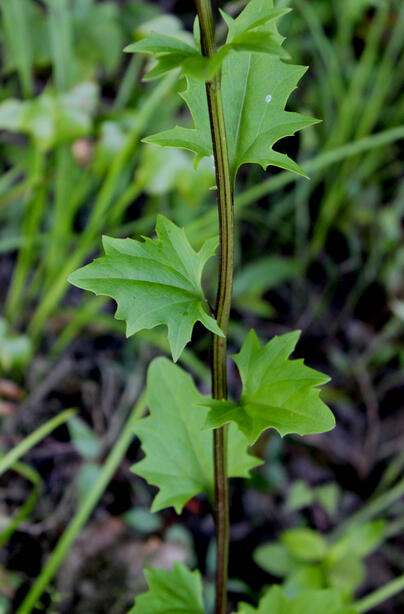
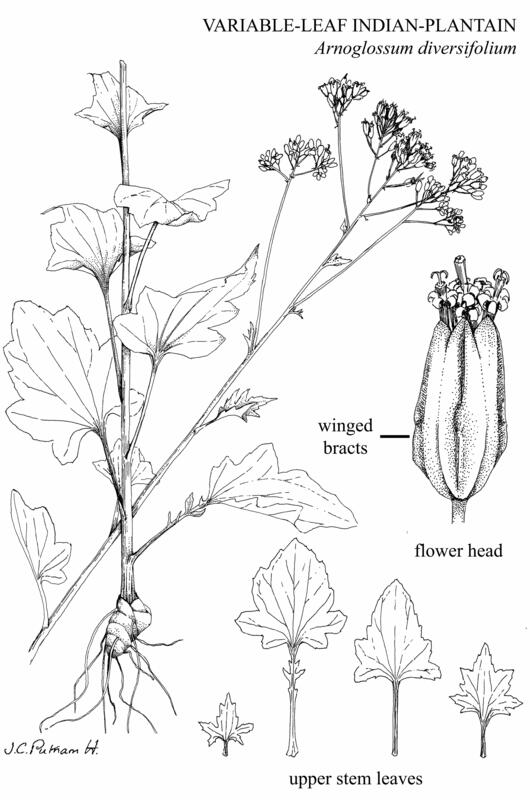
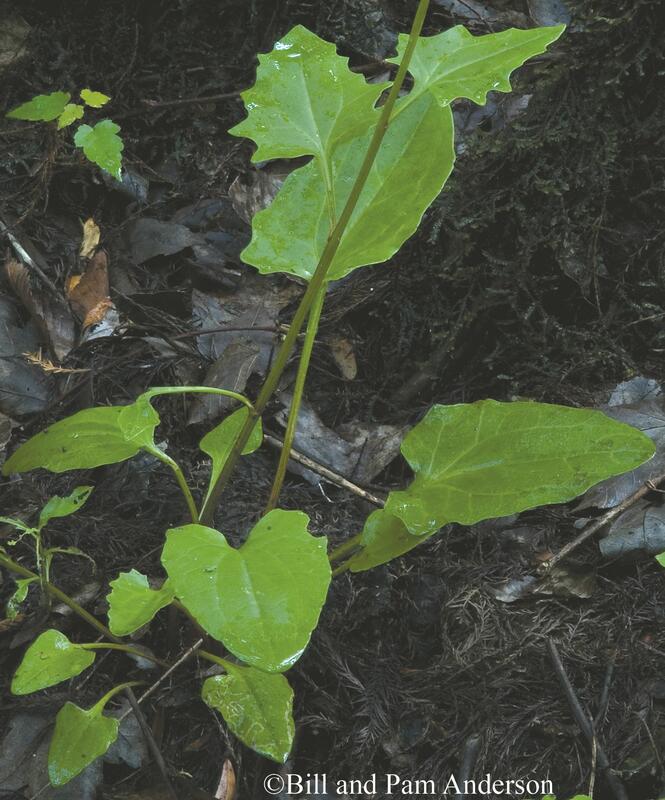
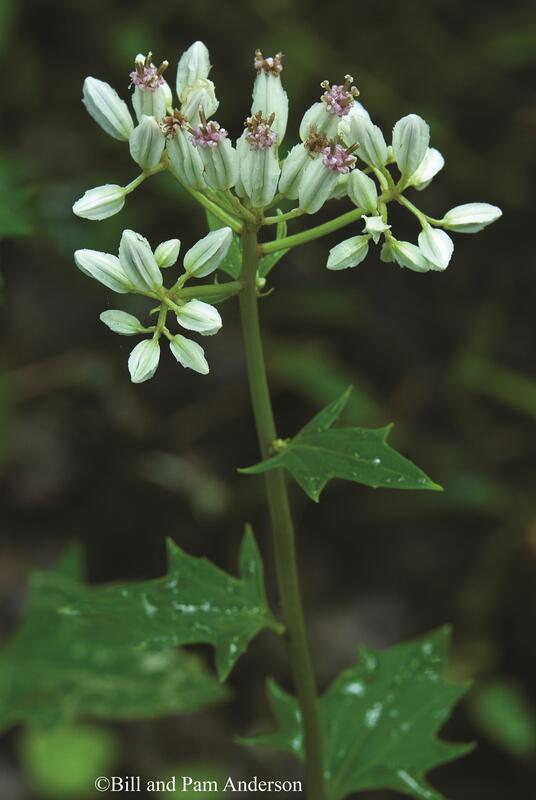
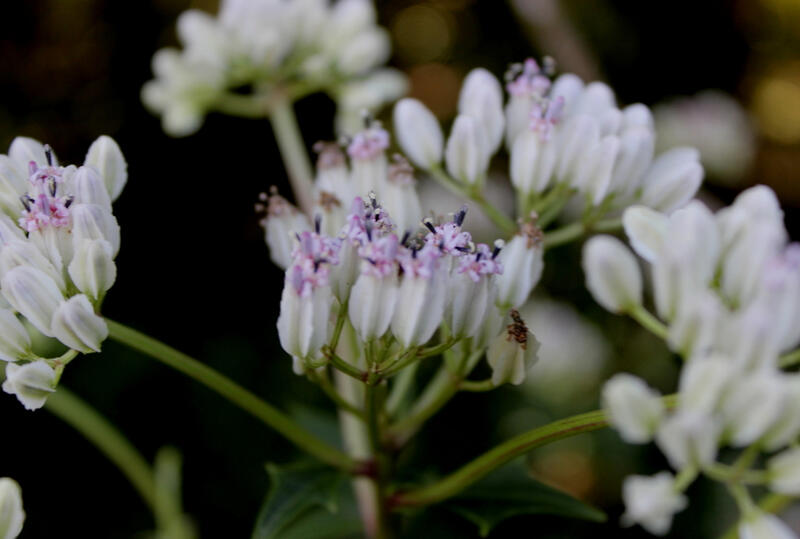
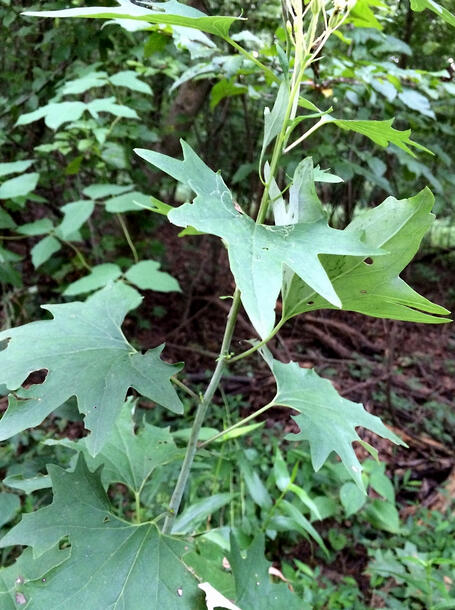
Perennial herb with slightly grooved and angled stems up to 6.5 feet (200 cm) tall, usually unbranched below the flower cluster; stems may be purplish-green or pale green but are not waxy-white. Leaves are alternate and green on both surfaces (lower leaf surfaces are not waxy-white). Lower stem leaves have blades up to 4 inches (10 cm) long, heart- or lance-shaped with rounded or squared-off bases, and shallowly lobed or coarsely toothed margins; leaf stalks of lower stem leaves are 4 - 8 inches (10 - 20 cm) long. Upper stem leaves are smaller and more deeply toothed, with short or no leaf stalks. The flower cluster is held at the top of the stem and is usually large and open with many heads. Flower heads are cylindrical, about 0.5 inch (1.25 cm) high, held at the tips of small branches; each head is surrounded by small, greenish-white, winged involucral bracts. Flowers are 5 per head, white to lavender, barely visible above the bracts.
Broadleaf Indian-plantain (Arnoglossum ovatum) leaves are waxy-whitened on the lower surfaces, its involucral bracts lack wings, and its flowers are pale yellow.
Pale Indian-plantain (Arnoglossum atriplicifolium) is an upland plant with a waxy-whitened stem, leaves whitened on the lower surfaces, and white flowers.
Grooved-stem Indian-plantain (Arnoglossum sulcatum) occurs in sphagnum bogs and wet woodlands in southwest Georgia. It has yellow flowers, and its lower leaves are oval, tapering gradually to the base and forming wings on the leaf stalk. For more information, see: https://georgiabiodiversity.org/portal/profile?group=plants&es_id=17823
Swamps, wet hardwood hammocks, openings in floodplain forests over limestone with clayey, basic soils and a canopy of hardwood trees and bald cypress.
Arnoglossum diversifolium is a perennial herb that reproduces sexually by seed and by basal offshoots that form overwintering leaf rosettes. The rosettes separate from the parent plant when the connection disintegrates; the new plant may or may not flower the next year. Little is known about pollination and seed dispersal in this species; it is likely pollinated by bees and other insects. Its seeds are probably dispersed by a combination of wind, gravity, water, and a variety of small animals. Each fruit is surrounded by a whorl of fine bristles, the pappus, which aids in wind and animal dispersal. Plants probably flower the second year following seed germination.
Plants are most conspicuous when in flower (mid-May–July) and fruit (June–September).
Georgia, Florida, and Alabama.
Ditching, draining, and filling in wetlands. Clearcutting in bottomlands and floodplains. Impounding streams to form ponds and lakes and other hydrologic alterations. Invasion by exotic pest plants such as Chinese Privet and Japanese Climbing Fern.
| Threat 1 | Threat 2 | Threat 3 | |
|---|---|---|---|
| General Threat | Climate change & severe weather | Residential & commercial development | Agriculture & aquaculture |
| Specific Threat | None | None | None |
Arnoglossum diversifolium is ranked S1 by the GA Department of Natural Resources, indicating that it is critically imperiled in the state. It is also listed by the state of Georgia as Threatened. Only seven populations are known, and only one occurs on conservation land.
Avoid logging, ditching, and draining in wetlands. Avoid hydrologic alterations, especially stream impoundment.
Allison, J.R. 1991. The status of Cacalia diversifolia and Lythrum curtissii in southwest Georgia. Georgia Department of Natural Resources, Wildlife Resources Division, Social Circle, Georgia.
Chafin, L.G. 2007. Field guide to the rare plants of Georgia. State Botanical Garden of Georgia and University of Georgia Press, Athens.
Cronquist, A. 1980. Vascular flora of the southeastern United States, Vol. 1, Asteraceae. University of North Carolina Press, Chapel Hill.
Anderson, L.C. 2006. Arnoglossum diversifolium species account. Flora of North America. Vol. 20, Oxford University Press, New York. http://www.efloras.org/florataxon.aspx?flora_id=1&taxon_id=250066134
GADNR. 2019. Element occurrence records for Arnoglossum diversifolium. Georgia Department of Natural Resources, Wildlife Resources Division, Social Circle, Georgia.
Godfrey, R.K. and J.W. Wooten. 1981. Aquatic and wetland plants of southeastern United States, Vol. 2, dicotyledons. University of Georgia Press, Athens.
Harper, R.M. 1905. Phytogeographical explorations in the coastal plain of Georgia in 1903. Bulletin of the Torrey Botanical Club 32(3): 141-171. https://www.jstor.org/stable/2478676?seq=1#metadata_info_tab_contents
Kral, R. 1983. A report on some rare, threatened, or endangered forest-related vascular plants of the South. Technical Publication R8-TP2. United States Forest Service, Atlanta.
Kral, R. and R.K. Godfrey. 1958. Synopsis of the Florida species of Cacalia (Compositae). Quarterly Journal of the Florida Academy of Sciences 21: 193-206. https://www.jstor.org/stable/24315233?seq=1#metadata_info_tab_contents
NatureServe. 2019. Arnoglossum diversifolium comprehensive report. NatureServe Explorer. Arlington, Virginia. http://explorer.natureserve.org/servlet/NatureServe?searchName=Arnoglossum%20diversifolium
Patrick, T.S., J.R. Allison, and G.A. Krakow. 1995. Protected plants of Georgia. Georgia Department of Natural Resources, Wildlife Resources Division, Social Circle.
Weakley, A.S. 2015. Flora of the southern and mid-Atlantic States. University of North Carolina Herbarium, University of North Carolina, Chapel Hill. http://www.herbarium.unc.edu/flora.htm
Linda G. Chafin
L. Chafin, Sept. 2007: original account.
K. Owers, Jan. 2010: updated status and ranks, added pictures.
L. Chafin, Jan 2020: updated original account.