


Loading profile. Please wait . . .
Egretta caerulea (Linnaeus, 1758)
Little Blue Heron




Federal Protection: No US federal protection
State Protection: No Georgia state protection
Global Rank: G5
State Rank: S3S4
Element Locations Tracked in Biotics: Yes
SWAP 2015 Species of Greatest Conservation Need (SGCN): Yes
SWAP 2025 Species of Greatest Conservation Need (SGCN): Yes
2025 SGCN Priority Tier: High Conservation Concern
Element Occurrences (EOs) in Georgia: 0
Habitat Summary for element in Georgia: Forested freshwater wetlands, including impounded wetlands, cypress swamps, freshwater ponds, and coastal saltwater wetlands
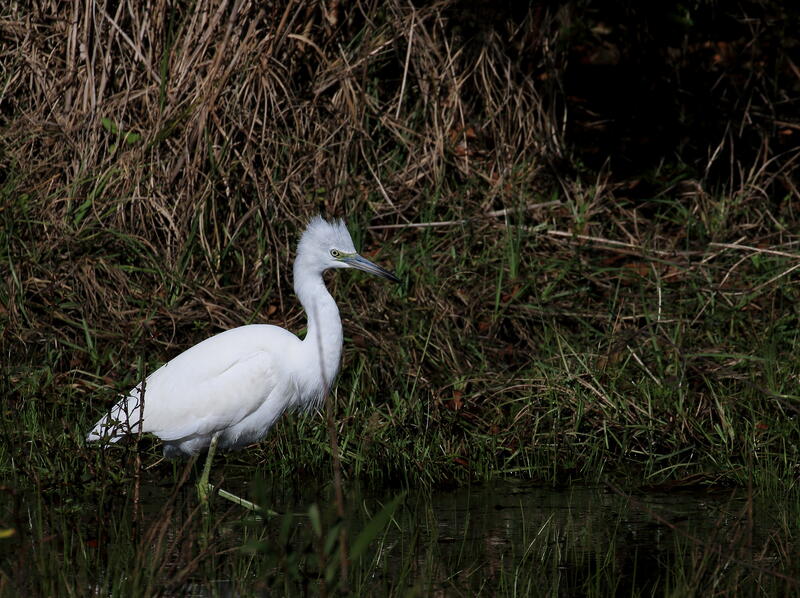
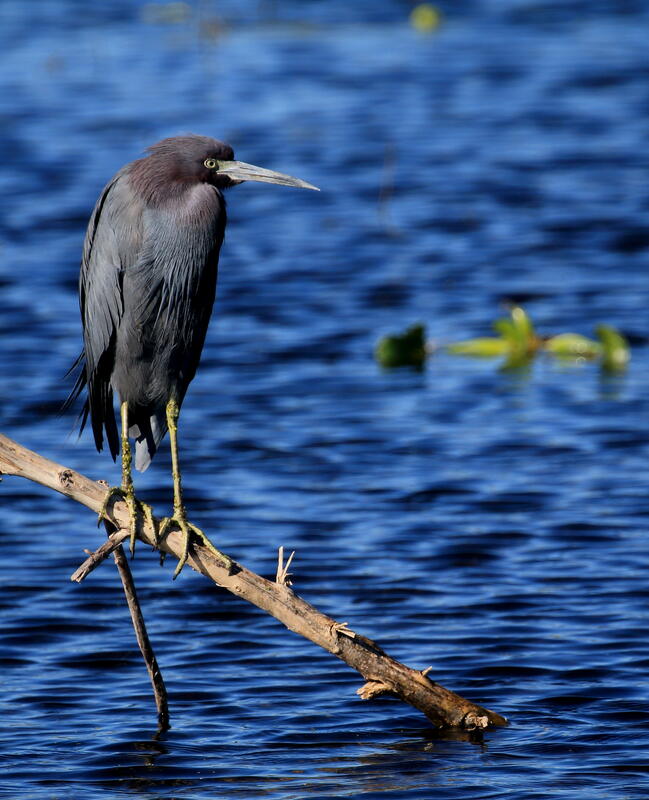
The little blue heron exhibits distinct first-year and adult plumages; immature birds are white and adults a purplish-blue. Both have a bluish bicolored bill with a black tip and pale green legs. Birds in their first spring are white with blotchy blue patches. They are 60 cm (24 in) in length with a 100 cm (40 in) wingspan and weigh about 340 g (12 oz).
Immatures closely resemble snowy egrets (Egretta thula), with which they commonly forage. They are best distinguished by leg, foot, and bill color. White morph reddish egrets (Egretta rufescens) have different bill colors and very active foraging behavior. Adult little blues are more blue than juvenile Reddish Egrets and shorter necked and more uniformly colored than tricolored herons (Egretta tricolor).
Utilizes a wide variety of freshwater and saltwater wetlands for feeding, including swamps, marshes, shallow ponds, lakeshores, and ditches. Nests above water or on small islands in wetlands. This bird is more closely associated with inland habitats than other small heron species, except the green heron.
The main prey items of the little blue heron are small fish, small amphibians, and invertebrates, particularly crustaceans, as well as many different types of insects.
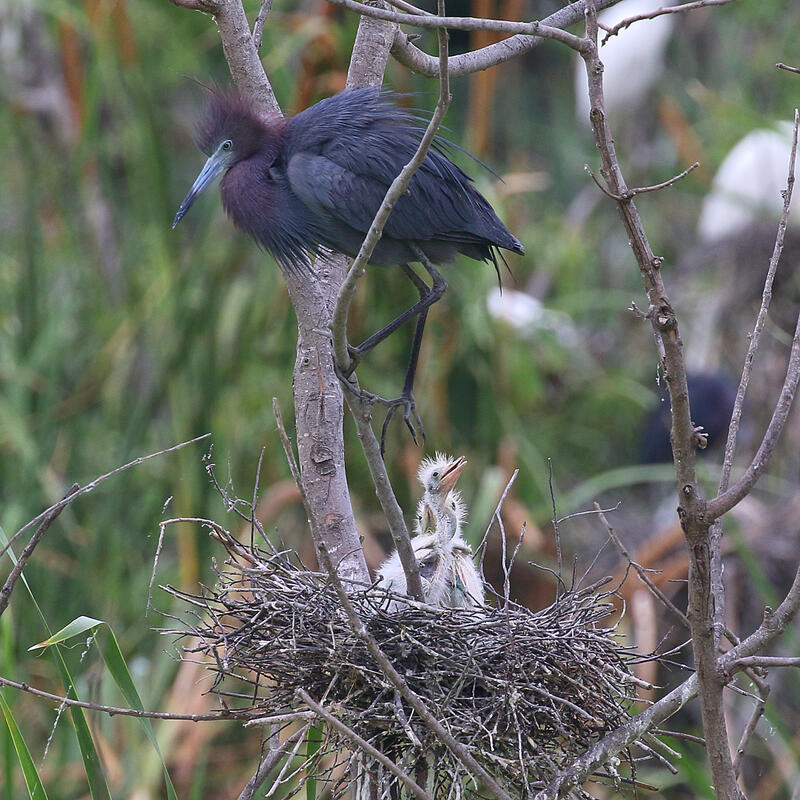
The little blue heron breeds in small single species assemblages or with other wading birds in large multi-species colonies. Nests are often built below the canopy in lower shrubs, bushes, and small trees, and occasionally in herbaceous vegetation. In Georgia, nests have been documented in slash pine, sweet gum, water oak, pond-cypress, tupelo, black gum, buttonbush, water-willow, and black needle rush on low marsh islands. The nest is located within the male’s territory and is built mostly or entirely by the female with sticks collected by the male. Both sexes engage in a ritualized "greeting" display when the sticks are passed from the male to the female. Nest diameter is 30-46 cm (1-1.5 ft). Clutch size is two to five eggs, but starvation often limits the number of fledglings that survive to less than the full clutch. Eggs are pale bluish green and hatch in 22-23 days. Chicks may climb out of the nest at 2-3 weeks and fledglings achieve independence at about 49 days. This species is more secretive and solitary than other day herons and egrets. Individuals forage alone, in small groups, or with other species, particularly the snowy egret, using a variety of freshwater and estuarine habitats where water is 5-15 cm (2-6 in) deep. Most often this species feeds by walking slowly stalking prey. However, on occasion it does hunt from the air, flying from one to a few meters above the water, hovering, and then plunging into the water feet first capturing prey in its bill, particularly metamorphosing frogs. The little blue heron will also at times use its feet to stir up or startle prey.
Given the dark adult plumage and similarity of appearance to other species as juveniles, historic population size of the little blue heron may have been underestimated. Surveying from the air can be problematic for the above reasons as well as the fact that nests are often placed below the canopy, making them difficult to see. Colony counts from the ground are needed to determine population numbers, trends, nest success, and productivity.
The little blue heron breeds along the Atlantic Coast from Maine to Maryland, throughout much of the southern Coastal Plain, and in the lower Mississippi River Valley. It is resident along the Southeast Atlantic Coast, the Gulf Coast, in the Bahamas, Cuba, Jamaica, Hispaniola, and the Pacific Coast of Mexico. Wintering birds can be found in southern Mexico, Central America, and the northern half of South America.
Primary conservation concerns for the little blue heron are similar to those of other wading birds. Habitat loss and degradation are the two greatest threats. However, since many population centers of this species occur in forested wetlands along inland rivers, it perhaps is exposed to a greater threat from habitat loss than many other wading bird species. Food availability impacts reproductive success, limiting the number of surviving young. Therefore, this species is highly susceptible to population reductions due to reduced prey availability brought about by changes in water quality, hydrology, or other alterations. Environmental contaminants, particularly mercury, PCBs, and toxaphene are possible threats as is competition for nesting sites with cattle egrets (Bubulcus ibis). Increased variability in rainfall driven by climate change, with more severe drought conditions punctuated by more extreme rainfall events, could lead to direct nest loss, reduced prey capture rates, and lower reproductive success.
Although considered common and widespread, the little blue heron qualifies as a species of Regional and Continental Concern requiring Immediate Action in the Southeastern U. S. Waterbird Conservation Plan. It was given this status due to documented declines over most of its U. S. range. Little blue heron populations declined by nearly 1.6% per year across the U. S. between 1966 and 2015 according to the North American Breeding Bird Survey. The reasons for these declines are unclear but are likely related to habitat loss. It is possible that something is happening in inland freshwater systems that disproportionately affects the little blue heron.
| Threat 1 | Threat 2 | Threat 3 | |
|---|---|---|---|
| General Threat | Residential & commercial development | Climate change & severe weather | Other options |
| Specific Threat | Housing & urban areas | Habitat shifting & alteration | Other threat |
May be viewed at many protected sites with extensive wetlands in the Coastal Plain. Harris Neck NWR and the Gilman Paper Company colony site have dozens of pairs nesting each year. Many nesting pairs are also found on an island in the Altamaha River near its mouth. A large mixed wading bird colony in Cordele is a reliable location for nesting.
Promote state legislation that protects isolated wetlands and non-flowing waters to help safeguard nesting and important feeding sites. Use GIS and remote sensing to determine locations of suitable wetlands in regions experiencing heavy development pressure. Pursue acquisition or conservation easements for the highest valued privately-owned sites. At some sites control of predators such as raccoons may be a viable option to increase site reproductive output and long-term use. Prevent human disturbance at colonies where possible.
Hopkins, M., Jr. 1970. Identified food items in the diets of nestling Little Blue Heron, Cattle Egret, and Anhinga. Oriole 35:30-32.
Hopkins, M. N., Jr., and P. G. Murton. 1969. Rookery data from south Georgia. Oriole 34:1–11.
https://www.allaboutbirds.org/guide/Little_Blue_Heron
https://www.audubon.org/field-guide/bird/little-blue-heron
https://www.birdsna.org/Species-Account/bna/species/libher
Parks, R. A. 1957. Little Blue Heron rookery in Monroe County, Georgia. Oriole 22:20-21.
Rodgers, J. A., Jr., and H. T. Smith. 1995. Little Blue Heron (Egretta caerulea). The Birds of North America, No. 145 (A. Poole and F. Gill, eds.). The Academy of Natural Sciences, Philadelphia, and The American Ornithologists' Union, Washington, D.C.
Melvin, S. L. 2010. Little Blue Heron (Egretta caerulea). Pp. 98-99 in T. M. Schneider, G. Beaton, T. S. Keyes, and N. A. Klaus, eds. The Breeding Bird Atlas of Georgia. University of Georgia Press, Athens.
Sibley, D. A. 2003. The Sibley Guide to Birds. A. A. Knopf, New York, NY
Shanholtzer, G. F., W. J. Kuenzel, and J. J. Mahoney. 1970. Twenty-one years of the McKinney’s Pond rookery. Oriole 35:23-28.
Stefani L. Melvin and Andy Day
S. Melvin, 2010: Breeding Bird Atlas species account
A. Day, November 2019: Modified and edited text