


Loading profile. Please wait . . .
Charadrius melodus Ord, 1824
Piping Plover




Federal Protection: Listed Threatened
State Protection: Threatened
Global Rank: G3
State Rank: S2
Element Locations Tracked in Biotics: Yes
SWAP 2015 Species of Greatest Conservation Need (SGCN): Yes
SWAP 2025 Species of Greatest Conservation Need (SGCN): Yes
2025 SGCN Priority Tier: High Conservation Concern
Element Occurrences (EOs) in Georgia: 13
Habitat Summary for element in Georgia: Sandy beaches; tidal flats, inlets
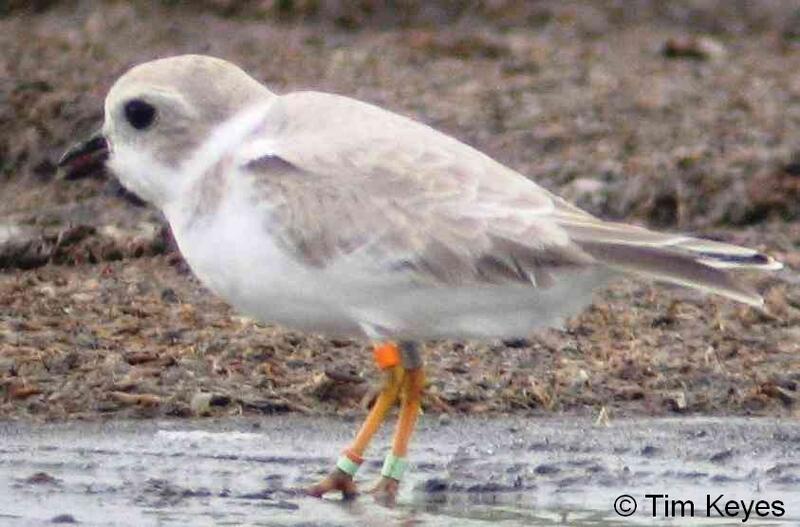
The piping plover is about 17.5 cm (7 in) in length. The crown of the head, cheek, and back is a pallid, sandy-gray color, much like the color of beach sand. White on the forehead tapers into a white line that extends over the top of the eyes to the back of the head. The throat, breast, abdomen, and vent are white. The white of the throat extends around to the back of the neck as a thin collar. During the breeding season, and often into winter, a black collar-like band occurs on the throat, and a thin black band extends over the top of the forehead from eye to eye. The bill is yellow to orange with a black tip, although sometimes completely black during winter. Legs are yellow to orange-yellow in color. A distinct white rump patch is visible during flight; other small plovers lack this distinctive field mark.
The semipalmated plover (Charadrius semipalmatus) is similar in appearance but has a darker brown plumage on the head and back, and a wide brown or black collar on the neck. The snowy plover (C. alexandrinus) is very similar to the piping plover in appearance and size, but has dark legs, a thin black bill, and is rarely seen in Georgia. Wilson's plover (Charadrius wilsonia) is slightly larger than the piping plover and its head and back are more brown in color and its bill is large and always black.
Northern Great Plains breeding habitats include sparsely vegetated sand and gravel beaches adjacent to large alkali lakes, washed-out hillside beaches near smaller semi-permanent alkali wetlands, pastures and rangeland near these areas consisting of mid- to short-grass prairie (the less vegetated and more graveled microhabitats within these grasslands), and sparsely vegetated beaches, sandflats, dredge islands, and drained river floodplains of some of the larger rivers in this region. Breeding birds nesting along the Great Lakes, larger inland lakes in the northern Great Plains, and along the Atlantic Coast prefer sparsely vegetated sandy beaches, gravel, or cobble; frequently near sand dunes. Wintering areas include beaches, mudflats, and tidal ponds that are periodically inundated by water from high tide.
Invertebrates, including marine worms, fly larvae, beetles, crustaceans and mollusks, and small fish when available.
Nest sites include open sparsely vegetated sand, gravel, or shell-covered beaches or flats and sparsely vegetated areas within some prairie habitats. The nest is a small depression scraped in the ground, lined with pebbles or small pieces of shells. Clutches usually consist of four eggs laid within 6 days. Both sexes take part in incubation, which lasts about 25-28 days. The precocial young usually leave the nest within several hours of hatching and are capable of sustained flight within 3-4 weeks. They remain with the adults for approximately one month after hatching. Piping plovers feed in intertidal areas of beaches, mudflats, sandflats, shorelines of coastal ponds, lagoons, and salt marshes. Most of their feeding activity is concentrated during daylight hours, but they have been known to feed at night. Some wintering birds arrive in Georgia as early as late June and early July, but most do not arrive until October. The earliest arrivals are usually adult females and immature birds that were born that summer. In spring most piping plovers depart the state for breeding areas by late April.
The best time to survey wintering piping plovers is from December through mid-February, though migrants arrive by August in fall and remain into April in spring. Walking beaches within two hours on either side of high tide when birds are concentrated is the best time of day to survey. Extreme weather conditions (heavy rain or strong winds) can reduce effectiveness of surveys since birds will often congregate in inaccessible marsh areas when these conditions exist.
This species breeds in the northern Great Plains of the U.S. and Canada, on the beaches of Lake Superior, Lake Michigan, and Lake Huron, and on the northeast Atlantic coast from very southern Newfoundland south to northern North Carolina. Wintering areas include the southeast Atlantic Coast from North Carolina to central Florida, the Gulf Coast from Florida to south Texas, portions of the Gulf Coast from south Texas to the Yucatan Peninsula, several Caribbean islands, and areas along the northern Gulf of California on the Pacific Coast of Mexico. Approximately a quarter of the population winters in the Bahamas. Barrier islands along the Georgia and South Carolina coasts are a major wintering area for this species and a few of Georgia's barrier islands, particularly Little Egg Island Bar and Little St. Simons Island, harbor 60% of wintering individuals from the Great Lakes breeding population. Over 200 piping plovers use the state annually.
The greatest threats to nesting piping plovers are loss of nesting habitat to beachfront development; destruction of adults, nests, and young by humans and vehicles; disturbance by humans and pets; and predation by wild, feral, and domesticated animals. Beach-front development often directly eliminates habitat, while associated activities such as construction of sea walls, jetties, and other beach stabilizing structures reduce the natural forces which maintain, renew, and create piping plover habitat. Inadvertent destruction occurs when nests or birds are stepped on or driven over. In addition, people, pets, and vehicles traveling in the vicinity of nests can lead to disturbance and subsequent abandonment by the adult plovers. Along the migratory pathway, and on the wintering grounds, loss of critical stopover and wintering sites can greatly reduce the survival rate of individuals by increasing the distance between "refueling" stops (stopover sites) and increasing competition with other piping plovers and shorebird species. These birds are also susceptible to disturbance by humans, pets, and vehicular traffic, which often cause repeated flushing, thus depleting vital fat reserves needed for successful migration. In winter, birds are vulnerable to inlet modifications, beach renourishment, and shoreline hardening. Extremely cold weather in winter can also lead to mortality, and during the winter of 2010/2011 approximately 30% of our wintering piping plovers were lost during an extreme cold period. Despite this, Georgia's remote beaches provide high quality habitat for wintering piping plovers where they average higher body weight and higher survival than more disturbed beaches.
| Threat 1 | Threat 2 | Threat 3 | |
|---|---|---|---|
| General Threat | Natural system modifications | Human intrusions & disturbance | Climate change & severe weather |
| Specific Threat | Dams & water management/use | Recreational activities | Habitat shifting & alteration |
Piping plovers do not nest in Georgia but can be found regularly during migration and wintering on Little Tybee, Williamson, Wassaw, Ossabaw, St. Catherines, Blackbeard, Sapelo, Wolf, Little St. Simons, Jekyll, and Cumberland Islands and Wolf Island Bar, Little Egg Island Bar, and St. Catherines Island Bar (Little St. Simons and Cumberland Islands have particularly large numbers). Many of our inlets in the state are classified as critical habitat for wintering piping plovers in the recovery plan for the species.
On the breeding grounds this species has been protected by excluding people, pets, and vehicles from nesting areas during the breeding season. Wire enclosures have been used to protect nests from predators where depredation is a problem. Entire public beaches have been closed in Massachusetts to protect nests and young from disturbance. It appears these efforts have helped the plover population increase. Preliminary estimates for the Atlantic Coast breeding population (in 2008) are 1848 breeding pairs. The interior breeding population is estimated at about 2000 pairs while the Great Lakes population numbers about 70 nesting pairs. Since 1996, a mid-winter survey for piping plovers and other shorebirds has been run annually in Georgia to track wintering populations. This one-day event covers all beach habitat suitable for piping plovers and other shorebirds. A total of 124 piping plovers were documented on the Georgia Coast during the first survey in 1996. Between 2006-2010 the mid-winter survey averaged 168 piping plovers per year but regularly documented around 200 individuals, an increase that may have been due to a growing population. Following a severe cold snap in 2010/2011, the winter population dropped to about 60 birds but has been slowly building to average about 120 birds per year by 2018. Identifying and protecting important migratory stopover and wintering sites as well as the birds on these sites will ensure opportunities for these birds to breed in subsequent years.
Bent, A. C., ed. 1929. Life Histories of North American Shorebirds, Part 2. U.S. National Museum Bulletin 146.
Burleigh, T. D. 1958. Georgia Birds. University of Oklahoma Press, Norman. 746pp.
Cairns, W. E. 1982. Biology and behavior of breeding piping plovers. Wilson Bulletin. 94:531-545.
Elliott-Smith, E., and S. M. Haig. 2004. Piping Plover (Charadrius melodus), The Birds of North America Online (A. Poole, ed.). Cornell Lab of Ornithology, Ithaca, NY
Gibson, D. et al. 2018. Impacts of anthropogenic disturbance on body condition , survival, and site fidelity of nonbreeding Piping Plover. The Condor, 120:3. 566-580
Gratto-Trevor, C., D. Amirault-Langlais, D. Catlin, F. Cuthbert, J. Fraser, S. Maddock, E. Roche, and F. Shaffer. 2009. Winter distribution of four different piping plover breeding populations. Report to U.S. Fish and Wildlife Service. 11 pp.
Haig, S. M., and J. H. Plissner. 1993. Distribution and abundance of piping plovers: results of the 1991 international census. Condor 95:145-156.
Haig, S. M., C. L. Ferland, D. Amirault, F. J. Cuthbert, J. Dingledine, J. P. Goosen, A. Hecht, and N. McPhillips. 2005. A complete species census and evidence for regional declines in piping plovers. Journal of Wildlife Management 69:160-173.
Hecht, A., D. Arvin, S. Melvin, J. Nicholls, C. Raithel, and K. Terwilliger. 1995. Piping plover (Charadrius melodus) Atlantic Coast population revised recovery plan. U.S. Fish and Wildlife Service, Hadley, Mass. 225pp.
Nicholls, J. L., and G. A. Baldassarre. 1990. Habitat associations of piping plovers wintering in the United States. Wilson Bulletin. 102:581-590.
Nicholls, J. L., and G. A. Baldassarre. 1990. Winter distribution of piping plovers along the Atlantic and Gulf Coasts of the United States. Wilson Bulletin. 102:400-412.
Noel, B. L., and C. R. Chandler. 2005. Report on migrating and wintering piping plover activity on Little St. Simons Island, Georgia in 2003-2004 and 2004-2005. Report to U.S. Fish and Wildlife Service, Panama City, FL. 38 pp.
Noel, B. L., and C. R. Chandler. 2008. Spatial distribution and site fidelity of nonbreeding piping plovers on the Georgia coast. Waterbirds 31:241-251.
Noel, B. L., C. R. Chandler, and B. Winn. 2007. Seasonal abundance of nonbreeding piping plovers on a Georgia barrier island. Journal of Field Ornithology 78:420-427.
Schneider, T. M. 1999. Piping Plover (Charadrius melodus). Pp. 36–37 in T. W. Johnson, J. C. Ozier, J. L. Bohannon, J. B. Jensen, and C. Skelton, eds., Protected Animals of Georgia. Georgia Department of Natural Resources, Wildlife Resources Division, Nongame Wildlife–Natural Heritage Section, Social Circle.
Stucker, J. H., F. J. Cuthbert, B. Winn, B. L. Noel, S. B. Maddock, P. R. Leary, J. Cordes, and L. C. Wemmer. 2010. Distribution of non-breeding Great Lakes piping plovers (Charadrius melodus) along the Atlantic and Gulf of Mexico coastlines: Ten years of band sightings. Waterbirds 33(1): 22-32.
Todd M. Schneider, Bradford Winn, Tim Keyes
T. Schneider, 1999: original account
T. Schneider and B. Winn, July 2010: modified and edited text
K. Owers, July 2010: updated status and ranks, added picture
G. Krakow, April 2016: updated link to BNA
Tim Keyes eidted/updated text Jan 2019