

Loading profile. Please wait . . .
Brachyelytrum aristosum (Michx.) Trel.
Northern Shorthusk




Federal Protection: No US federal protection
State Protection: No Georgia state protection
Global Rank: G5
State Rank: S1
Element Locations Tracked in Biotics: Yes
SWAP 2015 Species of Greatest Conservation Need (SGCN): No
SWAP 2025 Species of Greatest Conservation Need (SGCN): No
2025 SGCN Priority Tier:
Element Occurrences (EOs) in Georgia: 11
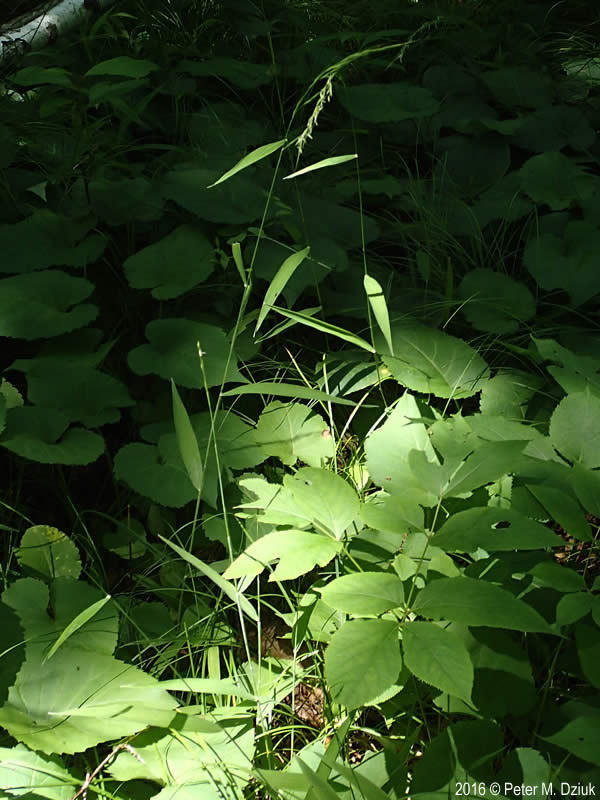
Habitat Summary for element in Georgia: Rich, north-facing cove forests; moist, north-facing cliff ledges
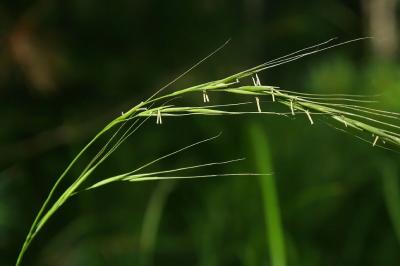
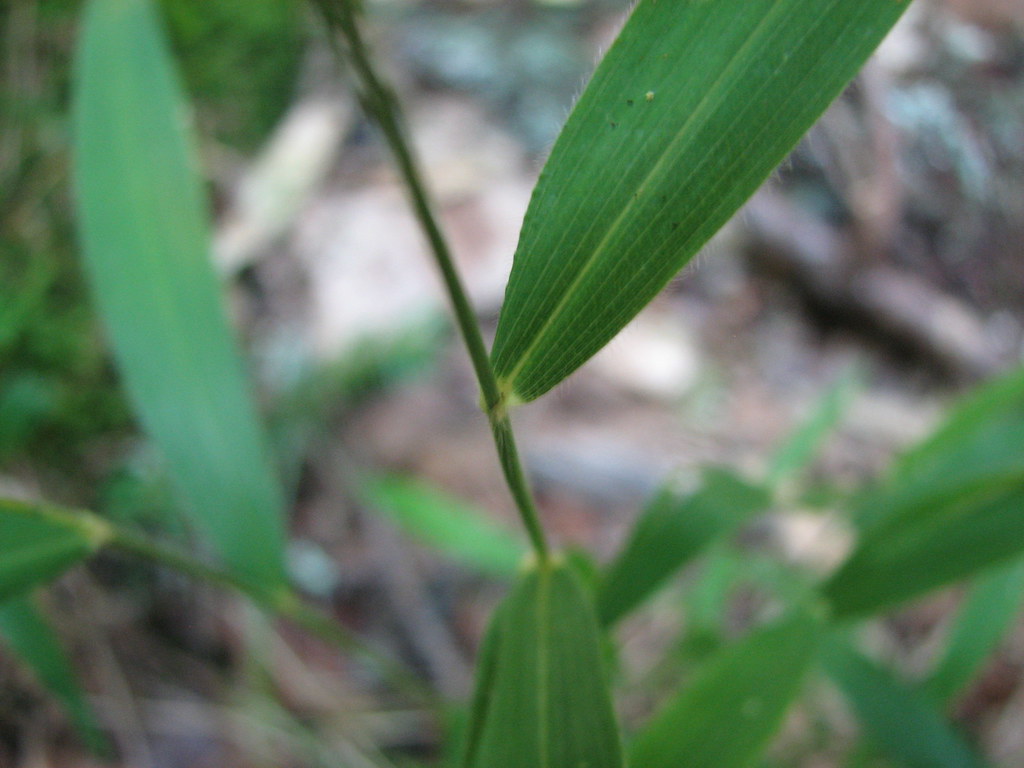
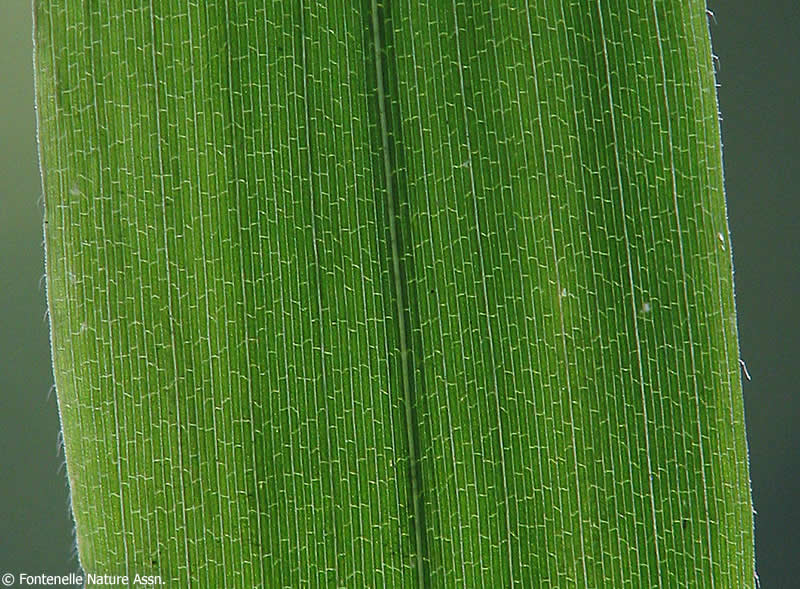
Perennial graminoid, one of two members of its genus in the United States, growing to 12-36 inches in height (91 cm), and erect to nodding. Roots rhizomatous, forming clusters of plants. Stems singular or several together from rhizomes, upright, light green to green, with hairs present at the leaf nodes. The leaves are cauline, few, and spaced along the stem, somewhat auriculate, are 3-6 inches long and are typically up to almost ½ inch wide. The leaves are green, hairy on the abaxial (lower) surface, and adaxially (upper) the hairs are restricted mainly to the veins, and they have rough margins. Venation of the leaves is a distinct key for the genus; having many cross veins between the parallel veins. Flowers are a panicle of spikelets, usually 1-3 but up to 5 per stem, and 3-7 inches long, and yellow. The blooming period occurs briefly during the summer. At the base of a spikelet is a pair of bracts (glumes), both hairy, the lower glume egg-shaped and less than 1 mm long, often obscure and sometimes absent; the upper glume lance-shaped to triangular with a blunt tip, up to 3 mm long. Florets are surrounded by a pair of bracts (lemma and palea), the lemma narrowly elliptic, the body 9 to 10 mm (~3/8 inch) long, tapering to a straight awn 14 to 26 mm (½ to 1 inch) long, 5-veined, variously covered in short, stiff hairs especially along the veins, the hairs less than .2 mm long; the palea is 7.7 to 11.5 mm long, hairless and 2-keeled, the keels forming 2 teeth at the tip. Arising from the base and running along the palea is a naked stalk (rachilla) extension, more than half as long as the palea. The spikelet fruits from the flowers are a light brown. Seeds are brown and taper to a beak. The spikelets with seeds eventually drop in the fall, leaving the stem. Leaves persist with a tan color through winter.
In Georgia, Northern Shorthusk is found in the northern portion of the state at mid to high elevations, while the other species in the genus, Common Shorthusk (Brachyelytrum erectum) is found in mesic forests in the mountains, but at lower elevations than Northern Shorthusk. Northern Shorthusk has wider leaves, shorter hairs on the sheath and shorter hairs and less prominent veins on the lemmas than Brachyletrum erectum.
None.
Northern Shorthusk is found in mesic mountain forests, at mid to high elevations.
Brachyelytrum aristosum is an herbaceous perennial graminoid. Fibrous roots produce leaves in the spring. The stem with spikes, flowers, and spikelets emerges in summer, and lasting into the fall. The spikes with spikelets and seeds within the spikelets drop in the fall.
Brachyelytrum aristosum may be identified in summer from Brachyletrum erectum by leaf venation (having many cross veins between the parallel veins) that identifies the Brachyletrum genus from other grasses, its few leaves along the stem, wider leaf blades 10-14 mm wide, hairs on the sheath (base of leaf) at the leaf nodes on the stem (0.06-) 0.08-0.14 (-0.2) mm long (not evident at 10×), and generally shorter hairs and less prominent veins on the lemmas than Brachyletrum erectum.
Throughout most of eastern North America and eastern Canada. In Georgia, Northern Shorthusk is known from the mountain counties in the northern portion of the state (See Range Map).
Conversion of habitat, habitat destruction, and trail maintenance.
Brachyelytrum aristosum is ranked S1 by the Georgia Department of Natural Resources, indicating that it is critically imperiled in Georgia. Northern Shorthusk has been observed in 11 locations in Georgia. Most of these populations occur on protected land.
Protect known populations from habitat destruction, habitat conversion, and improper trail maintenance.
Digital Atlas of the Virginia Flora, 2025. https://vaplantatlas.org/index.php?do=plant&plant=411.
Flora of North America, 2021. http://floranorthamerica.org/Brachyelytrum_aristosum.
Flora of the Southeastern United States, 2025. https://fsus.ncbg.unc.edu/show-taxon-detail.php?taxonid=1810.
GADNR. 2025. Element occurrence records for Brachyelytrum aristosum. Georgia Department of Natural Resources, Wildlife Resources Division, Wildlife Conservation Section. Social Circle, Georgia.
GoBotany, 2025. https://gobotany.nativeplanttrust.org/species/brachyelytrum/aristosum/.
MN Wildflowers, 2006-2025. https://www.minnesotawildflowers.info/grass-sedge-rush/northern-shorthusk.
NatureServe. 2025. Species account for Brachyelytrum aristosum. NatureServe Explorer: an online encyclopedia of life. NatureServe Network Biodiversity Location Data accessed through NatureServe Explorer [web application]. NatureServe, Arlington, Virginia. Available https://explorer.natureserve.org/. Accessed 2025 April 3.
Peterson et al, 1971. A Taxonomic Revision of the Eastern North American and Eastern Asian Disjunct Genus Brachyelytrutn (Poaceae): Evidence from Morphology, Phytogeography and AFLPs.
Vascular Plants of North Carolina, 2025. https://auth1.dpr.ncparks.gov/flora/species_account.php?id=3710.
Weakley, A.S. 2020. Flora of the southeast United States. University of North Carolina at Chapel Hill Herbarium, North Carolina Botanical Garden. University of North Carolina, Chapel Hill.
Nathan Thomas
22 April 2025