

Loading profile. Please wait . . .
Waldsteinia lobata (Baldw.) Torr. & Gray
Lobed Barren-strawberry




Federal Protection: No US federal protection
State Protection: Rare
Global Rank: G3
State Rank: S2
Element Locations Tracked in Biotics: Yes
SWAP 2015 Species of Greatest Conservation Need (SGCN): Yes
SWAP 2025 Species of Greatest Conservation Need (SGCN): Yes
2025 SGCN Priority Tier: High Conservation Concern
Element Occurrences (EOs) in Georgia: 42
Habitat Summary for element in Georgia: Stream terraces and adjacent gneiss outcrops
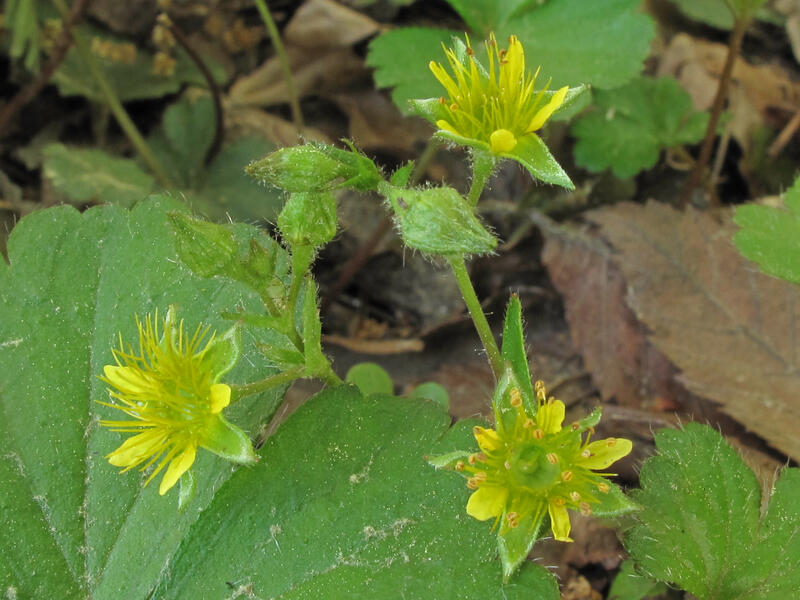
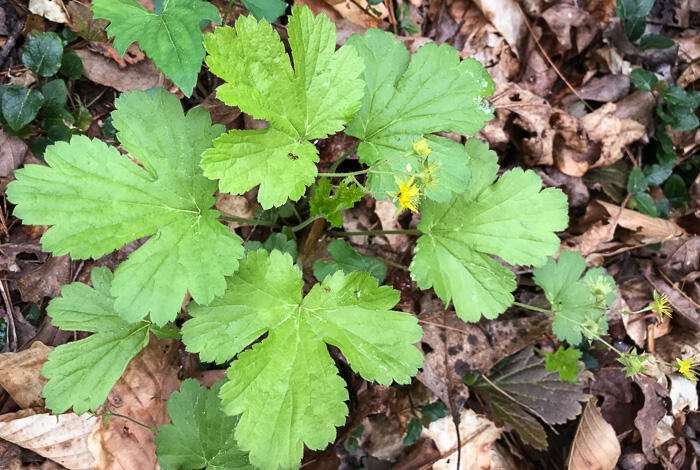
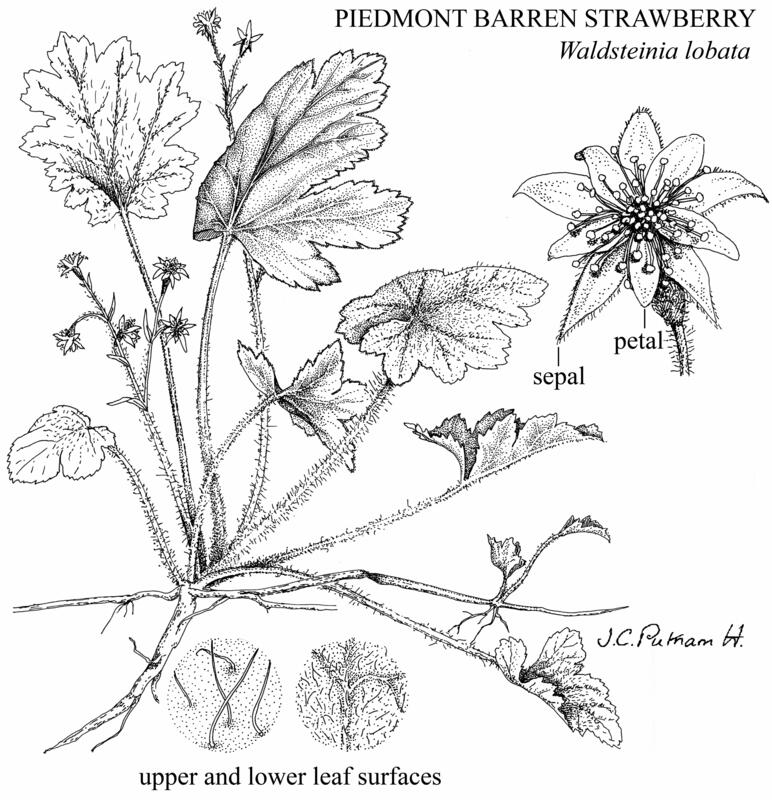
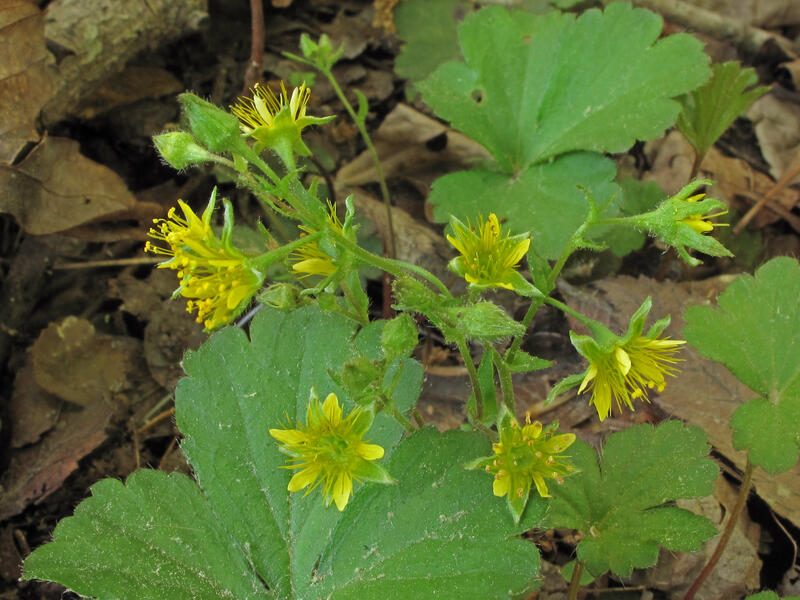
Waldsteinia lobata, synonym Geum lobatum, is a perennial herb spreading by underground stems and runners and forming small patches of plants; there are no aboveground stems. Leaves are in basal rosettes, the leaf blades 1.2 - 3 inches (3 - 8 cm) long, hairy on both surfaces, and divided into 3 - 5 rounded lobes but not cut completely to the base of the leaf; the leaf margins are coarsely and unevenly toothed. Leaf stalks are 2.8 - 4.7 inches (7 - 12 cm) long and hairy. Flower clusters are branched, and held on erect, hairy stalks. The flowers are about 0.4 inch (0.8 - 1 cm) wide, with 5 yellow petals, 5 green spreading sepals that alternate with and are often longer than the petals, and many showy, yellow stamens. Fruits are 4 - 6 per cluster, dry and seed-like (not at all strawberry-like).
Barren Strawberry (Waldsteinia fragarioides, synonym Geum donianum) leaves are divided into 3 separate, more-or-less wedge-shaped leaflets that are hairy primarily on the veins with only a few, scattered hairs between the veins. Basal leaves of some Avens (Geum spp.) species are lobed similarly to Waldsteinia lobata, but these plants also have leafy, aboveground stems.
Three-toothed Cinquefoil (Sibbaldiopsis tridentata) occurs on high-elevation rock outcrops and mountaintop balds. For more information, see: https://www.georgiabiodiversity.org/portal/profile?group=plants&es_id=16892.
Stream terraces and lower slopes with Oak-Hickory-Pine forest, often with Mountain Laurel.
Piedmont Barren Strawberry is a perennial, evergreen herb that reproduces sexually by seed as well as vegetatively by producing rosettes at the tips of spreading rhizomes which may spread up to 3 feet. Its flowers are probably pollinated by bees and flies but nothing has been published about pollination, breeding system, or seed dispersal for this species.
Surveys are best conducted during flowering (March–May) and fruiting (June–July). Leaves are evergreen, turning reddish in the winter, and are fairly distinctive all year.
Georgia, Alabama, South Carolina, and North Carolina.
Logging and clearing on slopes and in floodplains. Conversion of habitat to pine plantations and developments. Competition from exotic pest plants such as Japanese Honeysuckle.
| Threat 1 | Threat 2 | Threat 3 | |
|---|---|---|---|
| General Threat | Residential & commercial development | Climate change & severe weather | None |
| Specific Threat | None | None | None |
Waldsteinia lobata is ranked S2 by the Georgia Department of Natural Resources, indicating that the species is imperiled in Georgia. It is listed as Rare by the State of Georgia. More than 40 populations have been documented in Georgia, only 10 on conservation lands.
Avoid clearing and logging on slopes and along streams. Eradicate exotic pest plants such as Japanese Honeysuckle and Chinese Privet.
Chafin, L.G. 2007. Field guide to the rare plants of Georgia. State Botanical Garden of Georgia and University of Georgia Press, Athens.
GADNR. 2020. Element occurrence records for Waldsteinia lobata. Georgia Department of Natural Resources, Wildlife Resources Division, Social Circle, Georgia.
Hilty, J. 2020. Barren Strawberry, Waldsteinia fragarioides, Illinois Wildflowers. https://www.illinoiswildflowers.info/woodland/plants/bar_strawberry.html
Kral, R. 1983. A report on some rare, threatened, or endangered forest-related vascular plants of the South. Technical Publication R8-TP2. United States Forest Service, Atlanta.
NatureServe. 2020. Waldsteinia lobata species account. NatureServe Explorer. NatureServe, Arlington, Virginia. https://explorer.natureserve.org/Taxon/ELEMENT_GLOBAL.2.157978/Waldsteinia_lobata
Patrick, T.S., J.R. Allison, and G.A. Krakow. 1995. Protected plants of Georgia. Georgia Department of Natural Resources, Natural Heritage Program, Social Circle.
Phipps, J.B. 2015. Waldsteinia lobata species account. Flora of North America, vol. 9. http://beta.floranorthamerica.org/Waldsteinia_lobata
Weakley, A.S. 2015. Flora of the southern and mid-Atlantic States. University of North Carolina Herbarium, University of North Carolina, Chapel Hill. http://www.herbarium.unc.edu/flora.htm
Weakley, A.S. and K.N. Gandhi. 2008. Recognition of three taxa of eastern North American "Waldsteinia" and their appropriate names when incorporated into Geum (Colurieae: Rosaceae). Journal of the Botanical Research Institute of Texas 2(1): 415-418.
Linda G. Chafin
L.Chafin, Feb. 2009: original account.
D.Weiler, Jan. 2010: added pictures.
L. Chafin, June 2020: updated original account.