


Loading profile. Please wait . . .
Botaurus exilis (Gmelin, 1789)
Least Bittern




Federal Protection: No US federal protection
State Protection: No Georgia state protection
Global Rank: G4
State Rank: S3
Element Locations Tracked in Biotics: No
SWAP 2015 Species of Greatest Conservation Need (SGCN): Yes
SWAP 2025 Species of Greatest Conservation Need (SGCN): Yes
2025 SGCN Priority Tier: Moderate Conservation Concern
Element Occurrences (EOs) in Georgia: 5
Habitat Summary for element in Georgia: Fresh and brackish water wetlands with emergent herbaceous cover including impoundments, natural freshwater marshes, and tidally influenced marshes
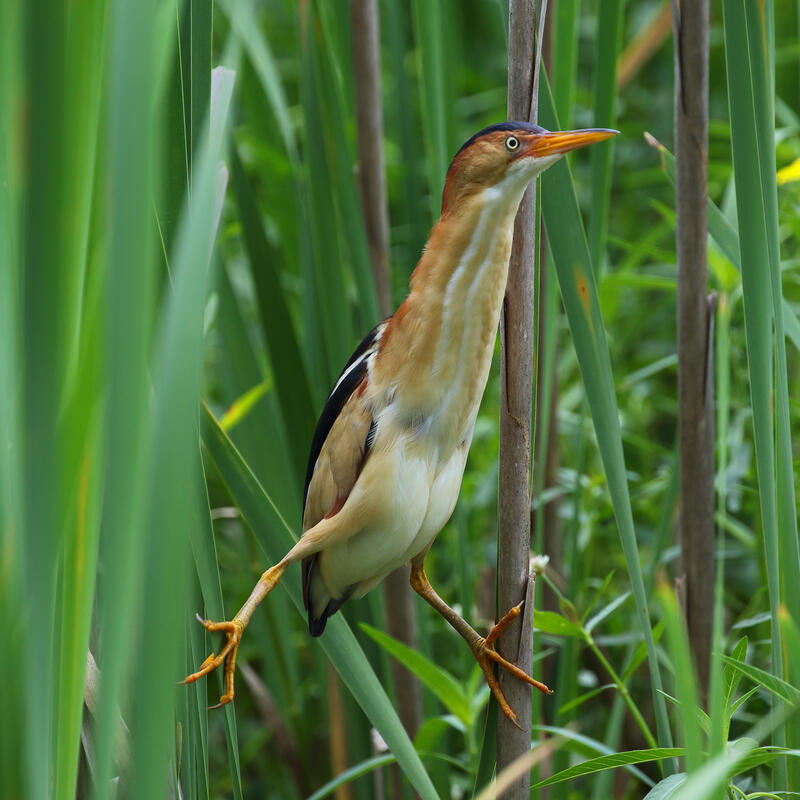
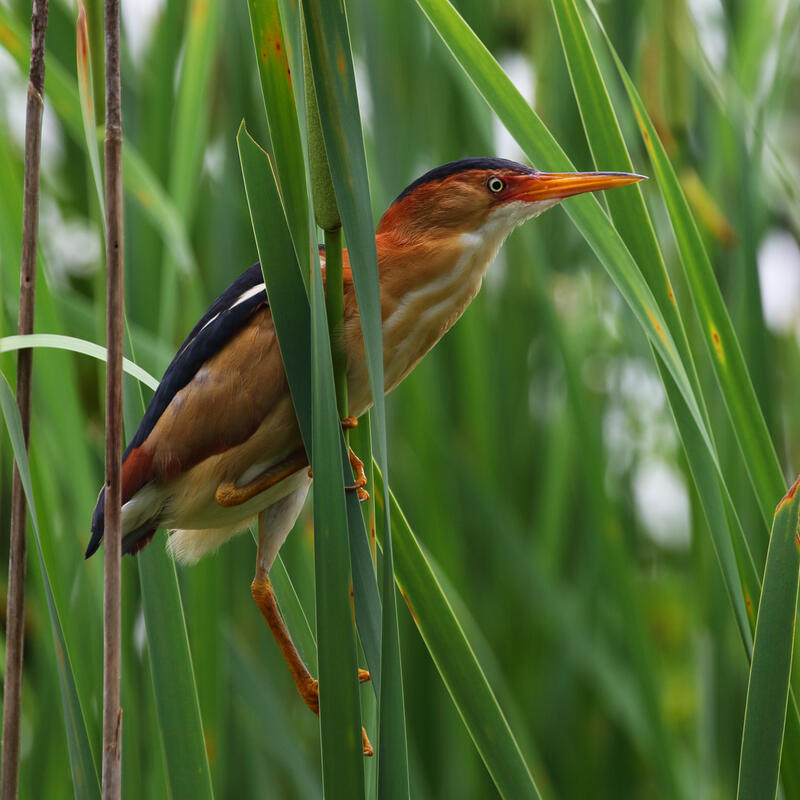
The smallest heron in the Americas (length: 28-36cm; weight: ~80g), this bird is a pale yellow buff color on the face and neck with a white chin and broad white and yellow buff streaking on the throat and breast. The stomach, abdomen, and vent are white. The crown, back, and upper tail of the male are a greenish black, while the female’s crown and back are a paler purplish chestnut in color. The eyes, legs, and feet are yellow, as is the pointed dagger-like bill. A white stripe at the base of each wing runs parallel to the mid-line of the body.
Juvenile green herons (Butorides virescens) can look somewhat similar to least bitterns but have dark brown and white streaking on their neck and breast rather than yellow buff and white streaking. The green heron’s crown, back, and upper wings are green-gray not the greenish black or purplish-chestnut seen on the least bittern.
The least bittern prefers freshwater or brackish marshes with tall vegetation, usually giant cutgrass (Zizaniopsis miliacea), great bulrush (Schoenoplectus sp.), cattails, dense reeds, sedges, rice, some bushes or trees, and scattered areas of open water.
Small fish, crayfish, frogs and tadpoles, snakes, insects (mostly dragonflies), leeches, other invertebrates, small mammals (shrews and mice), and plant material, and occasionally bird eggs and nestlings.
Least bitterns arrive in Georgia in late March to early April. Pair formation presumably occurs soon after arrival. Territories are often quite small, and bittern nests have been found in marshes only 0.4 ha in size. In larger marshes densities of up to 15 nests per hectare have been documented, and in one instance it appeared that least bitterns were nesting colonially. The nest is built mostly by the male in tall stands of emergent vegetation or occasionally in small trees or shrubs and may be solitary or part of a loose aggregation. It is usually a platform suspended above the water and built by pulling down and weaving surrounding grass and reeds and adding material including parts of herbaceous plants and sticks. Normally, a canopy is constructed over the top using adjacent vegetation. Clutch size ranges from two to seven eggs and incubation takes 17-20 days, with fledging 13-15 days after hatching. Both parents share incubation duties and can be so engrossed in this task that they can be lifted off the nest. Of the few nests documented in Georgia, most have been found in May and contained three or four eggs. However, one nest near Valdosta had eggs in late July. This species generally forages by straddling vegetation over water and grabbing prey from above or from platforms it constructs at productive feeding sites. Fall migration starts in September and runs through early November. Individuals from Georgia likely winter in south Florida, the Bahamas, Cuba, and Hispaniola. However, some may winter in Mexico and Central America. Little is known about where specific populations winter.
Call playback surveys that incorporate both a passive listening period as well as a series of recorded least bittern vocalizations is the most effective survey technique to use during the breeding season. This technique had been used successfully at Altamaha and Silver Lake WMAs by Wildlife Conservation Section staff for several years starting in 2011 when standardized playback surveys were conducted for secretive marshbirds. These surveys were also conducted at Clayhole Swamp and Chickasawhatchee WMAs and a Georgia Department of Transportation mitigation site in Brooks County. Many least bitterns were detected at Altamaha WMA and several least bitterns were detected at Silver Lake WMA. However, numbers detected in a given year at Altamaha WMA varied greatly depending on water levels in the various impoundments. Additional sites that should be surveyed in the future include Lake Seminole, Grand Bay, and Ocmulgee WMAs, Arrowhead and Paradise Public Fishing Areas (PFAs), and Eufaula, Savannah, and Banks Lake NWRs.
The least bittern breeds in much of the eastern half of the U. S., excluding the higher elevations of the Appalachian Mountain range and some parts of the Northeast and northern Midwest. It also breeds in widely scattered populations in portions of the West. It is a permanent resident in southern Florida, south coastal Texas, southeast California, southwest Arizona, the Caribbean, and parts of Mexico and Central America.
Wetland filling, ditching, and draining are the greatest threat to least bittern habitat across its range. Climate change, with predicted warmer and drier conditions, will likely further reduce the number and quality of wetlands through decreased water inputs, higher evaporation rates, and more erratic rainfall patterns. Other threats associated with wetland loss and modification that decrease the functionality of remaining wetlands include: displacement of native wetland vegetation by invasive native and non-native plant species (e.g., Phragmites); fragmentation of wetland habitats from construction of roads, utility rights-of-way, and levees; siltation and excess nutrient loads from development, farms, and roads that alter or destroy wetland vegetation or alter hydrology; residential storm water and agricultural runoff that that alters habitat by changing flooding regimes. Saltwater intrusion into tidal, freshwater, and brackish marshes caused by sea level rise or reduced freshwater inputs; incompatible management practices for other species (e.g., open water management for waterfowl; inappropriate fire regimes); and contaminant runoff causing direct mortality or indirectly disrupting food supplies are additional threats. Pesticides and herbicides carried in runoff waters may cause direct poisoning, destroy vegetation, or reduce insect abundance, a significant food source for this bird. In addition, increased numbers of raccoons (Procyon lotor), and other predators caused by development and other human modifications to the landscape could cause elevated predation rates in some areas. This bird is often killed by collisions with automobiles when it inhabits wetlands dissected by, or adjacent to, busy roads. This has occurred along U.S. Highway 17 at Altamaha WMA where traffic levels can be very high, particularly during the hours around sunrise when birds are most active. The level of roadkill mortality has not been quantified at this site.
| Threat 1 | Threat 2 | Threat 3 | |
|---|---|---|---|
| General Threat | Climate change & severe weather | Climate change & severe weather | Natural system modifications |
| Specific Threat | Habitat shifting & alteration | Storms & flooding | Dams & water management/use |
There are several wildlife management areas, national wildlife refuges, and other state and federal lands that have breeding least bittern populations. Some that likely have significant populations include; Altamaha, Phinizy Swamp, and Silver Lake/Lake Seminole WMAs and Eufaula and Savannah NWRs.
Georgia appears to have many areas of potentially suitable breeding habitat including sites on state, federal, and private lands. Altamaha WMA is the largest (~3000 acres of impoundments) and best state-owned site and most years a significant number of least bitterns nest there. Numbers of birds detected do fluxuate considerably from year to year depending on water levels in the impoundments and likely other factors. Effective management strategies should be developed for least bitterns and rails that also provide for waterfowl. One of the biggest impediments to management has been failing and non-functioning water control structures due to age and damage caused by hurricanes and other storms. In recent years this issue has been addressed and now most water control structures have been repaired or replaced and function has been restored. Additional work creating micro-topography in the relatively flat-bottomed impoundments would add substantially to the amount of suitable habitat available for this species as well as rails and other marshbirds. Other WMAs and NWRs with impoundments within the state also offer potential for management and this possibility should be explored in the near future. Broad-scale conservation efforts across the state that reduce the amount of wetland loss from filling and draining, and that control runoff and siltation near wetlands should be a high priority. Where wetlands remain undisturbed and unpolluted this species usually does well, even tolerating fairly high levels of human activity.
Beaton, G., P. W. Sykes, Jr. and J. W. Parrish, Jr. 2003. Annotated Checklist of Georgia Birds. 5th edition. Georgia Ornithological Society Occasional Publication No. 14.
Bent, A. C., ed. 1926. Life Histories of North American Marsh Birds. U. S. National Museum Bulletin 135.
Brown, M., and J. J. Dinsmore. 1986. Implications of marsh size and isolation for marsh bird management. Journal of Wildlife Management 50:392-397.
Burleigh, T. D. 1958. Georgia Birds. University of Oklahoma Press, Norman.
DeVore, J. E. 1968. A nesting study of the King Rail and Least Bittern. Migrant 39:53-58.
Dopson, W. 1962. Breeding data from Little Ocmulgee State Park. Oriole 27:35-36.
Erichsen, W. J. 1921. Notes on the habits of the breeding water birds of Chatham County, Georgia. Wilson Bulletin 33:16-28; 69-82.
Gibbs, J. P., F. A. Reid, and S. M. Melvin. 1992. Least Bittern (Ixobrychus exilis). In The Birds of North America, No. 17 (A. Poole, P. Settenheim, and F. Gill, Eds.). The Academy of Natural Sciences, Philadelphia, PA and The American Ornithologists’ Union, Washington, DC.
Howell, A. H. 1932. Florida Bird Life. U. S. Department of Agriculture Bureau of Biological Survey and Florida Department of Game and Fresh Water Fish. Coward-McCann, Inc., New York, NY.
Hunter, W. C., W. Golder, S. Melvin, and J. Wheeler. 2006. Southeast United States Regional Waterbird Conservation Plan [Online]. http://www.fws.gov/birds/waterbirds/SoutheastUS/.
Johnston, D. W. 1954. Supplemental notes on birds of the Athens area. Oriole 19:1-3.
Kushlan, J. A. 1973. Least bittern nesting colonially. Auk 90:685-686.
Major, J. 1945. Notes on a least bittern's nest at Atlanta. Oriole 10:56.
Major, J., and D. Johnston. 1944. Least bittern breeding near Atlanta. Oriole 9:36.
Martin, A. C., H. S. Zim, and A. L. Nelson. 1951. American Wildlife and Plants: A Guide to Wildlife Food Habits. McGraw-Hill Book Company, Inc, New York, NY.
Nero, R. W. 1950. Notes on a least bittern nest and young. Passenger Pigeon 12:3-8.
Palmer, R. S., ed. 1962. Handbook of North American Birds, Volume 1: Loons through Flamingos. Yale University Press, New Haven, CT.
Patterson, T. K. 1976. Breeding records of some pond and marsh birds in Laurens County, Georgia. Oriole 41:8-13.
Schmalz, G. 2010. Least Bittern (Ixobrychus exilis). Pp. 90-91 in T. M. Schneider, G. Beaton, T. S. Keyes, and N. A. Klaus, eds. The Breeding Bird Atlas of Georgia. University of Georgia Press, Athens.
Sutton, G. M. 1936. Food capturing tactics of the least bittern. Auk 53:74-75.
Weller, M. W. 1961. Breeding biology of the least bittern. Wilson Bulletin 73:11-35.
Todd Schneider and Georgann Schmalz
9 March 2019