


Loading profile. Please wait . . .
Chlosyne gorgone (Hübner, 1810)
Gorgone Checkerspot




Federal Protection: No US federal protection
State Protection: No Georgia state protection
Global Rank: G5
State Rank: S2
Element Locations Tracked in Biotics: Yes
SWAP 2015 Species of Greatest Conservation Need (SGCN): Yes
SWAP 2025 Species of Greatest Conservation Need (SGCN): Yes
2025 SGCN Priority Tier: Moderate Conservation Concern
Element Occurrences (EOs) in Georgia: 20
Habitat Summary for element in Georgia: Open woods and savannahs with woodland sunflower (Helianthus divaricatus)
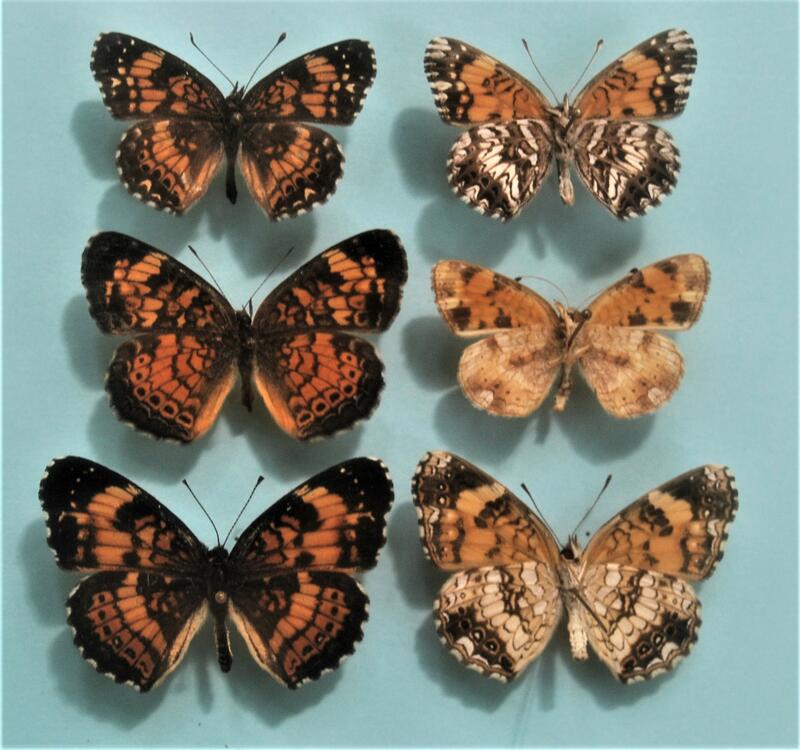
The Gorgone Checkerspot (Chlosyne gorgone) is a small orange butterfly with black markings. The wingspan is typically 3.2 to 4 cm (Schweitzer, et al, 2011). The upperside pattern is recognizable once learned, but the easiest way to distinguish this butterfly from other species is by the underside of the hindwing (see image above), as well as the underside of the forewing outer margin. The ground color of the underside of the hindwing of the Gorgone Checkerspot is a whitish gray with significant dark banding. The outer margin of the forewing underside is striped with white between the veins (see Similar Species, below).
In the image above, I have included the two most similar species in Georgia to the Gorgone Checkerspot. The Pearl Crescent (Phyciodes tharos), is likely sympatric with the Gorgone Checkerspot wherever it occurs in Georgia. P. tharos is approximately the same size as C. gorgone, but the underside of the hindwing is yellowish tan (in males), more mottled with brown markings in females, with virtually no dark markings (and a small "pearl crescent" about halfway around the outer margin). Additionally, there is no white striping along the outer margin of the forewing underside, and the pattern of dark markings on the upperside is quite different as well (see image above). The Silvery Checkerspot (Chlosyne nycteis) is also widespread in the state, and should occur in most places where there are colonies of C. gorgone. C. nycteis has a similar upperside to C. gorgone, but is significantly larger (in wingspan), and the underside of the hindwing is again yellowish, with rows of silvery spots. The outer margin of the forewing underside also does not have any white striping.
This species has records from a wide variety of locations across the state, and, as such, it is difficult to characterize one single type of habitat for this species. It does seem to frequent open habitat in woodlands, which would make sense considering the food plant (Woodland Sunflower) does grow in openings and edge habitats in the forest, including powerline cuts.
The main larval food plant for the Gorgone Checkerspot in the SE U.S. is Woodland Sunflower (Helianthus divaricatus L.) (Schweitzer, et al., 2011). It is certainly possible that the Gorgone Checkerspot could use other asteraceous plants as host plants in Georgia, as it uses a variety of species farther west.
All "recent" records (last four decades; Calhoun, et al., 2019; Gatrelle, 1998; Ogard and Bright, 2011a, 2011b; personal observations) seem to indicate a single Spring brood for the Gorgone Checkerspot in Georgia. However, Harris (1972) indicates several June and July records, as well as a single August and even a September specimen. So, this species has a Spring brood in Georgia, with potentially opportunistic individuals emerging later in the year. This primarily univoltine habitus of the Gorgone Checkerspot may be tied to the development of its hostplant, though I have seen this plant available later in the year, and, as suggested above, it is not impossible that the species could use other host plants in Georgia.
Eggs are laid in clusters on the foodplant. When the larvae hatch, they form web shelters which are shared by many larvae in the early instars. Later instars are solitary when feeding (Schweitzer, et al., 2011). The species overwinters in the larval stages. The larvae have transverse segmental rows of ornate spines, typical of members of the genus Chlosyne. Mature Gorgone Checkerspot larvae have lateral rows of white markings.
The foodplant for this species is quite local in Georgia (USDA PLANTS database), and is not recorded from many of the locations where Chlosyne gorgone has been recorded in the past. There are two potential reasons for this: lack of complete surveys for the plant, and the possibility that Chlosyne gorgone might use other asteraceous foodplants. It is difficult to suggest specific survey plans for this species, since the species seems to use rather non-descript openings in wooded habitats. Certainly, continued searches at historically known locations would seem prudent, as well as at known locations for Helianthus divaricatus.
This is a widespread and common species west of the Mississippi River across the plains states, and is at least double-brooded in much of this range. It is much more local east of the Mississippi, but there are at least a few specimens from most states from Wisconsin (where it can be common) to New York and southward into Kentucky (Schweitzer, et al., 2011). The abundance further west probably has a lot to do with the much broader use of a variety of sunflower (and other) foodplants in much of the range west of the Mississippi River.
This species is (was?) widespread, but very local in the state of Georgia (see map). More of the records are from the northern part of the state, but the most recent records are from Burke County in the east (2003) and Bartow County in the northwest (2011-2012). It is interesting that the Burke County populations may still be extant, as these populations are also some of the earliest that were recognized, by John Abbot as early as the 1790s, in the state (Calhoun, 2005; Calhoun, et al., 2019).
As for the current status of the species in Georgia, there may be few populations left extant in the state. The Bartow County location indicated in the photo above has been altered significantly (Pierre Howard, pers. comm.) and the species may be gone from there. As there are no other very recent records from anywhere in the state, the status of this species in Georgia is truly unknown.
There has been a question about the subspecific status of the coastal versus mountain populations of this species. Historically, two subspecies have been recognized -- the widespread western C. gorgone carlota and the much more restricted nominate C. gorgone gorgone. However, a recent critical study (Calhoun, 2018) suggests that subspecifc boundaries are very "muddy" at best, and that the diagnosis of this species would probably be served best as a single variable taxon, with no distinct subspecific boundaries.
This species is likely on the threshold of being extirpated from the state, if it isn't already. The biggest threat to this species is development/alteration of the habitat for the foodplant and the butterfly. If Gypsy moth spraying ever happens in C. gorgone habitat, larvae that come out of diapause early in the year after overwintering could easily be susceptible, as spraying for Gypsy Moth larvae is always done early in the year. And, as I have indicated with other species of butterflies (Erynnis martialis, Autochton cellus) and their foodplants, Helianthus divaricatus is yet another plant that deer apparently eagerly browse. As such, persistent large deer populations could pose a threat to the butterfly by removing the food plant.
| Threat 1 | Threat 2 | Threat 3 | |
|---|---|---|---|
| General Threat | Natural system modifications | Pollution | Agriculture & aquaculture |
| Specific Threat | Fire & fire suppression | Air-borne pollutants | Wood & pulp plantations |
Because of the lack of recent records, this species could easily be S1 in, and perhaps even extirpated from, the state. After recent assessment (2023), this species has been marked as S2.
If populations of the Gorgone Checkerspot are found, then every effort should be made to find the host plants and manage the habitat for the host plants. The primary host plant, Helianthus divaricatus, prefers openings in woodlands and along forest edges (including roads, paths, and powerline cuts). As such, managing for the host plants means maintaining a certain level of open understory in the woods. So, as was the case with Autochton cellus, careful thinning of woods that are filling in may be necessary, but this needs to be done with minimal damage to the understory. If thinning is done with prescribed burning to kill young trees (and to clear detritus build up), then the prescribed burning should be done in a small patchwork pattern to provide refugia for the butterfly, which would then allow populations to return to the areas post burn.
Calhoun, J. V. 2003. The history and true identity of Melitaea ismeria (Boisduval & Le Conte): a remarkable tale of duplication, misinterpretation and presumption. J. Lepid. Soc. 57:204-219.
_____. 2005. An early drawing of Chlosyne gorgone (Hübner) (Nymphalidae) by John Abbot. J. Lepid. Soc. 59:121-122.
_____. 2006. More on Melitaea ismeria Boisduval & Le Conte: the discovery of Boisduval’s specimens of Chlosyne nycteis (Doubleday). News Lepid. Soc. 48:56-57, 59.
_____. 2018. A checkered history: reconsidering the subspecific status of Chlosyne gorgone (Nymphalidae) in the southeast and beyond. News Lepid. Soc. 60:14-23.
Calhoun, J. V., C. A. Adams, & D. M. Wright. 2019. In the footsteps of John Abbot: the first modern record of Chlosyne gorgone (Nymphalidae) and other gems from coastal Georgia. News Lepid. Soc. 61:72-73.
Gatrelle, R. R. 1998. The rediscovery, taxonomy, and biology of Chlosyne gorgone gorgone and Chlosyne ismeria (Nymphalidae) in Burke County, Georgia. Taxon. Rpt. 1(2):1-8.
Harris, L., Jr. 1972. Butterflies of Georgia. University of Oklahoma Press, Norman.
Ogard, P. H. & S. Bright. 2011a. Gorgone checkerspots in Georgia. So. Lepid. News. 33:41-42, 75-76.
_____. 2011b. Gorgone checkerspots in Georgia revisited. So. Lepid. News. 33:156.
Schweitzer, D. F., M. C. Minno, and D. L. Wagner. 2011. Rare, declining and poorly known butterfly and moths (Lepidoptera) of forests and woodlands in the eastern United States, pages 197-200. Forest Health Technology Enterprise Team.
US Department of Agriculture website. PLANTS database. Online at https://plants.usda.gov/java/
James K. Adams, Professor of Biology, Dalton State College, Dalton, GA
July 17, 2020