Loading profile. Please wait . . .
Macranthera flammea (Bartr.) Pennell
Flameflower




Federal Protection: No US federal protection
State Protection: Threatened
Global Rank: G3
State Rank: S1?
Element Locations Tracked in Biotics: Yes
SWAP 2015 Species of Greatest Conservation Need (SGCN): Yes
SWAP 2025 Species of Greatest Conservation Need (SGCN): Yes
2025 SGCN Priority Tier: High Conservation Concern
Element Occurrences (EOs) in Georgia: 15
Habitat Summary for element in Georgia: Wet, sandy thickets; pitcherplant bogs
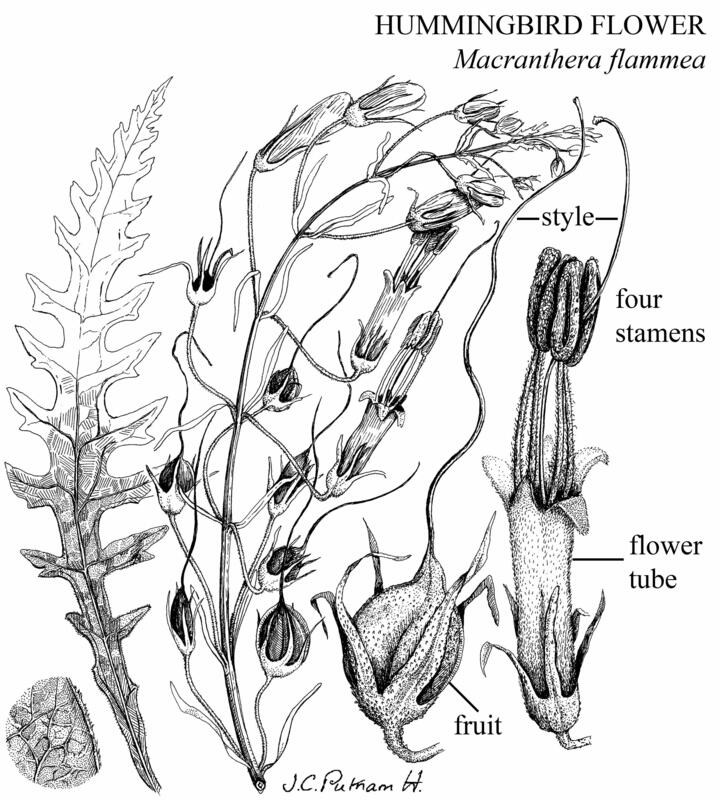
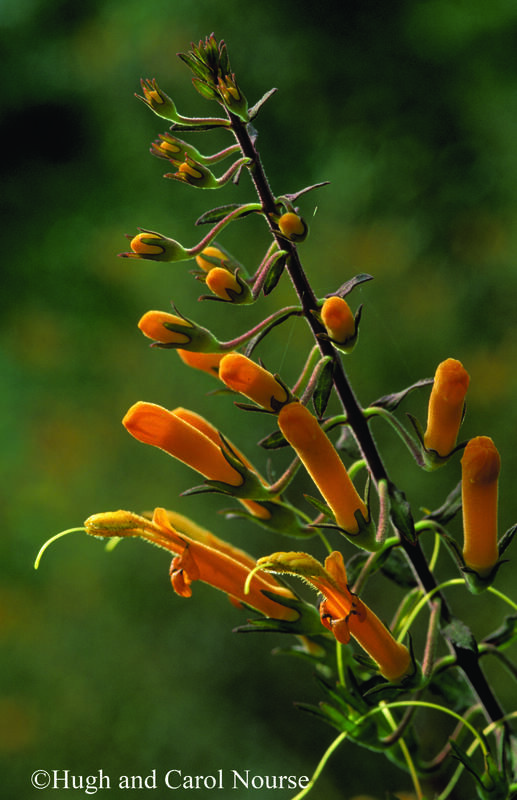
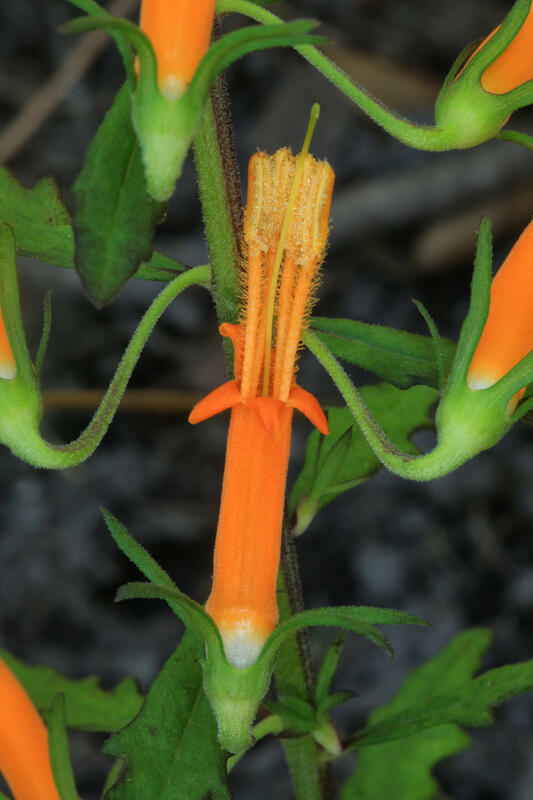
Large, biennial herb with erect, 4-angled stems, 5 - 10 feet (150 - 300 cm) tall. Lower stem leaves are 3.3 - 6.3 inches (8.5 - 16 cm) long, becoming smaller up the stem, opposite, deeply lobed and toothed, hairless except for tiny hairs on the leaf margin. Flower clusters are up to 2 feet (60 cm) long, held erect at the tips of stems. Flowers are up to 1 inch (2.5 cm) long, orange, on long, curving flower stalks, with a long tube and 5 short lobes; the style, up to 1.8 inches (4.6 cm) long, and 4 stamens extend well beyond the opening of the flower tube. The fruit is a capsule, about 0.4 inch (1 cm) long, tipped with the long, persistent style; the capsule is 2-parted, each half deeply grooved.
With its large size, deeply cut leaves, and bright orange, tubular flowers, Flame Flower resembles no other plants in Georgia; it is the only species in this genus. When not in flower, its leaves somewhat resemble in shape those of Downy False Foxglove (Aureolaria virginica) and Yellow False Foxglove (Aureolaria flava), both of which occur in drier habitats.
Flame Flower is the only species in its genus.
Seepage slopes, wet streamside thickets, Pitcherplant bogs, edges of Cypress-Gum ponds, and utility rights-of-way through these habitats. Semi-parasitic on the roots of Swamp Black Gum, Bayberry, Blackberry, Tulip Poplar, and other wetland shrubs and trees.
Flame Flower is a biennial herb – its first year is devoted to vegetative growth; the second year, it flowers, sets seed, then dies. Flame Flower is pollinated by hummingbirds; butterflies are also a major pollinator. Flame Flower is a hemiparasite; although it is green and photosynthesizes, it connects to the roots of other plants through haustoria, small root-like organs that penetrate the roots of other plants and extract water, minerals, hormones, and sugars. It has been found to form haustorial connections with as many as 18 different tree species and several herbs, shrubs, and grasses. Flame Flower plants turn black when dried.
Surveys are best conducted during flowering (July–September) and fruiting (August–October).
Coastal Plain of Georgia, Florida, Alabama, Mississippi, and Louisiana.
Fire suppression, construction of firebreaks in wetland ecotones, conversion of habitat to pine plantations, alteration of stream hydrology, herbicide application in utility rights-of-way, rooting by feral hogs.
| Threat 1 | Threat 2 | Threat 3 | |
|---|---|---|---|
| General Threat | Natural system modifications | Agriculture & aquaculture | Invasive & other problematic species, genes & diseases |
| Specific Threat | None | None | None |
Macranthera flammea is ranked S1? by the Georgia Department of Natural Resources, indicating that it is probably critically imperiled in Georgia but more data are needed to make a definitive ranking. It is listed as Threatened by the State of Georgia. Fifteen populations have been documented in Georgia, but only four have been seen in the last 20 years; one occurs on state conservation land; one is protected by a conservation easement.
Apply prescribed fire every 2 - 3 years. Avoid altering hydrology of streams and wetlands. Protect wetlands from conversion to pine plantations. Eradicate feral hogs. Limit off-road vehicle access to wetlands and rare plant sites.
Alford, J.D. and L. C. Anderson. 2002. The taxonomy and morphology of Macranthera flammea (Orobanchaceae). Sida 20: 189-204. https://www.jstor.org/stable/41968012?seq=1
Cabrera-Rodriguez, F. 1995. Reproductive ecology and host relationships of the hemiparasitic herb Macranthera flammea (Scrophulariaceae). M.S. Thesis, Auburn University. Auburn, Alabama.
Chafin, L.G. 2007. Field guide to the rare plants of Georgia. State Botanical Garden of Georgia and University of Georgia Press, Athens.
Chafin, L.G. 2000. Field guide to the rare plants of Florida. Florida Natural Areas Inventory, Tallahassee.
Determann, R., L.K. Kirkman, and H. Nourse. 1997. Plant conservation by propagation: the case of Macranthera and Schwalbea. Tipularia, Journal of the Georgia Botanical Society 12: 2-12.
GADNR. 2020. Element occurrence records for Macranthera flammea. Georgia Department of Natural Resources, Wildlife Resources Division, Social Circle, Georgia.
Godfrey, R.K. and J.W. Wooten. 1981. Aquatic and wetland plants of southeastern United States, Vol. 2, dicotyledons. University of Georgia Press, Athens.
Musselman, L.J. 1972. Root parasitism of Macranthera flammea and Tomanthera auriculata (Scrophulariaceae). Journal of Elisha Mitchell Scientific Society 88(2): 58-60. https://www.jstor.org/stable/24334887?seq=1
Musselman, L.J. and W.F. Mann. 1977. Host plants of some Rhinanthoideae (Scrophulariaceae) of eastern North America. Plant Systematics and Evolution 127: 45-53. https://www.jstor.org/stable/23642199?seq=1
Musselman, L.J. and W.F. Mann. 1978. Root parasites of southern forests. U.S. Forest Service, General Technical Report SO-20. Southern Forest Experiment Station, Alexandria, Louisiana. https://www.srs.fs.usda.gov/pubs/gtr/gtr_so020.pdf
NatureServe. 2019. Macranthera flammea comprehensive report. NatureServe Explorer. Arlington, Virginia. http://explorer.natureserve.org/servlet/NatureServe?searchName=Macranthera+flammea
Weakley, A.S. 2015. Flora of the southern and mid-Atlantic States. University of North Carolina Herbarium, University of North Carolina, Chapel Hill. http://www.herbarium.unc.edu/flora.htm
Linda G. Chafin
L. Chafin, Jun 2008: original account
K. Owers, Feb 2010: added pictures
L. Chafin, Mar 2020: updated original account.