


Loading profile. Please wait . . .
Sarracenia purpurea var. venosa (Raf.) Fern.
Southern Purple Pitcherplant




Federal Protection: No US federal protection
State Protection: Endangered
Global Rank: G5T4
State Rank: S1
Element Locations Tracked in Biotics: Yes
SWAP 2015 Species of Greatest Conservation Need (SGCN): Yes
SWAP 2025 Species of Greatest Conservation Need (SGCN): Yes
2025 SGCN Priority Tier: Highest Conservation Concern
Element Occurrences (EOs) in Georgia: 6
Habitat Summary for element in Georgia: Seepage bogs
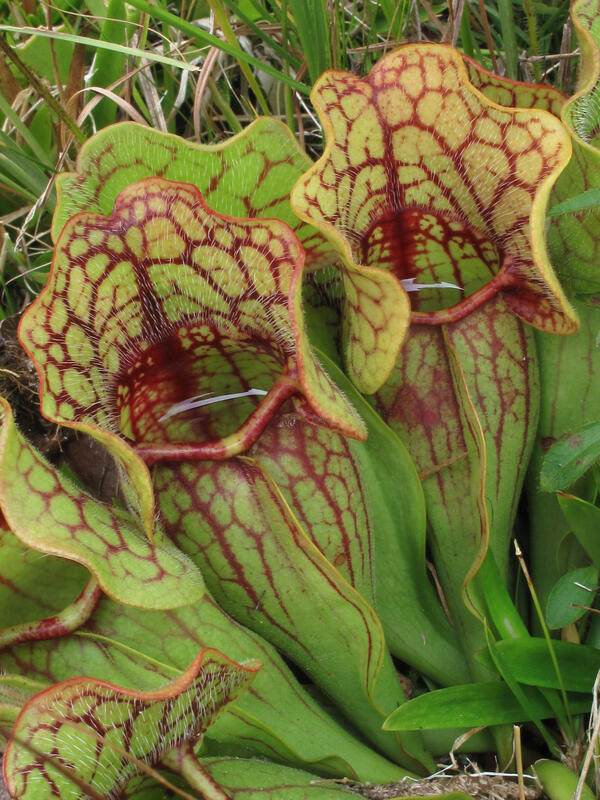
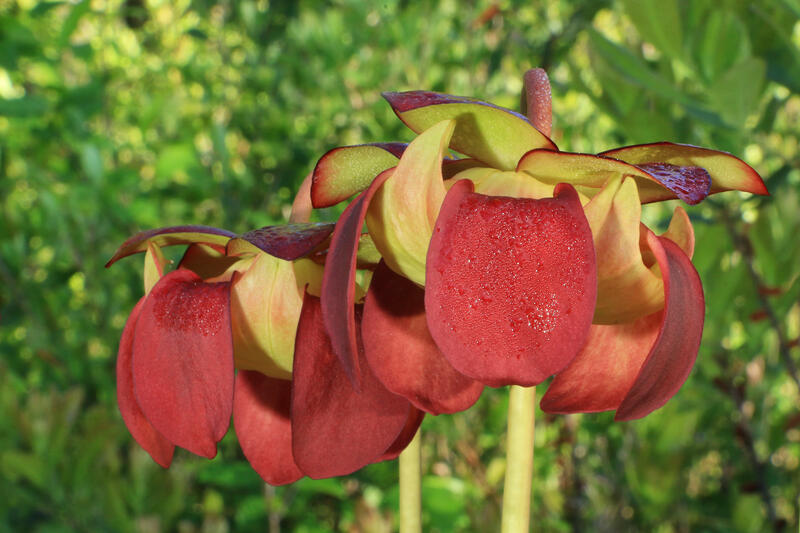
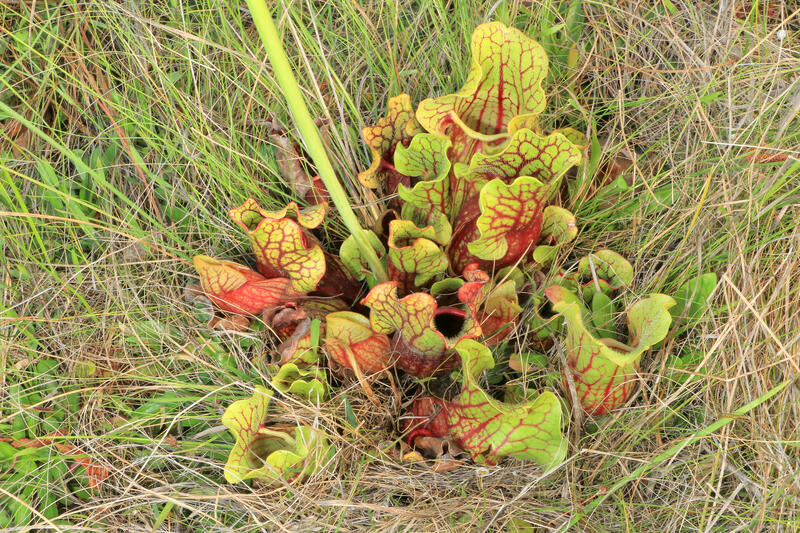
Perennial herb with leaves modified into 4 or 5 inflated pitchers that often rest on the ground or are held semi-erect. The pitchers are 2 - 18 inches (5 - 45 cm) long and widest at the middle, less than 3 times as long as wide; green with purple veins, bristly-hairy on the outside and lined with downward pointing hairs on the inside; the hood is erect, expanded, and wavy-edged, with side lobes that do not strongly incurve or touch each other when mature; the pitchers persist through the winter. The flower stalk is 8.6 - 31 inches (22 - 79 cm) tall, leafless, bearing one flower. The flower has 5 drooping, red to maroon petals, 1.2 - 2.4 inches (3 - 6 cm) long; 5 sepals that are maroon on the outside, greenish on the inside; and a yellow-green, umbrella-shaped style disk in the center of the flower. Sepals and style disk persist on the plant long after petals fall. Fruit is a round, warty capsule, 0.4 - 0.8 inch (1 - 2 cm) in diameter.
Similar pitcherplants with pale pink petals and a white style disk occurring in southwest Georgia are Rose Pitcherplant (Sarracenia rosea). For more information, see: https://www.georgiabiodiversity.a2hosted.com/portal/profile?group=plants&es_id=34058
Similar pitcherplants occurring in the mountains of northeast Georgia are Mountain Purple Pitcherplant (Sarracenia purpurea var. montana); the lobes of their mature pitcher hoods are strongly incurved, often touching, and nearly covering the pitcher opening. For more information, see: https://www.georgiabiodiversity.a2hosted.com/portal/profile?group=plants&es_id=34032
Eleven types of pitcherplant occur in Georgia, including 8 species, 4 varieties, and 2 subspecies. All are considered rare, vulnerable, threatened or endangered.
Sarracenia flava (Yellow Flytrap), https://www.georgiabiodiversity.org/portal/profile?group=plants&es_id=18445
Sarracenia leucophylla (Whitetop Pitcherplant), https://www.georgiabiodiversity.org/portal/profile?group=plants&es_id=18829
Sarracenia minor var. minor (Hooded Pitcherplant), https://www.georgiabiodiversity.org/portal/profile?group=plants&es_id=33691
Sarracenia minor var. okefenokeensis (Okefenokee Giant Pitcherplant), https://www.georgiabiodiversity.org/portal/profile?group=plants&es_id=33687
Sarracenia oreophila (Green Pitcherplant), https://www.georgiabiodiversity.org/portal/profile?group=plants&es_id=16880
Sarracenia psittacina (Parrot Pitcherplant), https://www.georgiabiodiversity.org/portal/profile?group=plants&es_id=15362
Sarracenia purpurea var. montana (Mountain Purple Pitcherplant), https://www.georgiabiodiversity.org/portal/profile?group=plants&es_id=34032
Sarracenia purpurea var. venosa (Southern Purple Pitcherplant), https://www.georgiabiodiversity.org/portal/profile?group=plants&es_id=21623
Sarracenia rosea (Rose Pitcherplant), https://www.georgiabiodiversity.org/portal/profile?group=plants&es_id=34058
Sarracenia rubra ssp. gulfensis (Gulf Sweet Pitcherplant) or Sarracenia rubra ssp. viatorum (Georgia Sweet Pitcherplant), https://www.georgiabiodiversity.org/portal/profile?group=plants&es_id=18435
Sarracenia rubra ssp. rubra (Sweet Pitcherplant), https://www.georgiabiodiversity.org/portal/profile?group=plants&es_id=19129
Coastal Plain wet savannas, sandhill seepage bogs, and sunny rights-of-way through these habitats; often with other, more common pitcherplants such as Hooded Pitcherplant (Sarracenia minor) and Yellow Flytrap (Sarracenia flava).
Pitcherplants capture and digest insects and other small animals in their pitchers. Nectar is produced by glands around the top of the pitcher, luring animals to the opening with its sweet smell. Stiff, down-pointing hairs line the pitcher, encouraging the animals to slide in and impeding their escape. Enzymes dissolved in water in the base of the pitcher digest the animals, making nutrients, particularly nitrogen, available for absorption by the plant. (Soils of bogs and other permanently saturated wetlands are typically low in nitrogen.) Recent research indicates that the more species-diverse the insect diet, the greater the pitcherplant reproductive success.
Pitcherplants reproduce sexually and also vegetatively by spread of underground stems (rhizomes). The unusual shape of the flowers, with their drooping petals and umbrella-like style disk, promotes cross-pollination by insects. When an insect, usually a bee, pushes its way past the petals to reach nectar on the interior of the flower, it brushes against one of the stigmas, which are at the pointed tips of the “umbrella,” and deposits pollen gathered from a previously visited flower. Once inside the petals, it picks up pollen from the anthers and from the inner surface of the umbrella and then carries it to the next visited flower, usually avoiding the stigmas as it leaves the flower.
Since it would be a disadvantage to the plant to “eat” its pollinators, many pitcherplants produce flowers before their pitchers are well developed. Others, like the Purple Pitcherplants, hold their flowers well above the pitchers on long stalks. Pitcherplants are usually 4 - 5 years old before they flower and may live to be 20 - 30 years old.
Southern Purple Pitcherplant blooms April–May; its pitchers are distinctive throughout the growing season and even persist through the winter.
Atlantic Coastal Plain of Georgia, South Carolina, North Carolina, and Virginia.
Ditching, draining, and filling of habitat; conversion of habitat to agricultural fields, pastures, and development. Fire suppression leading to woody plant encroachment and closure of the canopy. Use of herbicides in powerline rights-of-way. Poaching. Off-road vehicle use. Digging by feral hogs.
| Threat 1 | Threat 2 | Threat 3 | |
|---|---|---|---|
| General Threat | Agriculture & aquaculture | Natural system modifications | Natural system modifications |
| Specific Threat | None | None | None |
Sarracenia purpurea var. venosa is ranked S1 by the Georgia Department of Natural Resources, indicating that it is critically imperiled in Georgia. Six populations are known, all on private lands, five of which are protected by a management agreement with Georgia Power Company.
Prevent ditching, draining, filling, and conversion of wetlands. Apply prescribed fire every 2 - 3 years preferably in the growing season. Avoid plowing fire breaks through habitat. Avoid herbicide use in rights-of-way with pitcherplant populations. Limit access to prevent poaching and off-road vehicle access. Eradicate feral hogs. Prosecute plant poachers.
Botanical Society of America. 2008. Sarracenia – the pitcher plants. https://botany.org/Carnivorous_Plants/Sarracenia.php
Chafin, L.G. 2007. Field guide to the rare plants of Georgia. State Botanical Garden of Georgia and University of Georgia Press, Athens.
Cheek, M., D. Schnell, J.L. Reveal, and J. Schlauer. 1997. Proposal to conserve the name Sarracenia purpurea (Sarraceniaceae) with a new type. Taxon 46(4): 781-783.
Ellison, A.M., C.C. Davis, P.J. Calie, R.F.C. Naczi. 2014. Pitcher plants (Sarracenia) provide a 21st-century perspective on infraspecific ranks and interspecific hybrids: a modest proposal for appropriate recognition and usage. Systematic Botany 39(3): 939-949.
Ellison, A.M., H.L. Buckley, T.E. Miller, and N.J. Gotelli. 2004. Morphological variation in Sarracenia purpurea (Sarraceniaceae): geographic, environmental, and taxonomic correlates. American Journal of Botany 91(11): 1930-1935.
Ellison, A.M. and J.N. Parker. 2002. Seed dispersal and seedling establishment of Sarracenia purpurea (Sarraceniaceae). American Journal of Botany 89(6): 1024-1026. https://bsapubs.onlinelibrary.wiley.com/doi/full/10.3732/ajb.89.6.1024
GADNR. 2020. Element occurrence records for Sarracenia purpurea var. venosa. Georgia Department of Natural Resources, Wildlife Resources Division, Social Circle, Georgia.
Godfrey, R.K. and J.W. Wooten. 1981. Aquatic and wetland plants of southeastern United States, Vol. 2, dicotyledons. University of Georgia Press, Athens.
Godt, M.J. and J.L. Hamrick. 1999. Genetic divergence among infraspecific taxa of Sarracenia purpurea. Systematic Botany 23(4): 427-438.
Hale, R.E., E. Powell, L. Beikmohamadi, and M.L. Alexander. 2020. Effects of arthropod inquilines on growth and reproductive effort among metacommunities of the purple pitcher plant (Sarracenia purpurea var. montana). PLoS ONE 15(5): e0232835. https://doi.org/10.1371/journal.pone.0232835
Jennings, D.E. and J.R. Rohr. 2011. A review of the conservation threats to carnivorous plants. Biological Conservation 144: 1356-1363. https://www.sciencedirect.com/science/article/pii/S0006320711001078
Karberg, J.M. and M.R. Gale. 2010. Exploration of meaningful subspecies definitions of the carnivorous Northern Pitcher Plant (Sarracenia purpurea), throughout its geographic distribution. Conservation Genetics 11, 2369-2378. https://doi.org/10.1007/s10592-010-0123-7
McDaniel, S. 1971. The genus Sarracenia. Bulletin 9, Tall Timbers Research Station, Tallahassee, Florida.
Mellichamp, T.L. and F.W. Case. 2009. Sarracenia purpurea. Flora of North America, vol. 8. http://beta.floranorthamerica.org/Sarracenia_purpurea_subsp._venosa
Naczi, R.F.C., E.M. Soper, F.W. Case, Jr., and R.A. Case. 1999. Sarracenia rosea (Sarraceniaceae), a new species of pitcherplant from the southeastern United States. Sida 18(4): 1183-1206.
NatureServe. 2020. Sarracenia purpurea var. montana species report. NatureServe Explorer. NatureServe, Arlington, Virginia.
Ne'eman, G., Ne'eman, R. and A.M. Ellison. 2006. Limits to reproductive success of Sarracenia purpurea (Sarraceniaceae). American Journal of Botany 93:1660-1666.
Patrick, T.S., J.R. Allison, and G.A. Krakow. 1995. Protected plants of Georgia. Georgia Department of Natural Resources, Natural Heritage Program, Social Circle.
Rice, B. 2008. Carnivorous plant FAQ. http://www.sarracenia.com/faq/faq5542.html
Schnell, D.E. 1979. A critical review of published variants of Sarracenia purpurea L. Castanea 44: 47-59.
Schnell, D.E. 1993. Sarracenia purpurea L. ssp. venosa (Raf.) Wherry var. burkii Schnell (Sarraceniaceae) – a new variety of the Gulf coastal plain. Rhodora 95: 6-10.
Schnell, D.E. and R.O. Determann. 1997. Sarracenia purpurea L. ssp. venosa (Raf.) Wherry var. montana Schnell & Determann (Sarraceniaceae) – a new variety. Castanea 62: 60-62.
Schnell, D.E. 2002. Carnivorous plants of the United States and Canada, 2nd edition. Timber Press, Inc. Portland, Oregon.
Stevens, T. 2002. An interview with Dr. Rob Naczi about Sarracenia rosea. Carnivorous Plant Newsletter 31: 87-90.
Weakley, A.S. 2015. Flora of the southern and mid-Atlantic States. University of North Carolina Herbarium, University of North Carolina, Chapel Hill. http://www.herbarium.unc.edu/flora.htm
Linda G. Chafin
L. Chafin: 18 May 2020, original account