

Loading profile. Please wait . . .
Cypripedium kentuckiense C.F. Reed
Kentucky Yellow Lady's-slipper




Federal Protection: No US federal protection
State Protection: Endangered
Global Rank: G3
State Rank: S1
Element Locations Tracked in Biotics: Yes
SWAP 2015 Species of Greatest Conservation Need (SGCN): Yes
SWAP 2025 Species of Greatest Conservation Need (SGCN): Yes
2025 SGCN Priority Tier: High Conservation Concern
Element Occurrences (EOs) in Georgia: 2
Habitat Summary for element in Georgia: Forested, springhead seeps in sandy soils
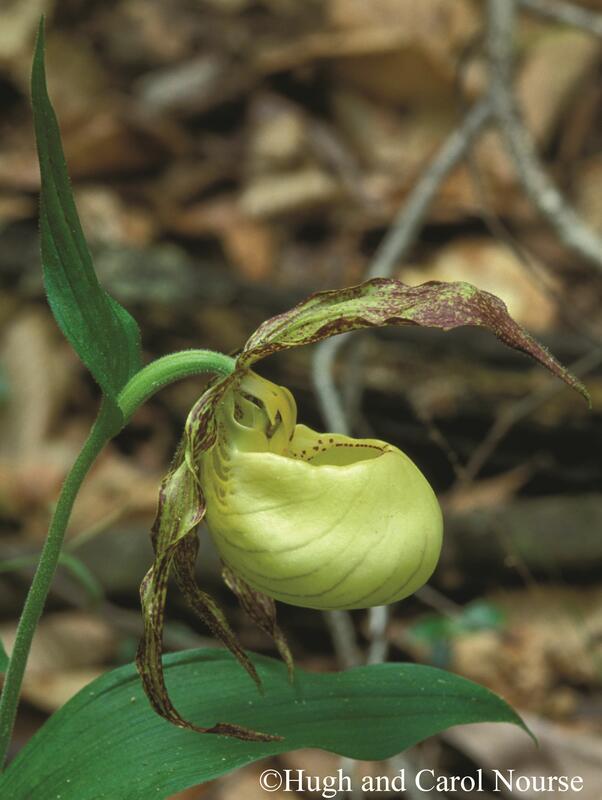
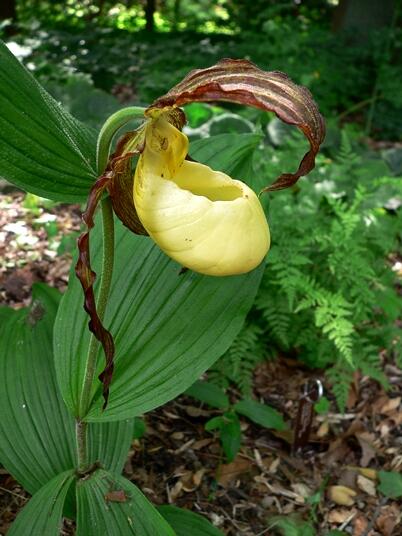
Perennial herb 13.5 - 39 inches (35 - 97 cm) tall, with 3 - 6 leaves evenly distributed along the stem. Leaves 5 - 9.5 inches (13 - 24 cm) long and 1.7 - 6 inches (4.3 - 15 cm) wide, alternate, broadly oval with pointed tips and clasping leaf bases. Flowers 1 - 2 per plant, held at the top of the stem; an erect, green bract stands behind each flower. A white or pale yellow, pouch-like lip petal (the “slipper”), up to 2 inches (5 cm) wide and 2.5 inches (6.5 cm) long with a large opening on the upper surface, is held at the bottom of the flower. Two spirally twisted petals, up to 6 inches (15.6 cm) long, droop beside the lip. There are 2 sepals, one curved over the top of the flower and another curved behind the slipper. All sepals and petals (except for the lip petal) are maroon or greenish-yellow marked with purple spots. Fruit is a capsule about 2.5 inches (6 cm) long.
Southern Lady’s Slipper differs from other Lady’s Slipper species by the large opening on the upper surface of the lip, and by the pale yellow or ivory color of the lip.
Yellow Lady’s Slipper (Cypripedium parviflorum) is state-listed as Rare. See: https://goorchids.northamericanorchidcenter.org/species/cypripedium/parviflorum/
Pink Lady’s Slipper (Cypripedium acaule) is state-listed as Unusual. See: https://georgiabiodiversity.org/portal/profile?group=plants&es_id=19349
In Georgia's upper Coastal Plain: forested springhead seeps; wet, sandy stream banks; and beech–red maple–oak forests adjacent to springheads.
Southern Lady’s Slipper is a perennial herb that reproduces by seed. Little is known about the life history of this species, but generally, lady’s-slipper orchid flowers are pollinated by bees that are attracted to their color and fragrance. A bee enters the colorful, inflated lip through a one-way opening and quickly discovers that there is neither pollen nor nectar available, and that it cannot readily escape. The bee can exit the flower only through two openings at the back of the lip. As it leaves from one of these openings, its back brushes against the female part of the flower, depositing a packet of pollen from the last orchid flower that it visited, and picking up a new packet of pollen from the male part of the flower. The packet is taken to the next visited flower; the pollen is held in small packets that stick to the bee’s back where it is not accessible to the bee and can’t be scraped off by the bee's legs. Bees soon learn to avoid these flowers because they fail to provide nectar or pollen; as a result, few flowers are pollinated.
Although flowers remain on the plants for several weeks to increase the chances of pollination, fewer than 10% of plants in a population will produce fruit in a given year. Fortunately, each fruit contains thousands of seeds. The seeds are tiny and dust-like, containing no stored food reserves, and are wind-dispersed. They must land on a patch of soil containing a specific fungus that provides nutrients for germination and subsequent plant growth. Lady’s Slipper plants of any species that are dug from the wild and transplanted into gardens rarely survive or reproduce due to the lack of this fungus.
Surveys are best conducted during flowering (mid-April–early May) and fruiting (July–August).
Georgia, and small, widely scattered populations in Alabama, Arkansas, Kentucky, Louisiana, Mississippi, Oklahoma, Tennessee, Texas, Virginia.
Logging, draining, and filling wetlands. Conversion of habitat to pine plantations. Clearcutting. Poaching. Invasion by exotic pest plants. Digging by feral hogs. Overbrowsing by deer.
| Threat 1 | Threat 2 | Threat 3 | |
|---|---|---|---|
| General Threat | Natural system modifications | Invasive & other problematic species, genes & diseases | Pollution |
| Specific Threat | None | None | None |
Cypripedium kentuckiense is ranked as S1 by the Georgia Department of Natural Resources, indicating that it is critically imperiled in the state. It is listed as Endangered by the State of Georgia. Only one small natural population is known, 220 miles from the nearest population in Alabama. Although on private land, this site is the focus of conservation and monitoring activities. Another site in an adjacent county with similar habitat was planted with this species grown from seed taken from the natural site.
Avoid logging, draining, or filling wetlands. Avoid clearcutting on slopes. Eradicate exotic pest plants and feral hogs. Prosecute plant poachers. All Lady’s Slippers are rare or unusual and should never be dug from the woods. They depend on a local soil fungus for nutrients and rarely survive transplanting. Most Lady’s Slipper species are now available from nurseries; always check with the seller that their plants came from an ethical source.
Barnett, J., S. Sharp, K. Allen, and A. Scott. 2013. Increasing populations of Kentucky lady’s slipper orchid on the Kisatchie National Forest: seedling production and outplanting trials. In: Guldin, James M., ed. 2013. Proceedings of the 15th biennial southern silvicultural research conference. e-Gen. Tech. Rep. SRS-GTR-175. Asheville, NC: U.S. Department of Agriculture, Forest Service, Southern Research Station. https://www.fs.usda.gov/treesearch/pubs/43669
Brown, P.M. 1995. Cypripedium kentuckiense: a retrospective of the literature. North American Native Orchid Journal 1: 255-266.
Brown, P.M. and S.N. Folsom. 2004. Wild orchids of the southeastern United States, north of peninsular Florida. University Press of Florida, Gainesville.
Cammack, S. and T. Patrick. 2000. A Kentucky find: the Georgia discovery of the Kentucky ladyslipper (Cypripedium kentuckiense). Tipularia 15: 17-22.
Case, M.A., H.T. Mlodozeniec, L.E. Wallace, and T.W. Weldy. 1998. Conservation genetics and taxonomic status of the rare Kentucky lady’s-slipper: Cypripedium kentuckiense (Orchidaceae). American Journal of Botany 85(12): 1779-1786. https://bsapubs.onlinelibrary.wiley.com/doi/abs/10.2307/2446512
Chafin, L.G. 2007. Field guide to the rare plants of Georgia. State Botanical Garden of Georgia and University of Georgia Press, Athens.
Sheviak, C.J. 2003. Species account for Cypripedium kentuckiense. Flora of North America, Vol. 26. Oxford University Press, New York. http://www.efloras.org/florataxon.aspx?flora_id=1&taxon_id=242101549
GADNR. 2020. Element occurrence records for Cypripedium kentuckiense. Georgia Department of Natural Resources, Wildlife Resources Division, Social Circle, Georgia.
NatureServe. 2019. Cypripedium kentuckiense comprehensive report. NatureServe Explorer. Arlington, Virginia. http://explorer.natureserve.org/servlet/NatureServe?searchName=Cypripedium%20kentuckiense
Reed, C.F. 1981. Cypripedium kentuckiense Reed, a new species of orchid in Kentucky. Phytologia 48: 426-428.
Weakley, A.S. 2015. Flora of the southern and mid-Atlantic States. University of North Carolina Herbarium, University of North Carolina, Chapel Hill.
Weldy, T.W., H.T. Mlodozeniec, L.E. Wallace, and M.A. Case. 1996. The current status of Cypripedium kentuckiense (Orchidaceae) including a morphological analysis of a newly discovered population in eastern Virginia. Sida 17: 423-435. https://www.jstor.org/stable/41967225?seq=1
Linda G. Chafin
L. Chafin, March 2007: original account
K. Owers, Jan. 2010: updated status and ranks, added pictures
L. Chafin, Feb 2020: updated original account.