

Loading profile. Please wait . . .
Eustachys floridana Chapman
Florida Finger Grass




Federal Protection: No US federal protection
State Protection: No Georgia state protection
Global Rank: G2?
State Rank: S1?
Element Locations Tracked in Biotics: Yes
SWAP 2015 Species of Greatest Conservation Need (SGCN): Yes
SWAP 2025 Species of Greatest Conservation Need (SGCN): Yes
2025 SGCN Priority Tier: Highest Conservation Concern
Element Occurrences (EOs) in Georgia: 16
Habitat Summary for element in Georgia: Sandhills and flatwoods
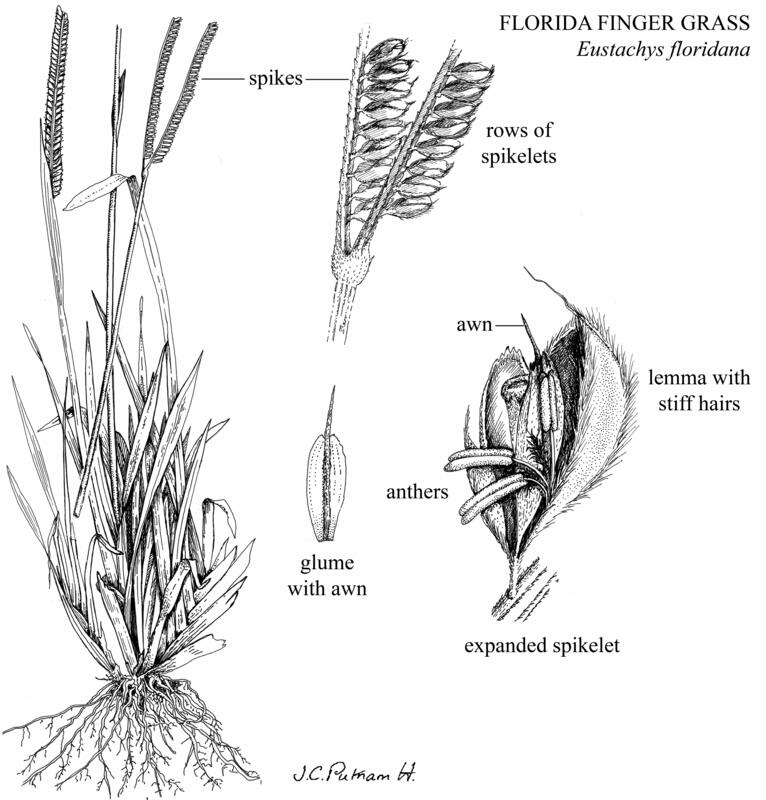
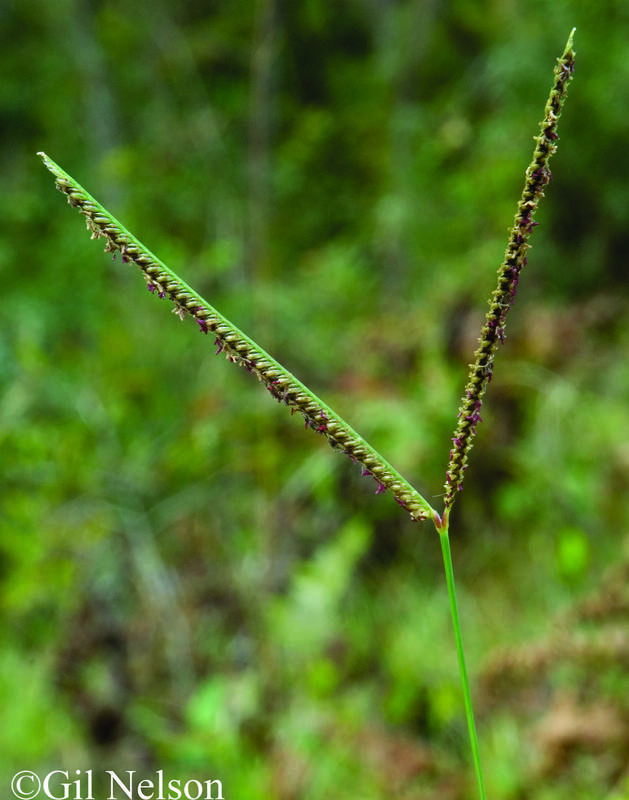
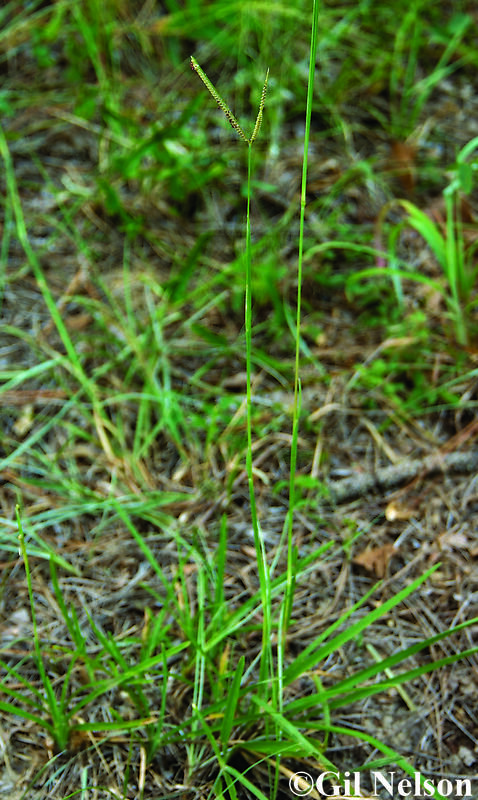
Perennial grass growing in tufts from a short, underground stem. The basal leaves are up to 12 inches (30 cm) long and 0.3 inch (8.2 mm) wide; there are few or no stem leaves. Flowering stalks are 20 - 40 inches (50 - 100 cm) tall, with 1 - 3 flower spikes (usually 2) spreading at the top of the stem. The flower spikes are 2 - 5 inches (5 - 13 cm) long, with many tightly packed spikelets in 2 rows along one side of each spike. Each spikelet is about 0.1 inch (3 - 3.7 mm) long, and contains 3 florets. Each floret has two outer bracts called glumes; the lower glume is 1.8-2 mm long, its tip obtuse to acutely pointed; the upper glume is 2.2 - 3.1 mm, truncate to occasionally lobed, with a bristle (awn) arising from between the lobes. The lower lemma is 2.9 - 3.7 mm long, oval, bristle-tipped, tan to light brown to reddish-brown at maturity, with whitish or golden, stiff and spreading hairs on the lateral veins and keel. The seed-like fruit is about 1.7 mm long.
Dune Finger-grass (Eustachys petraea, synonym Chloris petraea) also has a hairy lower lemma but the hairs on the veins are pressed against the lemma instead of spreading. The lower lemma is dark brown rather than tan or reddish-brown. It is common on and near beaches and dunes and often in nearby disturbed areas.
Bahia Grass (Paspalum notatum), a common turf grass that invades natural areas, also has 2 or more spikes, the lower ones alternate on the stem. Its spikelets are flattened and are not awned; its leaf bases are reddish and overlap to form a flattened, fan-like base and the leaves are 2-10 mm wide. It is native to Latin America.
None in Georgia.
Sandhills and other dry or moist (not wet) pinelands (and not beaches).
Florida Finger-grass is a perennial, warm-season grass that reproduces sexually as well as vegetatively by sending up stems from the tips of short rhizomes. As with all grasses, it is wind-pollinated. Its fruits are dispersed by insects and small animals. Florida Finger-grass, like all species in the genus Eustachys, uses an unusual mode of photosynthesis called “C4 photosynthesis” because carbon dioxide is incorporated into a four-carbon compound instead of a 3-carbon compound as in most grasses. C4 photosynthesis is an adaptation to high sunlight and temperatures and results in less water loss for the plant.
Surveys are best conducted during flowering (late summer–early fall).
Georgia and Florida; also known historically from Alabama.
Conversion of habitat to pine plantations, pastures, and agriculture; fire suppression.
| Threat 1 | Threat 2 | Threat 3 | |
|---|---|---|---|
| General Threat | Residential & commercial development | Agriculture & aquaculture | Natural system modifications |
| Specific Threat | None | None | None |
Eustachys floridana is ranked S1? by the Georgia Department of Natural Resources, indicating that it is likely critically imperiled in the state but that more surveys need to be conducted before a definitive ranking can be assigned. Seven populations have been documented in Georgia, and five of these have been seen in the last 20 years; only 2 populations occur on conservation land.
Burn sandhills and flatwoods every 2 - 3 years during the growing season. Avoid clearcutting, bedding, plowing fire lanes, and other soil disturbance. Conduct additional surveys for this species.
Alice, L.A., G.G. Borneo, and K.W. Hilu. 2000. Systematics of Chloris (Chloridoideae; Poaceae) and related genera: Evidence from nuclear ITS and chloroplast matK sequences. American Journal of Botany 87, Supplement. https://www.jstor.org/stable/2656784?seq=4#metadata_info_tab_contents
Aulbach, C. 2006. Eustachys floridana species account. Flora of North America, Vol. 25. http://beta.floranorthamerica.org/Eustachyshttp://herbarium.usu.edu/webmanual
Chafin, L.G. 2007. Field guide to the rare plants of Georgia. State Botanical Garden of Georgia and University of Georgia Press, Athens.
GADNR. 2020. Element occurrence records for Eustachys floridana. Georgia Department of Natural Resources, Wildlife Resources Division, Social Circle, Georgia.
Hitchcock, A.S. and A. Chase. 1971. Manual of the grasses of the United States. Dover Publications, New York.
NatureServe. 2019. Eustachys floridana comprehensive report. NatureServe Explorer. Arlington, Virginia. http://explorer.natureserve.org/servlet/NatureServe?searchName= Eustachys+floridana
Small, J.K. 1933. Manual of the southeastern flora. 1972 Reprint Edition. Hafner Publishing Company, New York.
Weakley, A.S. 2015. Flora of the southern and mid-Atlantic States. University of North Carolina Herbarium, University of North Carolina, Chapel Hill. http://www.herbarium.unc.edu/flora.htm
Linda G. Chafin
L. Chafin, Apr. 2007: original account
K. Owers, Jan. 2010: added pictures
L. Chafin, Feb 2020: updated original account.