

Loading profile. Please wait . . .
Ptilimnium nodosum (Rose) Mathias
Harperella




Federal Protection: Listed Endangered
State Protection: Endangered
Global Rank: G2
State Rank: S1
Element Locations Tracked in Biotics: Yes
SWAP 2015 Species of Greatest Conservation Need (SGCN): Yes
SWAP 2025 Species of Greatest Conservation Need (SGCN): Yes
2025 SGCN Priority Tier: Highest Conservation Concern
Element Occurrences (EOs) in Georgia: 5
Habitat Summary for element in Georgia: Granite outcrop seeps; shallow seasonal ponds in limesink depressions
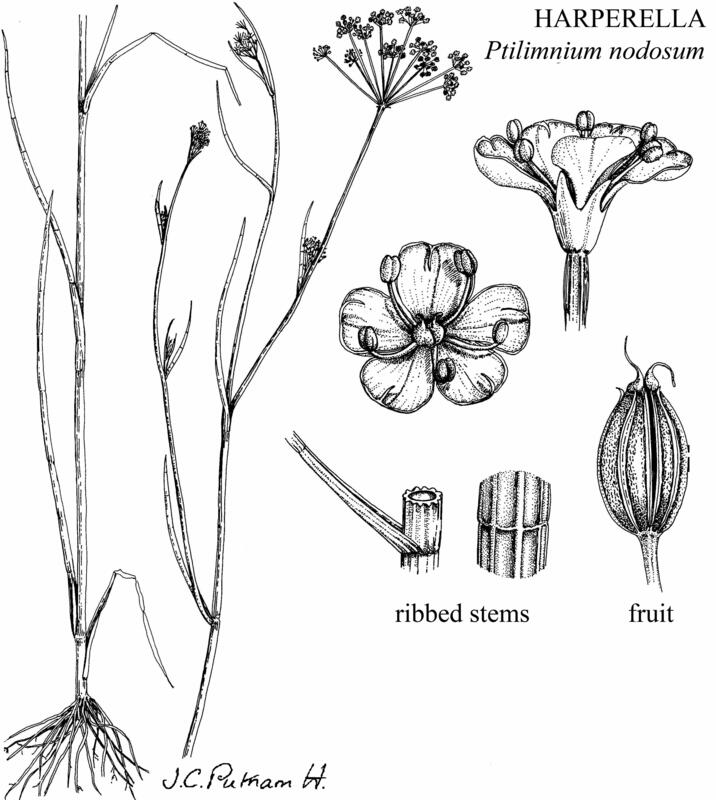
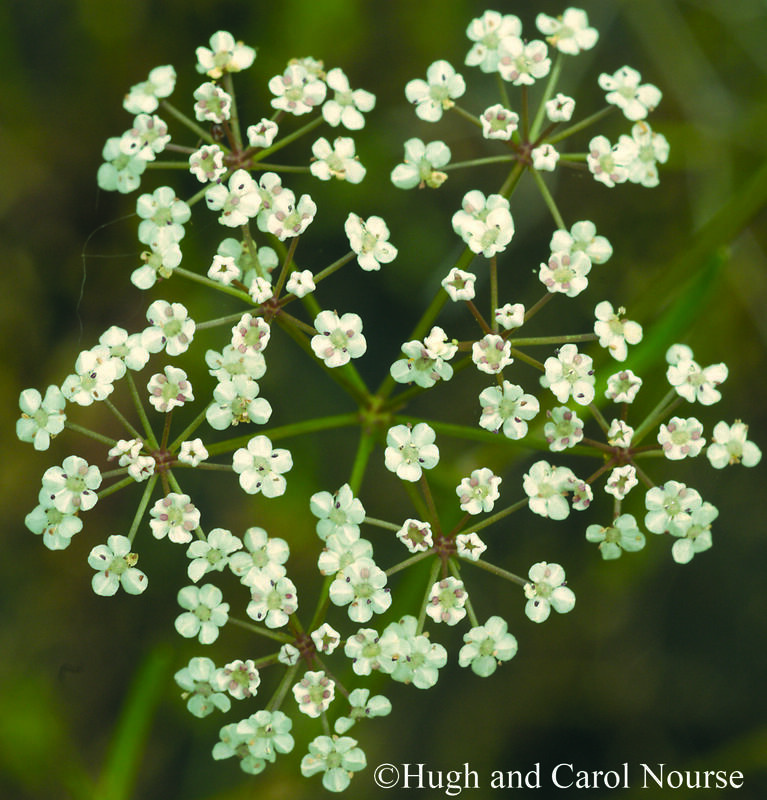
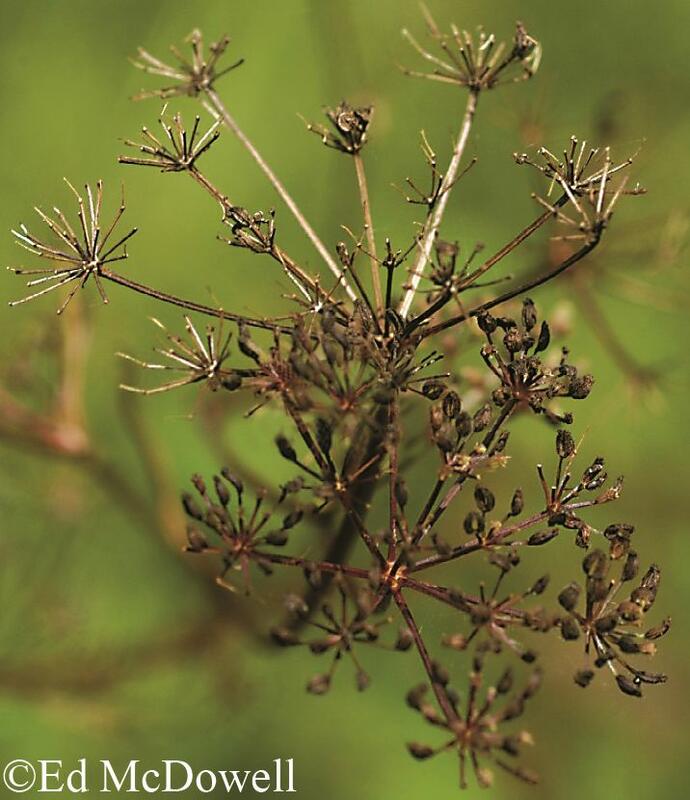
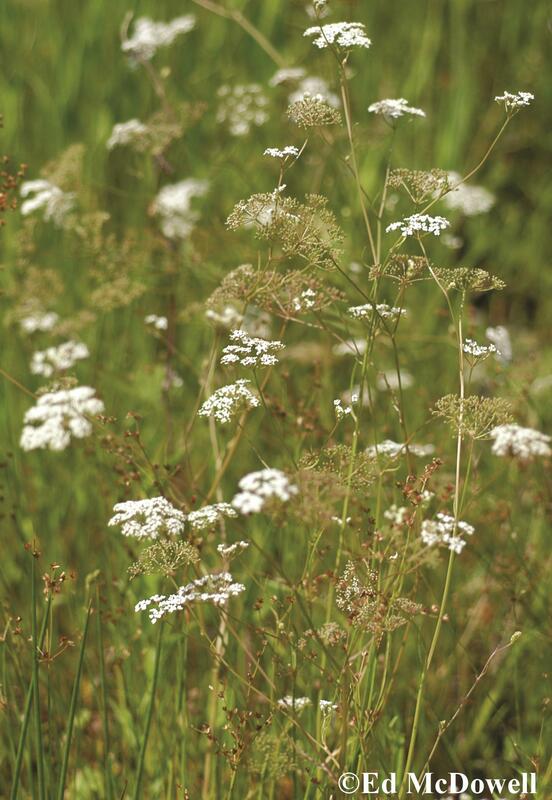
Ptilimnium nodosum (synonym Harperella nodosa) is an annual herb with erect stems up to 3 feet (1 m) tall; the height of plants varies greatly depending on rainfall. Leaves are up to 12 inches (30 cm) long near the base of the plant, becoming shorter up the stem, alternate; they are hollow tubes, except for cross-partitions, and taper to a point. The flowers are in flat-topped clusters (umbels) composed of 5 - 15 smaller umbelets. The flowers have 5 tiny, white petals, sometimes curved up and strongly inward over the center of the flower; the tips of the stamens (anthers) are dark pink. The fruits are oval with 6 - 10 ribs. All parts of the plant smell faintly of dill.
Harperella grows with Common Bishop-weed (Ptilimnium capillaceum), a similar species with rounded, rather than flat-topped, flower clusters and flat leaves divided into 3 very narrow segments.
Eastern Bishopweed (Ptilimnium costatum, Special Concern) occurs in the Coosa Valley Prairies and calcareous flatwoods in Floyd County. It has flat, crowded leaves divided into many, very narrow segments, and 20 - 24 small umbelets per umbel. For more information, see: http://missouriplants.com/Ptilimnium_costatum_page.html
Mock Bishopweed (Ptilimnium ahlesii, Special Concern) occurs in freshwater tidal marshes near the coast. For more information, see: https://georgiabiodiversity.org/portal/profile?group=plants&es_id=18883
In Georgia, Harperella occurs in a cypress pond in the Coastal Plain, and in seeps on the edges of granite outcrops in the Piedmont. In other states, it grows in the flooded margins of rocky streams.
Harperella is an annual herb that reproduces sexually and produces seed only from cross-pollination. Mature seeds are produced within 3 - 4 weeks after flowering and germinate shortly after being shed with the entire flowering and fruiting season lasting 6 - 12 weeks. (In cultivation, plants persist for two years and each year produce large amounts of seed that readily germinate.) As with other members of the Apiaceae family, its flowers are pollinated by a variety of insects. Its seeds, which readily float, are dispersed by gravity and moving water. In the absence of flowing water, long-range seed dispersal is probably rare.
Harperella also reproduces asexually when flowering stems fall over and root at the nodes in submerged or damp soils. When the flowering stems decompose, separate (though genetically identical) plants become established. Extensive populations of clones, if separated from non-clonal plants by habitat fragmentation, will not sexually reproduce.
Other members of this genus are larval hosts for Eastern Black Swallowtail butterflies.
Surveys are best conducted during flowering (late May–early July) and fruiting (fruits July–August); plants disintegrate soon after fruiting.
Georgia, Alabama, South Carolina, North Carolina, Arkansas, Virginia, and West Virginia.
Quarrying, trash dumping, mulching, and off-road vehicle traffic on granite outcrops; ditching, draining, and filling wetlands; fire suppression in uplands surrounding Coastal Plain depression ponds; habitat fragmentation.
| Threat 1 | Threat 2 | Threat 3 | |
|---|---|---|---|
| General Threat | Residential & commercial development | Human intrusions & disturbance | Transportation & service corridors |
| Specific Threat | None | None | None |
Ptilimnium nodosum is ranked S1 by the Georgia Department of Natural Resources, indicating that it is critically imperiled in Georgia. It is listed as Endangered by the State of Georgia and the U.S. Fish and Wildlife Service. Only 5 populations have been documented in Georgia; four have been confirmed since 2008. Only one is protected on conservation land.
Protect granite outcrops from quarrying, trash dumping, vehicle traffic, and other disturbance. Avoid draining wetlands. Allow fires in uplands to burn into edges of cypress ponds.
Chafin, L.G. 2007. Field guide to the rare plants of Georgia. State Botanical Garden of Georgia and University of Georgia Press, Athens.
GADNR. 2020. Element occurrence records for Ptilimnium nodosum. Georgia Department of Natural Resources, Wildlife Resources Division, Social Circle, Georgia.
Godfrey, R.K. and J.W. Wooten. 1981. Aquatic and wetland plants of southeastern United States, Vol. 2, dicotyledons. University of Georgia Press, Athens.
Kral, R. 1981. Notes on some quill-leaved umbellifers. Sida 9: 124-134. https://www.jstor.org/stable/41966599?seq=1#metadata_info_tab_contents
Kral, R. 1983. A report on some rare, threatened, or endangered forest-related vascular plants of the South. Technical Publication R8-TP2. United States Forest Service, Atlanta.
Kress, W. John, G.D. Maddox, and C.S. Roesel. 1994. Genetic variation and protection priorities in Ptilimnium nodosum (Apiaceae), an endangered plant of the eastern United States. Conservation Biology 8(1): 271-276. https://www.jstor.org/stable/2386742?seq=1#metadata_info_tab_contents
Marcinko, S.E. and J.L. Randall. 2008. Protandry, mating systems, and sex expression in the federally endangered Ptilimnium nodosum (Apiaceae). Journal of the Torrey Botanical Society 135(2): 178-188.
NatureServe. 2019. Ptilimnium nodosum comprehensive report. NatureServe Explorer. Arlington, Virginia. http://explorer.natureserve.org/servlet/NatureServe?searchName=Ptilimnium+nodosum
Patrick, T.S., J.R. Allison, and G.A. Krakow. 1995. Protected plants of Georgia. Georgia Department of Natural Resources, Natural Heritage Program, Social Circle.
USFWS. 2017. Harperella (Ptilimnium nodosum) species profile and related documents. U.S. Fish and Wildlife Service. https://ecos.fws.gov/ecp0/profile/speciesProfile?sId=3739
Weakley, A.S. 2015. Flora of the southern and mid-Atlantic States. University of North Carolina Herbarium, University of North Carolina, Chapel Hill. http://www.herbarium.unc.edu/flora.htm
Weakley, A.S. and G.L. Nesom. 2004. A new species of Ptilimnium (Apiaceae) from the Atlantic Coast. Sida 21(2): 743-752. https://www.jstor.org/stable/41968318?seq=1#metadata _info_tab_contents
Wells, E.F. 2012. Seed germination and reproductive strategies in federally endangered Harperella (Harperella nodosum Rose, Apiaceae). Castanea 77(3): 218-223.
Linda G. Chafin
L. Chafin, Jul. 2008: original account
K. Owers, Feb. 2010: added pictures
L. Chafin, Mar. 2020: updated original account