


Loading profile. Please wait . . .
Thaspium pinnatifidum (Buckl.) Gray
Cutleaf Meadow-parsnip




Federal Protection: No US federal protection
State Protection: Endangered
Global Rank: G2G3
State Rank: S1
Element Locations Tracked in Biotics: Yes
SWAP 2015 Species of Greatest Conservation Need (SGCN): Yes
SWAP 2025 Species of Greatest Conservation Need (SGCN): Yes
2025 SGCN Priority Tier: Highest Conservation Concern
Element Occurrences (EOs) in Georgia: 3
Habitat Summary for element in Georgia: Limestone outcrops and barrens
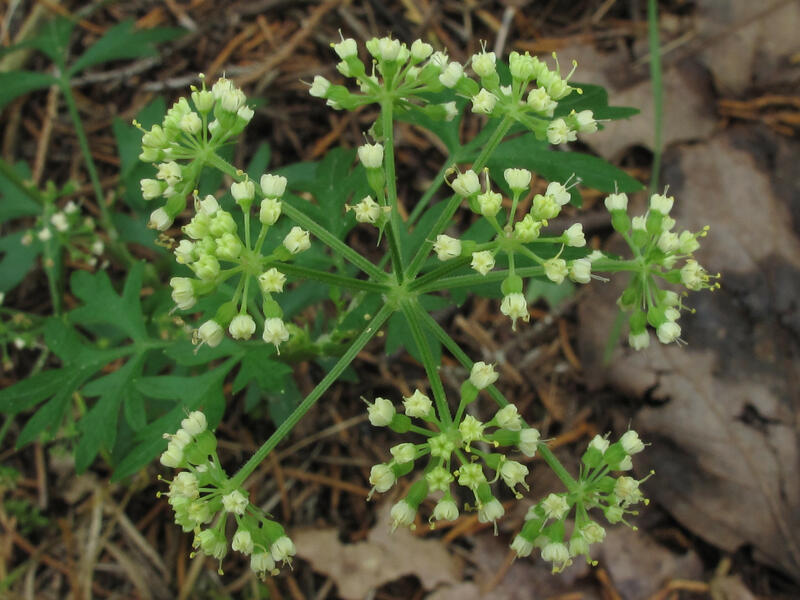
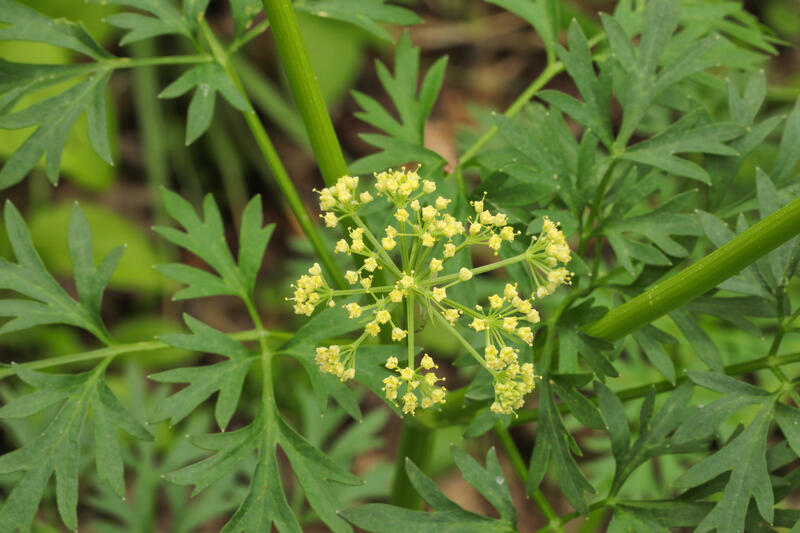
Perennial herb with an erect stem up to 3 feet (100 cm) tall, the lower stem smooth and ribbed, the upper stem hairy. The leaves are alternate, hairy, divided into narrow segments, the outermost segments usually less than 0.1 inch (1 - 3 mm) wide; the basal leaves and stem leaves are similar; leaves and leaf sheaths are not edged with a narrow, translucent margin. The flower clusters are flat-topped umbels, 3 - 6 per stem, held on stalks 1 - 2.4 inch (2.5 - 6 cm) long; each flower cluster contains several smaller clusters (umbelets) on slender stalks up to 1 inch (2.5 cm) long. The flowers have 5 tiny, cream-colored, pale yellow, or white petals. Fruits are about 0.1 inch (3 - 4 mm) long, slightly flattened, sparsely hairy, and winged.
Other Meadow-parsnips (Thaspium spp.) and Golden-alexanders (Zizia spp.) have bright yellow flowers, and their outermost leaf segments are not as narrow. Queen Anne’s-lace (Daucus carota, D. pusillus) is a large, coarse plant that occurs in disturbed areas; finely divided, leafy bracts surround the base of the flower clusters.
Creamy Meadow-parsnip (Thaspium chapmanii, Special Concern) occurs in Floyd, Bartow, and Randolph Counties in prairies and hardwood forests over limestone- or marble-based soils. For more information, see: http://missouriplants.com/Thaspium_chapmanii_page.html
Limestone cedar glades and sunny openings in adjacent woodlands.
Thaspium pinnatifidum is believed to be a weak perennial, bearing flowers only once in its short lifespan, or a biennial, flowering only during its second year then dying. The flowers provide both nectar and pollen and are visited by a variety of insect pollinators, including flies, bees, and beetles. Meadow-parsnips have a complicated flowering pattern that encourages cross-pollination: female flowers on a given plant bloom before that plant’s pollen-producing male flowers, and, in flowers with both male and female parts, the stamens and pistils ripen at different times. The seeds are dispersed by gravity and small animals, and require a period of cold dormancy in order to germinate.
Surveys are best conducted during flowering (May–June).
Georgia, Alabama, Tennessee, Kentucky, North Carolina, and possibly Virginia.
Destruction of glades habitat by trash dumping, off-road vehicle use, and conversion to pastures or developments. Invasion by exotic pest plants. Lack of sunlight due to tree canopy closure. Sites on national parkland are subject to horse and foot traffic.
| Threat 1 | Threat 2 | Threat 3 | |
|---|---|---|---|
| General Threat | Invasive & other problematic species, genes & diseases | Pollution | None |
| Specific Threat | None | None | None |
Thaspium pinnatifidum is ranked S1 by the Georgia Department of Natural Resources, indicating that the species is imperiled in Georgia. It is listed as Endangered by the State of Georgia.Three populations have been documented in Georgia, 2 are extant and occur on federal park land; the third has not been confirmed in 30 years.
Protect limestone glades from trash dumping, off-road vehicles, and conversion to pasture or developments. Limit foot and horse traffic on glades. Create forest openings with fire or hand-clearing. Eradicate exotic pest plants.
Baskin, C.C., E.W. Chester, and J.M. Baskin. 1992. Deep complex morphophysiological dormancy in seeds of Thaspium pinnatifidum (Apiaceae). International Journal of Plant Sciences 153(4): 565-571. https://www.journals.uchicago.edu/doi/abs/10.1086/297080
Chafin, L.G. 2007. Field guide to the rare plants of Georgia. State Botanical Garden of Georgia and University of Georgia Press, Athens.
GADNR. 2020. Element occurrence records for Thaspium pinnatifidum. Georgia Department of Natural Resources, Wildlife Resources Division, Social Circle, Georgia.
Lindsey, A.H. 1982. Floral phenology patterns and breeding systems in Thaspium and Zizia (Apiaceae). Systematic Botany 7(1): 1-12. https://www.jstor.org/stable/2418648?seq=1#metadata_info_tab_contents
NatureServe. 2020. Thaspium pinnatifidum species account. NatureServe Explorer. Arlington, Virginia. https://explorer.natureserve.org/Taxon/ELEMENT_GLOBAL.2.135186/Thaspium_pinnatifidum
Proctor, M., P. Yeo, and A. Lack. 1996. Natural history of pollination. Timber Press, Oregon.
Radford, A.E., H.E. Ahles, and C.R. Bell. 1968. Manual of the vascular flora of the Carolinas. University of North Carolina Press, Chapel Hill.
Small, J.K. 1933. Manual of the southeastern flora. 1972 Reprint Edition. Hafner Publishing Company, New York.
Weakley, A.S. 2015. Flora of the southern and mid-Atlantic States. University of North Carolina Herbarium, University of North Carolina, Chapel Hill. http://www.herbarium.unc.edu/flora.htm
Linda G. Chafin
L. Chafin, Sept. 2008: original account
K. Owers, Feb. 2010: added pictures
L. Chafin, June 2020: updated original account.