


Loading profile. Please wait . . .
Ruellia pinetorum Fern.
Pineland Wild Petunia




Federal Protection: No US federal protection
State Protection: No Georgia state protection
Global Rank: G5T2T3
State Rank: SH
Element Locations Tracked in Biotics: Yes
SWAP 2015 Species of Greatest Conservation Need (SGCN): No
SWAP 2025 Species of Greatest Conservation Need (SGCN): No
2025 SGCN Priority Tier:
Element Occurrences (EOs) in Georgia: 1
Habitat Summary for element in Georgia: Seasonally moist pine savannas with Aletris spp.
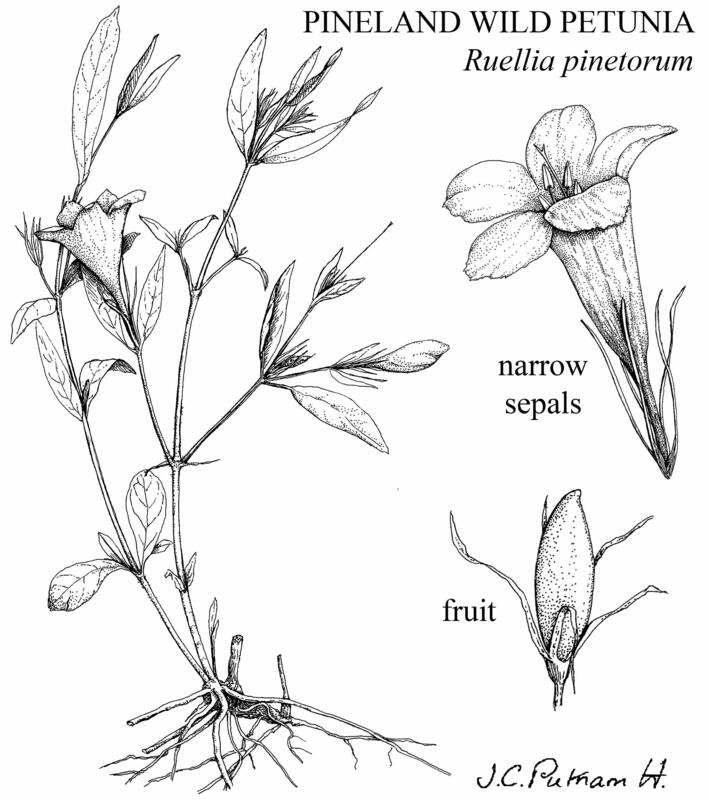
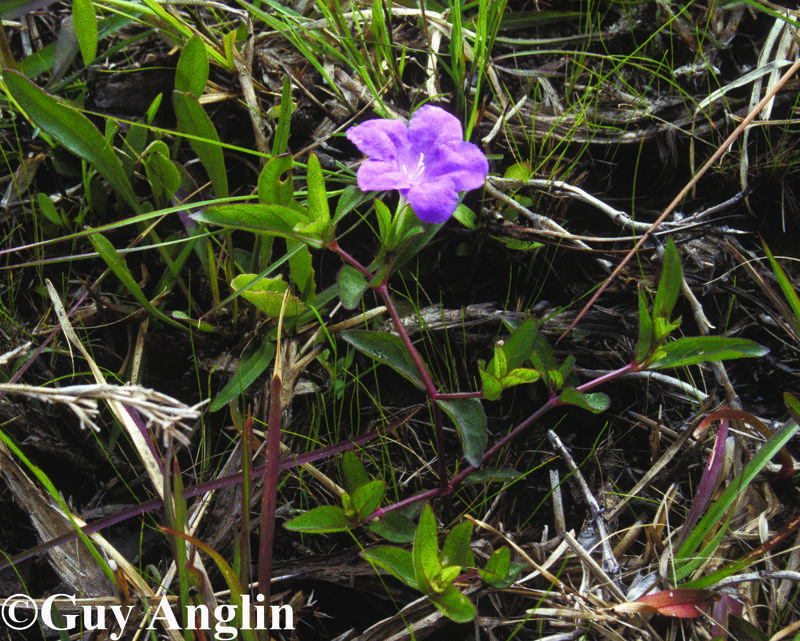
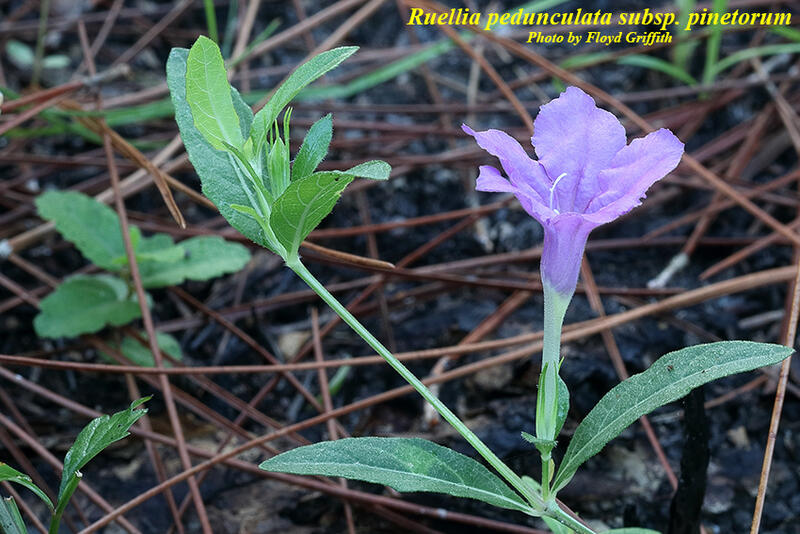
Perennial herb with reddish, minutely hairy, forking stems 4 - 16 inches (10 - 40 cm) tall. Leaves are 0.8 - 1.5 inches (2 - 4 cm) long and 0.7 inch (1.8 cm) wide, opposite, oval, with smooth or wavy margins and very short or no leaf stalks. Flowers are 1.2 - 1.6 inch (3 - 4 cm) long and 1.6 inch (4 cm) wide, purple, with 5 spreading petals; the calyx lobes are very narrow, almost bristle-like, nearly hairless but covered with cystoliths (mineral concretions that appear as dots or scales, visible only with 10x magnification). The flower stalk is about 1.2 inch (3 cm) long and straight. Fruits are hairless capsules about 0.5 inch (1.2 - 1.5 cm) long.
Carolina Wild-petunia (Ruellia caroliniensis) is a common herb found throughout Georgia in forests and woodlands. Its stems are usually unbranched, its leaf stalks are up to 0.8 inch (2 cm) long, and the flowers lack stalks.
Four species of Ruelllia are rare in Georgia:
Night-blooming Wild Petunia (Ruellia noctiflora, Special Concern) occurs moist to wet flatwoods and savannas, and low wet hammocks in southeast Georgia. For more information, see: https://www.georgiabiodiversity.org/portal/profile?group=plants&es_id=22444
Pineland Wild Petunia (Ruellia pinetorum, Special Concern) occurs in Dry to wet pine flatwoods and floodplains in the Coastal Plain. For more information, see: https://www.georgiabiodiversity.org/portal/profile?group=plants&es_id=21797
Pursh's Wild Petunia (Ruellia purshiana, Special Concern) occurs in dry woodlands and forests, especially over mafic or calcareous rocks, in north Georgia. For more information, see: https://explorer.natureserve.org/Taxon/ELEMENT_GLOBAL.2.147955/Ruellia_purshiana
Glade Wild Petunia (Ruellia strepens, Georgia Watch List) occurs in woodlands with calcium-rich soils and on limestone glades in Floyd and Catoosa Counties; its sepals are lance-shaped and about 0.1 inch (2 - 4 mm) wide. For photographs, see: https://www.discoverlife.org/mp/20q?search=Ruellia+strepens&flags=glean:&mobile=close
Dry to wet pine flatwoods and floodplains in the Coastal Plain.
Pineland Wild Petunia is a perennial herb that reproduces sexually by seed. Little else is known about its biology, but closely related species of Ruellia are well known. The flowers of other members of this genus open in early morning and wither by late afternoon. They are visited by a variety of bees and flies but only long-tongued bees, which probe the base of the flower tube for nectar, actually effect pollination. Some species of Ruellia are self-fertile. Research on Pineland Wild Petunia is needed to determine more details of its life history.
Surveys are best conducted during flowering (May–September).
Georgia, South Carolina, Florida, Alabama, Mississippi, Louisiana, and Texas.
Fire suppression, logging and other clearing, conversion of habitat to pine plantations, pastures and fields, and developments.
Ruellia pinetorum is ranked SH by the Georgia Department of Natural Resources, indicating that it has not been seen in Georgia in many years. Plants were last seen in 1994 in Lowndes County.
Burn pine flatwoods every 2 - 3 years during the growing season; avoid clearcutting, plowing fire lanes, and bedding. Avoid clearcutting in floodplains. Research on Pineland Wild Petunia is needed to determine more details of its life history and develop management recommendations.
Chafin, L.G. 2007. Field guide to the rare plants of Georgia. State Botanical Garden of Georgia and University of Georgia Press, Athens.
Fernald, M.L. 1945. Ruellia in the eastern United States. Rhodora 47:1-90. https://www.jstor.org/stable/41764765?seq=1#metadata_info_tab_contents
GADNR. 2020. Element occurrence records for Ruellia pinetorum. Georgia Department of Natural Resources, Wildlife Resources Division, Social Circle, Georgia.
Long, R.W. 1970. The genera of Acanthaceae in the southeastern United States. Journal of the Arnold Arboretum 51 (3): 257-309. https://www.jstor.org/stable/43781693?seq=1#metadata_info_tab_contents
Long, R.W. 1971. Genetic and morphological relationships of the southeastern coastal plain endemic Ruellia noctiflora (Acanthaceae). Bulletin of the Torrey Botanical Club 98(1): 16-21. https://www.jstor.org/stable/2483492?seq=1#metadata_info_tab_contents
NatureServe. 2020. Species account for Ruellia pedunculata ssp. pinetorum. NatureServe Explorer. NatureServe, Arlington, Virginia. https://explorer.natureserve.org/Taxon/ELEMENT_GLOBAL.2.141054/Ruellia_pedunculata_ssp_pinetorum
Nelson, G. 2006. Atlantic Coastal Plain wildflowers. Globe Pequot Press, Guilford, Connecticut.
Radford, A.E., H.E. Ahles, and C.R. Bell. 1968. Manual of the vascular flora of the Carolinas. University of North Carolina Press, Chapel Hill.
Wasshausen, D.C. 1998. Acanthaceae of the southeastern United States. Castanea 63(2): 99-116. https://www.jstor.org/stable/4034065?seq=1#metadata_info_tab_contents
Weakley, A.S. 2015. Flora of the southern and mid-Atlantic States. University of North Carolina Herbarium, University of North Carolina, Chapel Hill. http://www.herbarium.unc.edu/flora.htm
Linda G. Chafin
L. Chafin, Aug. 2008: original account
K. Owers, Feb. 2010: added pictures
L. Chafin, May 2020: updated original account.