

Loading profile. Please wait . . .
Chelone cuthbertii Small
Cuthbert's Turtlehead




Federal Protection: No US federal protection
State Protection: Threatened
Global Rank: G3
State Rank: S1
Element Locations Tracked in Biotics: Yes
SWAP 2015 Species of Greatest Conservation Need (SGCN): Yes
SWAP 2025 Species of Greatest Conservation Need (SGCN): Yes
2025 SGCN Priority Tier: High Conservation Concern
Element Occurrences (EOs) in Georgia: 5
Habitat Summary for element in Georgia: Bogs and wet meadows
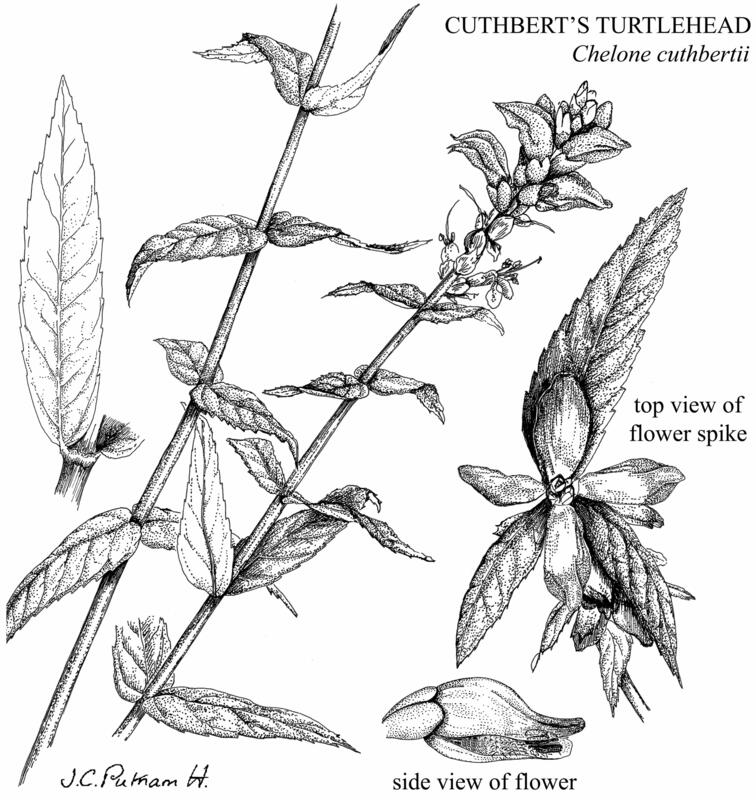
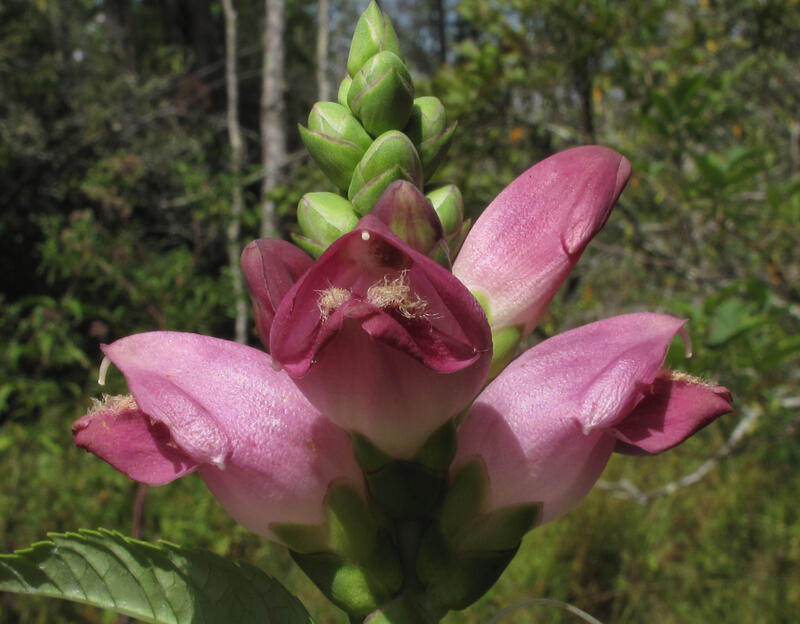
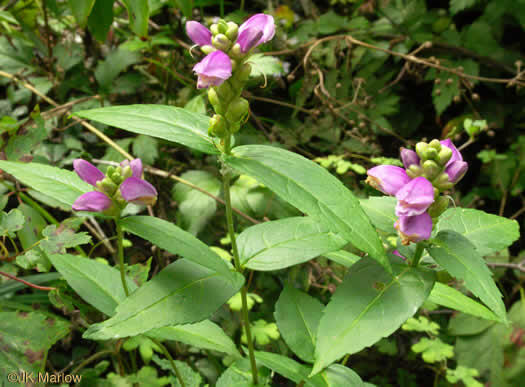
Perennial herb 16 - 39 inches (40 - 100 cm) tall. Leaves are 2 - 5 inches (5 - 12 cm) long and 0.4 - 2 inch (1 - 5 cm) wide, lance-shaped with rounded bases, slightly toothed edges, and no or very short leaf stalks; hairless except along veins, dark green on the upper surface and paler on the lower surface. Flower clusters are 1 - 2.75 inches (2.5 - 7 cm) high, distinctly 4-sided when viewed from above. Flowers are 0.8 - 1.2 inches (2 - 3 cm) long, pinkish-purple, tubular, inflated, two-lipped and nearly closed at the tip; inside the flower is a tuft of yellow hairs, 4 fertile stamens, and a short, purple-tipped, sterile stamen. Fruits are about 0.4 inch (1 cm) long, oval, with many flat, round, winged seeds.
Chelone species are quite similar; this species is distinguished by the very short or lack of leaf stalks and the purple-tipped sterile stamen (staminode).
Smooth Turtlehead (Chelone glabra) flowers are white with pink or purple tips; its leaves have tapered bases, sometimes with short leaf stalks; the sterile stamen is green. For more information, see: http://beta.floranorthamerica.org/Chelone_glabra
Purple Turtlehead (C. obliqua) has purple flowers; its leaves have tapered bases and the leaf stalks are up to 0.8 (0.3 - 2 cm) long; its sterile stamen is usually white-tipped, rarely green- or purple-tipped. For more information, see: http://beta.floranorthamerica.org/Chelone_obliqua
Chelone lyonii (Appalachian Turtlehead) occurs in wet woods, streamsides, and fens in the southern Appalachians. For more information, see: https://georgiabiodiversity.org/portal/profile?group=plants&es_id=15529
Chelone obliqua var. obliqua (Purple Turtlehead) occurs in mountains bogs in northeast Georgia. For more information, see: http://explorer.natureserve.org/servlet/NatureServe?searchName= Chelone%20obliqua%20var.%20obliqua AND https://www.illinoiswildflowers.info/wetland/plants/pink_turtlehead.htm
Mountain bogs, wet meadows, sphagnum seeps, and swamps.
Cuthbert's Turtlehead is a perennial, winter-dormant herb that sexually reproduces. Little is known about the life history of this species, but the flower and fruit ecology of the closely related White Turtlehead (Chelone glabra) has been studied, and the results – presented here – may apply to Appalachian Turtlehead. The flowers of White Turtlehead may occasionally self-pollinate but only cross-pollinated flowers will set seed. Although its flowers are visited by at least 20 species of insects, cross-pollination of White Turtlehead is effected mainly by the Half-black Bumble Bee (Bombus vagans), a species of bee that is large and strong enough to push open the nearly closed lips of the flower. Other bees, such as Common Eastern Bumble Bee (B. impatiens) and Annulate Masked Bee (Hylaeus annulatus), visit White Turtlehead flowers but do not effect pollination.
In order to prevent self-pollination, the stamens in flowers on a given White Turtlehead plant mature early, offering pollen rewards to bumble bees while their stigmas are not yet ready to receive pollen. Later, when the stamens have withered, the stigmas in the flowers on that plant become ready to receive pollen – hopefully pollen carried from the flowers of a different White Turtlehead plant that is still in male-phase. During the female-phase, the flowers produce copious amounts of nectar that attract a wide variety of insects but bumble bees are the most successful at retrieving it and effecting pollination at the same time. (Some bees rob the flower of its nectar by chewing a hole in the base of the flower and extracting nectar without passing by the anthers or the stigma.) The insignificant and seemingly useless sterile stamen may take part in pollination. By making it harder for a bee to move around inside of or exit from the flower, it increases the amount of time a bee stays in the flower and may raise the odds that it both deposits and picks up pollen.
The leaves of Chelone species contain compounds called iridoid glycosides that have a bitter taste and deter insect herbivores. However, some insects, notably Checkerspot butterflies, have adapted to the presence of these compounds. Their caterpillars eat the vegetation and sequester the compounds in their bodies (as well in the adult form), making them unpalatable to predators.
Surveys are best conducted during flowering (late July–October).
Georgia, South Carolina, North Carolina, and Virginia.
Draining of and sedimentation into mountain bogs. Conversion of mountain bogs and wetlands to agriculture. Fire suppression. Invasion by exotic pest plants digging by feral hogs.
| Threat 1 | Threat 2 | Threat 3 | |
|---|---|---|---|
| General Threat | Invasive & other problematic species, genes & diseases | Natural system modifications | Energy production & mining |
| Specific Threat | None | None | None |
Two natural populations have been documented in Georgia, one on private land that has not been seen in decades, and a second on the Chattahoochee National Forest that is actively monitored and ecologically managed. Three populations have been planted in suitable habitats as safeguarding sites in the Chattahoochee National Forest and in a state park.
Protect mountain bogs and streams from draining, filling, and other mechanical disturbances. Remove woody vegetation by hand or occasional prescribed fire. Eradicate exotic pest plants and feral hogs.
Chafin, L.G. 2007. Field guide to the rare plants of Georgia. State Botanical Garden of Georgia and University of Georgia Press, Athens.
GADNR. 2019. Element occurrence records for Chelone cuthbertii. Georgia Department of Natural Resources, Wildlife Resources Division, Social Circle, Georgia.
Godfrey, R.K. and J.W. Wooten. 1981. Aquatic and wetland plants of southeastern United States, Vol. 2, dicotyledons. University of Georgia Press, Athens.
NatureServe. 2019. Chelone cuthbertii comprehensive report. NatureServe Explorer. Arlington, Virginia. http://explorer.natureserve.org/servlet/NatureServe?searchName=Chelone%20cuthbertii
Nelson, A.D. 2012. Chelone cuthbertii species account. Flora of North America, Volume 17. Oxford University Press. http://beta.floranorthamerica.org/Chelone_cuthbertii
Nelson, A.D. and W.J. Elisens. 1999. Polyploid evolution and biogeography in Chelone (Scrophulariaceae): morphological and isozyme evidence. American Journal of Botany 86: 1487-1501. https://bsapubs.onlinelibrary.wiley.com/doi/full/10.2307/2656929
Radford, A.E., H.E. Ahles, and C.R. Bell. 1968. Manual of the vascular flora of the Carolinas. University of North Carolina Press, Chapel Hill.
Richardson, L.L. and R.W. Irwin. 2015. Pollination ecology and floral visitor spectrum of turtlehead (Chelone glabra L.; Plantaginaceae). Journal of Pollination Ecology 17(20): 132-144. https://www.pollinationecology.org/index.php?journal=jpe&page=article&op=view&path%5B%5D=354&path%5B%5D=127
Walker-Larsen, J. and L.D. Harder. 2001. Vestigial organs as opportunities for functional innovation: the example of the Penstemon staminode. Evolution 55(3): 477-487. https://onlinelibrary.wiley.com/doi/abs/10.1111/j.0014-3820.2001.tb00782.x
Weakley, A.S. 2015. Flora of the southern and mid-Atlantic States. University of North Carolina Herbarium, University of North Carolina, Chapel Hill. http://www.herbarium.unc.edu/flora.htm
Linda G. Chafin
L. Chafin, Nov. 2007: original account.
K. Owers, Jan. 2010: updated status and ranks, added pictures.
L. Chafin, Jan 2020: updated original account..