


Loading profile. Please wait . . .
Thermopsis fraxinifolia Nutt. ex Torr. & Gray
Ashleaf Bush-pea




Federal Protection: No US federal protection
State Protection: No Georgia state protection
Global Rank: G3?
State Rank: S2?
Element Locations Tracked in Biotics: Yes
SWAP 2015 Species of Greatest Conservation Need (SGCN): Yes
SWAP 2025 Species of Greatest Conservation Need (SGCN): Yes
2025 SGCN Priority Tier: High Conservation Concern
Element Occurrences (EOs) in Georgia: 16
Habitat Summary for element in Georgia: Oak and oak-pine ridge forests
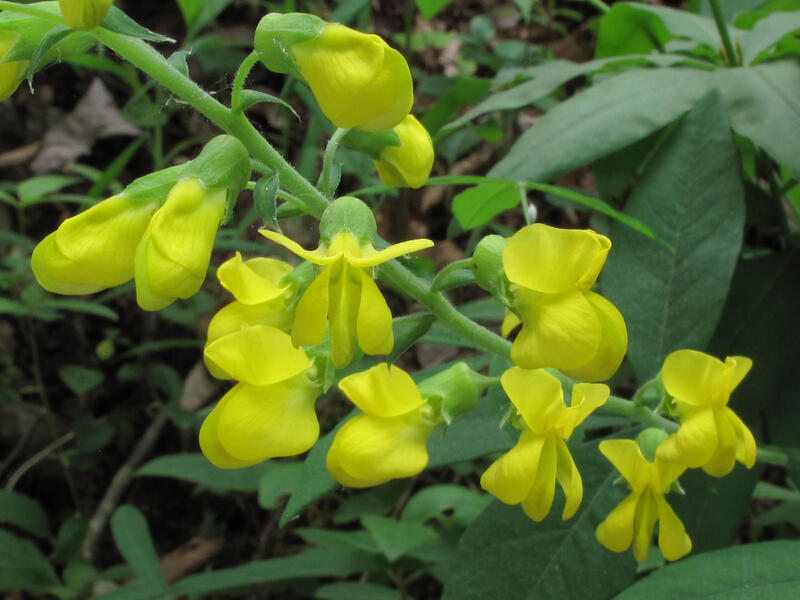
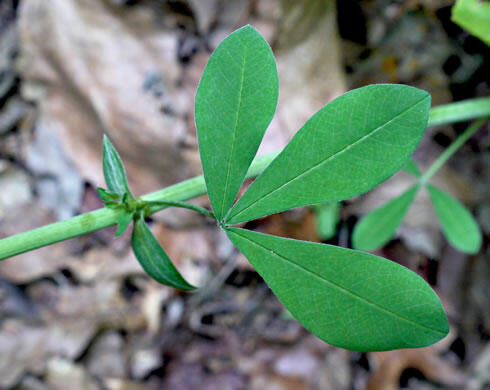
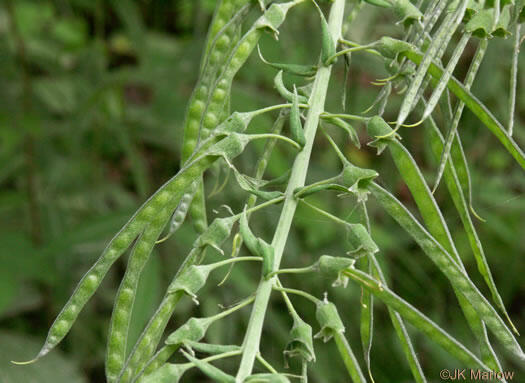
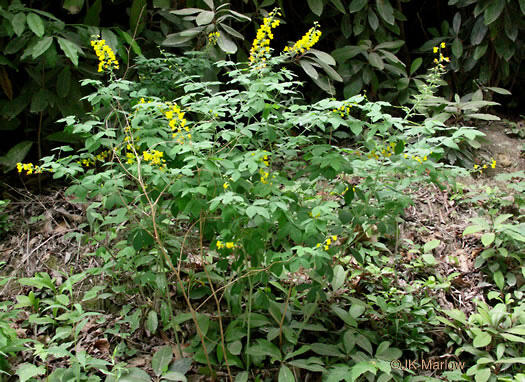
Perennial herb with several erect, slender, smooth or slightly hairy stems, 1.6 - 3.3 feet (50 - 100 cm) tall, rising in a cluster from a single woody rootstock (not rhizomatous), with strongly zigzagged, spreading branches. Leaves are alternate and compound with three elliptic leaflets and a pair of green, narrowly oval stipules at the base of the leaf stalk (the stipules are deciduous and are not always present). Leaf stalks are 0.6 - 1 inch long (1.6 - 3 cm) long. Leaflets are 1.8 - 3 inches long and 0.8 - 1.4 inches wide (4.5 - 8 cm long and 2 - 3.5 cm wide), smooth or slightly hairy, with entire margins and 9 - 12 pairs of veins forming a conspicuous network on the lower leaf surface. Flower clusters are 4.7 - 10 inches (12 - 25 cm) long, held at the top of the stem and below, arching to drooping, with 7 - 25 scattered flowers. Flowers are 0.6 - 0.75 inch (1.6 - 1.9 cm) long, yellow, with a typically pea-flower shape: an erect banner petal, two wing petals, and a keel petal mostly hidden by the wings and enclosing 10 free stamens and a tiny, slender ovary. The calyx is green, smooth or slightly hairy, often waxy-white, and bell-shaped with 4 spreading lobes. The flowers are on hairless stalks that are up to 0.8 inch (4 - 20 mm) long, as long as or longer than the bracts at the base of each flower stalk. The fruit is a narrow, flattened legume, 1 - 3 inches (3 - 7.5 cm) long, green turning tan or brown, with 5 - 15 kidney-shaped seeds.
Rattlebox or Rattleweed species, such as Crotalaria spectabilis and Crotalaria retusa, are large, invasive plants with erect flower clusters, yellow flowers, and trifoliate leaves. Both occur largely in disturbed areas and have large, inflated pods.
Thermopsis villosa (Carolina Golden Banner) occurs in habitats similar to that of T. fraxinifolia. It has showy, leafy stipules at least 1.5 inches (4 cm) long and 1 - 2 inches (1-2.5 cm) wide that clasp the stem at the base of the leaf stalk. Its leaflets have 6 - 8 pairs of veins. The flower clusters are held erect at the top of the plant, and the flower stalks are very short, less than 3 mm long. The pods are held erect and are densely hairy. For more information, see: https://georgiabiodiversity.org/portal/profile?group=plants&es_id=17025
Thermopsis mollis (Downy Bush-pea) occurs on dry slopes and ridges, mostly in open pine-oak forests, usually at lower elevations than T. fraxinifolia. T. mollis is a delicate plant with slender stems, fewer branches, 7 - 9 pairs of leaflet veins, flower clusters produced only at the top of the stem, hairy flower stalks that are shorter than the bracts. It forms colonies by extensive systems of rhizomes. It typically flowers two weeks before Thermopsis fraxinifolia. For more information, see: http://explorer.natureserve.org/servlet/NatureServe?searchName=Thermopsis%20mollis
Hybrids between Thermopsis fraxinifolia and Thermopsis mollis have been observed in Tennessee.
In Georgia, Ash-leaf Bush-pea is known mostly from moist to dry-moist deciduous, montane forests; also documented on roadsides and in floodplains and river islands in the upper Piedmont.
Ash-leaf Bush-pea is a perennial member of the Bean Family that reproduces sexually by seed; it lacks rhizomes and does not reproduce vegetatively. Ash-leaf Bush-pea's flowers, like those of many plants in the Bean Family, are pollinated by bees, such as bumblebees, which are large enough and heavy enough to part the wing petals and depress the keel petal, thus exposing the stamens and pistils. Bumblebees also have long tongues, which allow them to gather nectar from the nectaries located at the base of the petals while brushing against the pollen-laden anthers. Although no research has been done on toxicity in Ash-leaf Bush-pea, other species of Thermopsis are known to be toxic to grazing and browsing mammals.
Ash-leaf Bush-pea is most conspicuous when in flower, late April–July, but may be identified later in the growing season by its trifoliate leaves, and long, slender, flattened pods.
Southern Appalachian Mountains of Georgia, South Carolina, North Carolina, and Tennessee, and adjacent areas in the Piedmont.
Ash-leaf Bush-pea is threatened by logging, clearing, and development in mountain forests. Floodplain populations are threatened by impoundment (one Georgia population was destroyed when Lake Russell was built).
| Threat 1 | Threat 2 | Threat 3 | |
|---|---|---|---|
| General Threat | Human intrusions & disturbance | Natural system modifications | Invasive & other problematic species, genes & diseases |
| Specific Threat | None | None | None |
Thermopsis fraxinifolia is ranked S2? by the Georgia Department of Natural Resources, indicating that it is probably imperiled in the state but that there is not sufficient information to make a definitive ranking. Further surveys are needed to confirm historic populations and search for new sites. Fifteen populations have been documented in Georgia, most in the Chattahoochee National Forest, but nine of these were last seen before 1984.
Protect mountain and Piedmont forests from logging and development.
Chen, C.J., M.G. Mendenhall, and B.L. Turner. 1994. Taxonomy of Thermopsis (Fabaceae) in North America. Annals of the Missouri Botanical Garden 81(4): 714-742. https://www.jstor.org/stable/2399917?seq=1#metadata_info_tab_contents
GADNR. 2019. Element occurrence records for Thermopsis fraxinifolia. Georgia Department of Natural Resources, Wildlife Resources Division. Social Circle, Georgia.
Isely, D. 1990. Vascular flora of the southeastern United States, Vol. 3, Leguminosae (Fabaceae). University of North Carolina Press, Chapel Hill.
NatureServe. 2019. Species account for Thermopsis fraxinifolia. NatureServe Explorer. NatureServe, Arlington, Virginia. https://explorer.natureserve.org/Taxon/ELEMENT_GLOBAL.2.141200/Thermopsis_fraxinifolia
Weakley, A.S. 2015. Flora of the southern and mid-Atlantic States. University of North Carolina Herbarium, University of North Carolina, Chapel Hill. http://www.herbarium.unc.edu/flora.htm
Linda G. Chafin
Linda G. Chafin, 23 December 2019: original account