

Loading profile. Please wait . . .
Epidendrum magnoliae Muhl.
Greenfly Orchid




Federal Protection: No US federal protection
State Protection: Unusal
Global Rank: G4
State Rank: S3
Element Locations Tracked in Biotics: Yes
SWAP 2015 Species of Greatest Conservation Need (SGCN): No
SWAP 2025 Species of Greatest Conservation Need (SGCN): No
2025 SGCN Priority Tier:
Element Occurrences (EOs) in Georgia: 86
Habitat Summary for element in Georgia: Epiphytic on limbs of evergreen hardwoods; also in crevices of Altamaha Grit outcrops
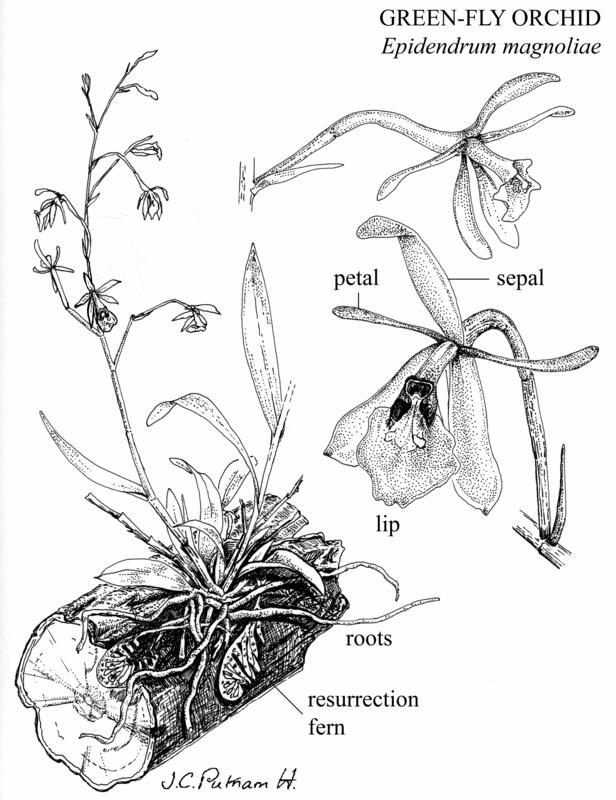
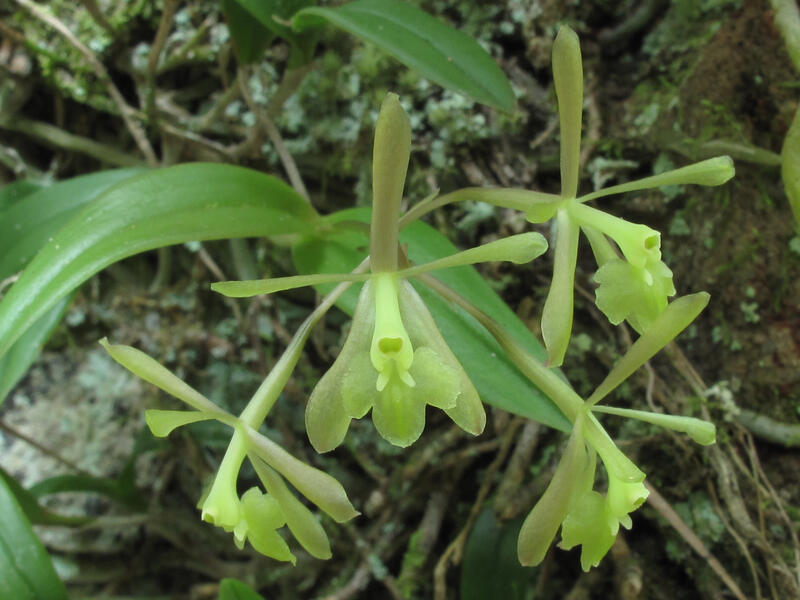
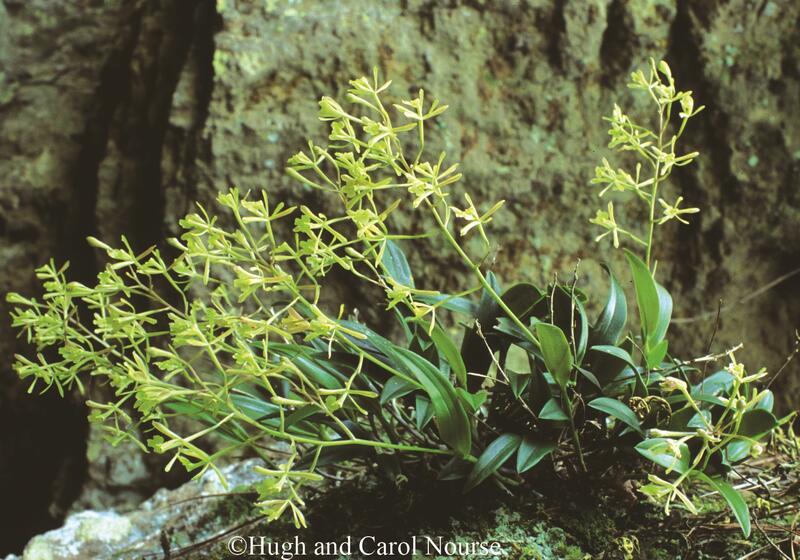
Perennial herb with an unbranched stem up to 12 inches (30 cm) long; its fleshy roots are embedded in the bark of tree limbs or in rock crevices. The leaves are 1.2 - 4 inches (3 - 10 cm) long and up to 0.6 inch (1.5 cm) wide, 2 - 3 per plant, growing mostly at the base of the stem with a few much reduced bracts on the stem itself; the leaves are oval, dark green, leathery, glossy, over-wintering, and present during flowering. The flower spike has a single row of 6 - 18, yellowish-green flowers spiraling around the stem, all blooming at the same time; each flower stalk is covered with gland-tipped hairs. Flowers are about 1 inch (2 - 3 cm) wide, yellowish-green to bronze; 3 sepals are up to 0.4 inch (1.1 cm) long, narrow and widely spreading; 2 petals are similar. The much wider lip petal is 3-lobed and curves slightly downward, with two conspicuous fleshy bumps near the base. The fruit is an elliptical capsule, about 0.3 inch (7 - 11 mm) long, with many tiny, dust-like seeds.
Green-fly Orchid is one of only a few epiphytic (tree-dwelling) and epipetric (rock-dwelling) species that occur in south Georgia; other such species include ferns and bromeliads, none of which could be confused with this orchid. There are no other epiphytic orchids in Georgia.
More than 30 species of orchids are rare in Georgia. See on this web site: many-flowered grass-pink (Calopogon multiflorus), pink lady’s-slipper (Cypripedium acaule), Kentucky lady’s-slipper (Cypripedium kentuckiense), yellow lady’s-slipper (Cypripedium parviflorum), green-fly orchid (Epidendrum magnoliae), Michaux's spider orchid (Habenaria quinqueseta), small whorled pogonia (Isotria medeoloides), Appalachian twayblade (Listera smallii), Florida adder's-mouth orchid (Malaxis spicata), southern white fringed-orchid (Platanthera blephariglottis), Chapman's fringed-orchid (Platanthera chapmanii), large purple fringed-orchid (Platanthera grandiflora), monkeyface orchid (Platanthera integrilabia), purple fringeless orchid (Platanthera peramoena), crestless plume orchid (Pteroglossaspis ecristata), downy slender ladies-tresses (Spiranthes brevilabris), Florida ladies-tresses (Spiranthes floridana), Great Plains ladies-tresses (Spiranthes magnicamporum), and three birds orchid (Triphora trianthophora).
Limbs of Southern Magnolia (Magnolia grandiflora) and Live Oak (Quercus virginiana) trees in moist forests, usually along streams; sandstone-like walls of crevices in Altamaha Grit outcrops, where the porous rock provides a constant moisture source.
Epidendrum magnoliae (synonym Epidendrum conopseum) is a perennial orchid usually found on the limbs of trees and, less frequently, on sandstone outcrops, with its roots embedded in fissures in the tree bark or sandstone. It reproduces sexually; its flowers are especially fragrant at night and are pollinated by moths. Each fruit contains thousands of minute seeds that are dispersed by the wind. The dust-like seeds contain no stored food reserves, and must land on a patch of bark or soil containing a specific mycorrhizal fungus (Epulorhiza sp.) that provides nutrients for germination and subsequent plant growth.
Surveys may be conducted year-round since plants are evergreen; plants are somewhat more conspicuous during flowering (June–July, sporadically until October) and fruiting (September–January).
Georgia, Alabama, Florida, Louisiana, Mississippi, South Carolina, North Carolina, and eastern Mexico. Green-fly Orchid is the only epiphytic orchid to occur outside of Florida.
Poaching by orchid collectors, logging, and other clearing in lowland forests.
Epidendrum magnoliae is ranked S3 by the Georgia Department of Natural Resources, indicating that the species is vulnerable to extirpation in Georgia. About 80 populations have been documented in Georgia but only 11 have been confirmed since 2000. Ten populations occur in conservation areas, and 13 occur on military installations.
Protect plants from poaching and prosecute plant poachers; protect bottomland and floodplain forests from clearcutting or other logging.
Brown, P.M. and S.N. Folsom. 2004. Wild orchids of the southeastern United States, north of peninsular Florida. University Press of Florida, Gainesville.
Chafin, L.G. 2007. Field guide to the rare plants of Georgia. State Botanical Garden of Georgia and University of Georgia Press, Athens.
GADNR. 2020. Element occurrence records for Epidendrum magnoliae. Georgia Department of Natural Resources, Wildlife Resources Division, Social Circle, Georgia.
Hágsater, E. 2003. Epidendrum magnoliae species account. Flora of North America, Vol. 26. Oxford University Press, New York. http://www.efloras.org/florataxon.aspx?flora_id=1&taxon_id=242101580
Hágsater, E. 2000. New names for Florida Epidendrums. North American Native Orchid Journal 6(4).
NatureServe. 2019. Epidendrum magnoliae comprehensive report. NatureServe Explorer. Arlington, VA. http://explorer.natureserve.org/servlet/NatureServe?searchName=Epidendrum%20magnoliae
Weakley, A.S. 2015. Flora of the southern and mid-Atlantic States. University of North Carolina Herbarium, University of North Carolina, Chapel Hill. http://www.herbarium.unc.edu/flora.htm
Zettler, L.W., T.W. Delaney, and J.A. Sunley. 1998. Seed propagation of the epiphytic green-fly orchid, Epidendrum conopseum R. Brown, using its endophytic fungus. Selbyana 19(2): 249-253. https://www.jstor.org/stable/41759996
Zettler, L.W., S.B. Poulter, K.I. McDonald, and S.L. Stewart. 2007. Conservation-driven propagation of an epiphytic orchid (Epidendrum nocturnum) with a mycorrhizal fungus. HortScience 42(1): 135-139. https://journals.ashs.org/hortsci/view/journals/hortsci/42/1/article-p135.xml
Linda G. Chafin
L. Chafin, Mar. 2007: original account
K. Owers, Jan. 2010: added pictures
L. Chafin, Feb 2020: updated original account.