

Loading profile. Please wait . . .
Rhynchospora thornei Kral
Thorne's Beakrush




Federal Protection: No US federal protection
State Protection: No Georgia state protection
Global Rank: G3
State Rank: S2
Element Locations Tracked in Biotics: Yes
SWAP 2015 Species of Greatest Conservation Need (SGCN): Yes
SWAP 2025 Species of Greatest Conservation Need (SGCN): Yes
2025 SGCN Priority Tier: High Conservation Concern
Element Occurrences (EOs) in Georgia: 8
Habitat Summary for element in Georgia: Margins of limesink ponds; moist limestone barrens, wet prairies
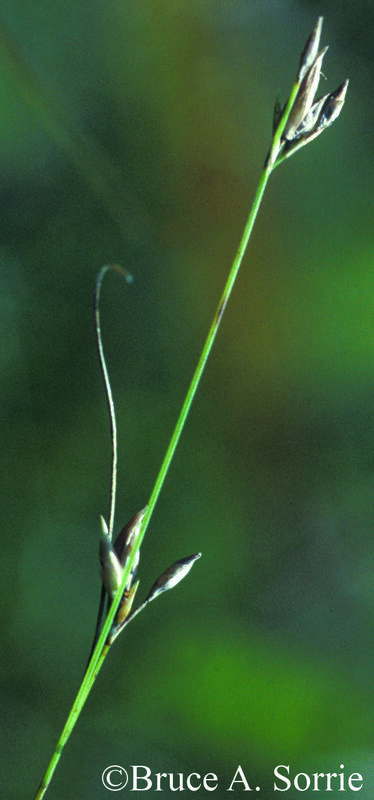
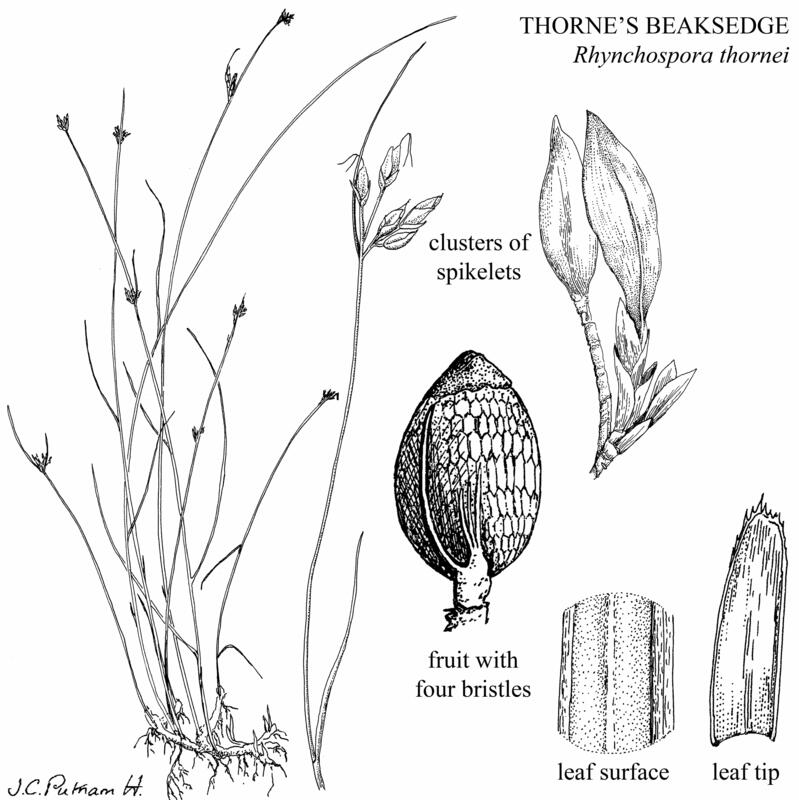
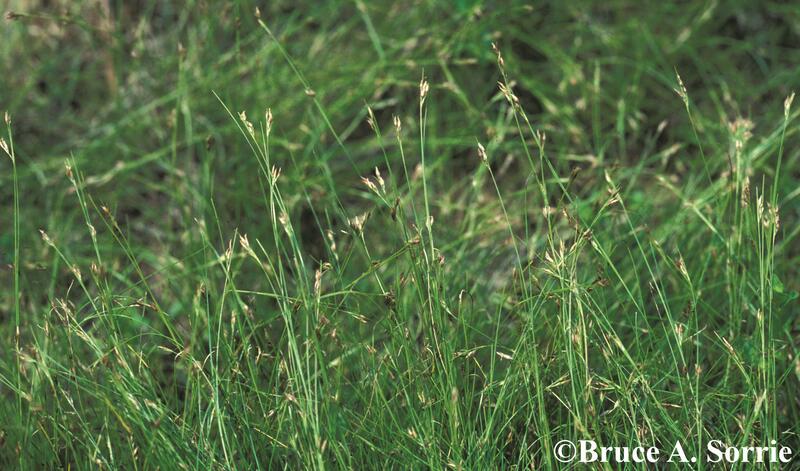
Perennial, grass-like herb forming dense clumps from lateral offshoots and mats from underground stems (rhizomes). Stems are 4 - 8 inches (10 - 20 cm) tall, wiry, and flexible. Leaves are up to 5 inches (13 cm) long, often much shorter, very narrow and wiry. Flower cluster is usually held at the top of the stem; 1 - 2 other clusters may be widely spaced along the stem; each cluster has 1 - 3 narrow, pointed spikelets. Spikelets are less than 0.1 inch (2.5 - 3 mm) long, with brown scales and 2 oval, pale brown, seed-like fruits. Fruits are less than 1 mm long, including the pointed tip (tubercle), yellowish with a patterned surface; 2 - 6 very short, nearly undetectable, white, barbed bristles are attached to the base of the fruit. Beaksedge species are difficult to identify; 10 - 20x magnification is needed to examine spikelets, fruits, and especially the bristles, which are otherwise undetectable.
Few-flowered Beaksedge (Rhynchospora rariflora) has fruits 1.8 - 2 mm long.
Two other similar Beaksedges (R. divergens and R. pusilla) may occur with Thorne’s beaksedge; they lack underground stems, their spikelets contain 1 - 3 or more fruits, and their fruits lack bristles (Thorne’s Beaksedge bristles are very difficult to see).
Fifteen species of beaksedge are rare in Georgia. For more information, see:
Northern White Beaksedge (Rhynchospora alba) http://beta.floranorthamerica.org/Rhynchospora_alba
Bearded Beaksedge (Rhynchospora crinipes) https://www.georgiabiodiversity.org/portal/profile?group=plants&es_id=20946
Georgia Beaksedge (Rhynchospora culixa) https://www.georgiabiodiversity.org/portal/profile?group=plants&es_id=17285
Decurrent Beaksedge (Rhynchospora decurrens) https://www.georgiabiodiversity.org/portal/profile?group=plants&es_id=21032
Fernald's Beakrush (Rhynchospora fernaldii) https://www.georgiabiodiversity.org/portal/profile?group=plants&es_id=20462
Harper's Beaksedge (Rhynchospora harperi) https://www.georgiabiodiversity.org/portal/profile?group=plants&es_id=17092
Many-bristled Beaksedge (Rhynchospora macra) https://www.georgiabiodiversity.org/portal/profile?group=plants&es_id=19539
Feather-bristle Beaksedge (Rhynchospora oligantha) http://beta.floranorthamerica.org/Rhynchospora_oligantha
Clonal Thread-leaved Beak (Rhynchospora pleiantha) https://www.georgiabiodiversity.org/portal/profile?group=plants&es_id=19634
Spotted Beaksedge (Rhynchospora punctata) https://www.georgiabiodiversity.org/portal/profile?group=plants&es_id=20475
Long-beak Beaksedge (Rhynchospora scirpoides) http://beta.floranorthamerica.org/Rhynchospora_scirpoides
Solitary Beaksedge (Rhynchospora solitaria) https://www.georgiabiodiversity.org/portal/profile?group=plants&es_id=21235
Chapman's Beakrush (Rhynchospora stenophylla) http://beta.floranorthamerica.org/Rhynchospora_stenophylla
Thorne’s Beaksedge (Rhynchospora thornei) https://www.georgiabiodiversity.org/portal/profile?group=plants&es_id=22487
Torrey's Beaksedge (Rhynchospora torreyana) http://beta.floranorthamerica.org/Rhynchospora_torreyana
Edges of limesink ponds, wet seeps over calcium-rich rock, openings and stream edges in wet to moist prairies; ditches and rights-of-way through these habitats. Often occurs with Narrow-leaf White-topped Sedge (Rhynchospora colorata).
Thorne’s Beaksedge is a perennial herb that reproduces sexually by seed as well as vegetatively by producing rhizomes and lateral offshoots at the base of the plant. All beaksedge flowers are wind-pollinated; their fruits are dispersed by water and gravity, and also by animals, assisted by the tiny, barbed bristles at the base of the fruit which attach to fur and feathers.
Surveys are best conducted during fruiting (June–October). Mature fruits and 10 - 20x magnification are needed for identification.
Georgia, Florida, Alabama, and North Carolina.
Conversion of wetland habitat to pine plantations, agriculture, and development; fire suppression; drying of ponds due to lowering of groundwater table by excessive withdrawal, disturbances to streamside zones, and use of herbicides in roadside rights-of-way.
| Threat 1 | Threat 2 | Threat 3 | |
|---|---|---|---|
| General Threat | Transportation & service corridors | Biological resource use | Human intrusions & disturbance |
| Specific Threat | None | None | None |
Rhynchospora thornei is ranked S2 by the Georgia Department of Natural Resources, indicating that is imperiled in the state. Eight populations have been documented in Georgia, 3 on conservation lands.
Protect isolated wetlands and small streams from filling, pollution, and off-road-vehicle access. Apply prescribed fire every 2 - 3 years in adjacent uplands, allowing fire to burn into pond and stream edges. Avoid herbicide use in rights-of-way and schedule mowing after fruiting.
Chafin, L.G. 2007. Field guide to the rare plants of Georgia. State Botanical Garden of Georgia and University of Georgia Press, Athens.
Kral, R. 2003. Species account for Rhynchospora thornei. Flora of North America, Vol. 23. http://beta.floranorthamerica.org/Rhynchospora_thornei
Gale, S. 1944. Rhynchospora, section Eurhynchospora, in Canada, the United States, and the West Indies. Rhodora 46(2): 169-175. https://www.jstor.org/stable/41764534?seq=1#metadata_info_tab_contents
Kral, R. 1977. A new species of Rhynchospora (Cyperaceae) from southwestern Georgia. Sida 7(1): 42-50. https://www.jstor.org/stable/41966515?seq=1#metadata_info_tab_contents
LeBlond, R.J. and B.A. Sorrie. 2003. Rhynchospora thornei status survey. U.S. Fish and Wildlife Service, Asheville, North Carolina.
NatureServe. 2020. Species account for Rhynchospora thornei. NatureServe Explorer. NatureServe, Arlington, Virginia. https://explorer.natureserve.org/Taxon/ELEMENT_GLOBAL.2.147674/Rhynchospora_thornei
Weakley, A.S. 2015. Flora of the southern and mid-Atlantic States. University of North Carolina Herbarium, University of North Carolina, Chapel Hill. http://www.herbarium.unc.edu/flora.htm
Linda G. Chafin
L. Chafin, Aug. 2008: original account
K. Owers, Feb. 2010: added pictures
L. Chafin, May 2020: updated original account