


Loading profile. Please wait . . .
Megaceros aenigmaticus Schust.
Headwaters Hornwort




Federal Protection: No US federal protection
State Protection: Threatened
Global Rank: G3
State Rank: S2
Element Locations Tracked in Biotics: Yes
SWAP 2015 Species of Greatest Conservation Need (SGCN): Yes
SWAP 2025 Species of Greatest Conservation Need (SGCN): Yes
2025 SGCN Priority Tier: High Conservation Concern
Element Occurrences (EOs) in Georgia: 25
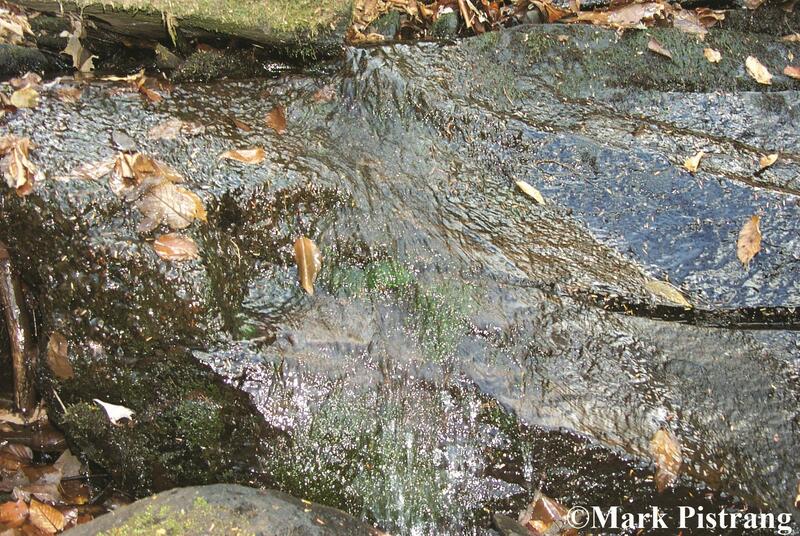
Habitat Summary for element in Georgia: Shaded rocks in small streams, springs or waterfall spray zones
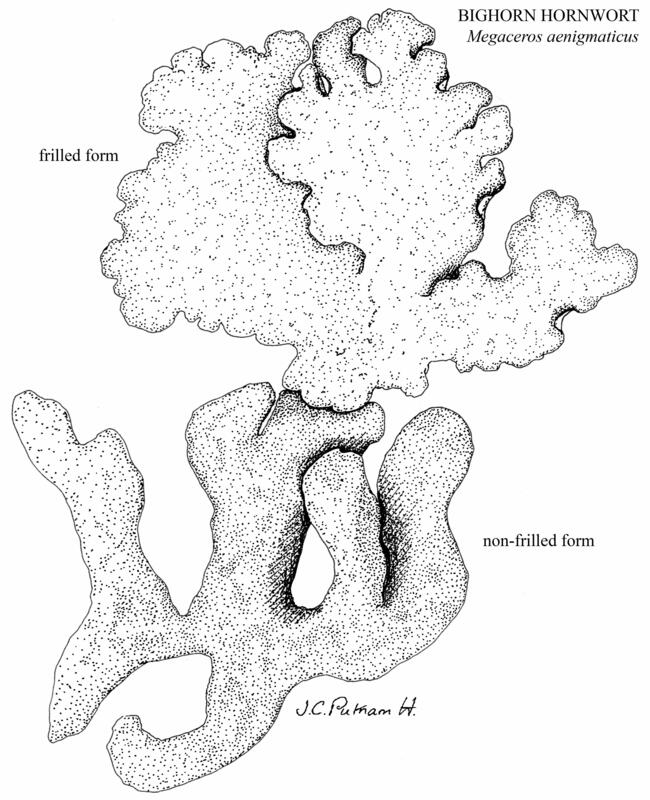
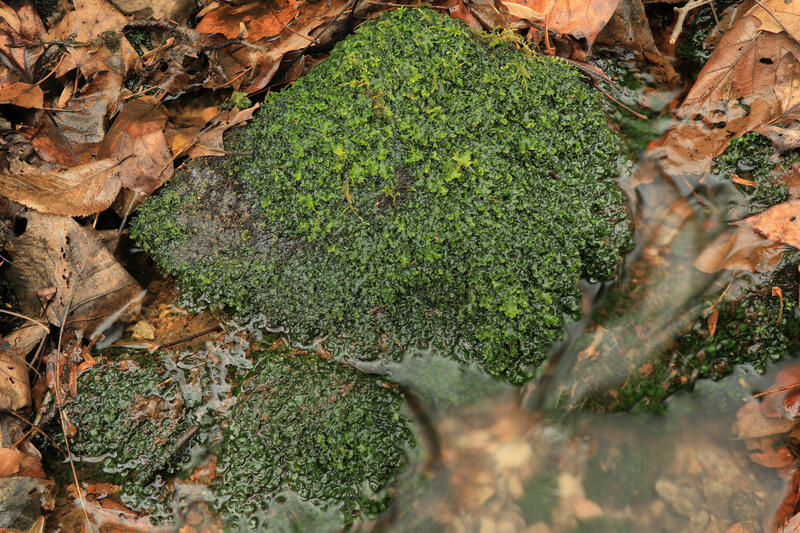
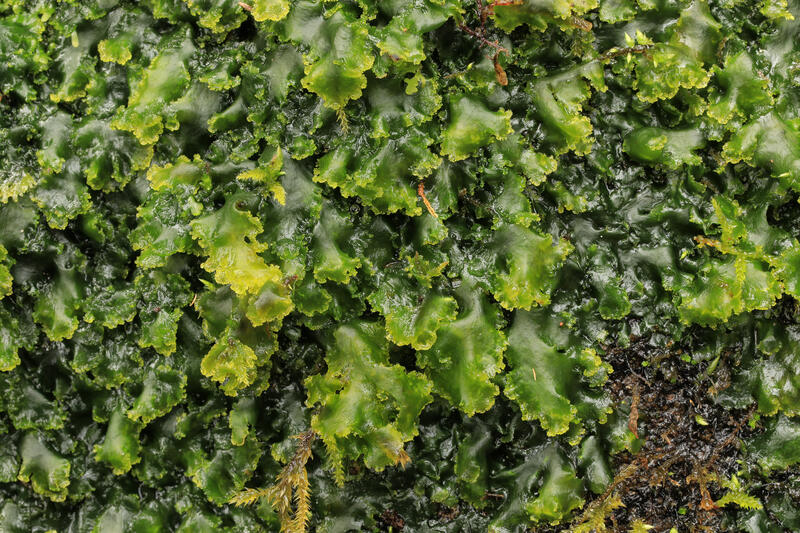
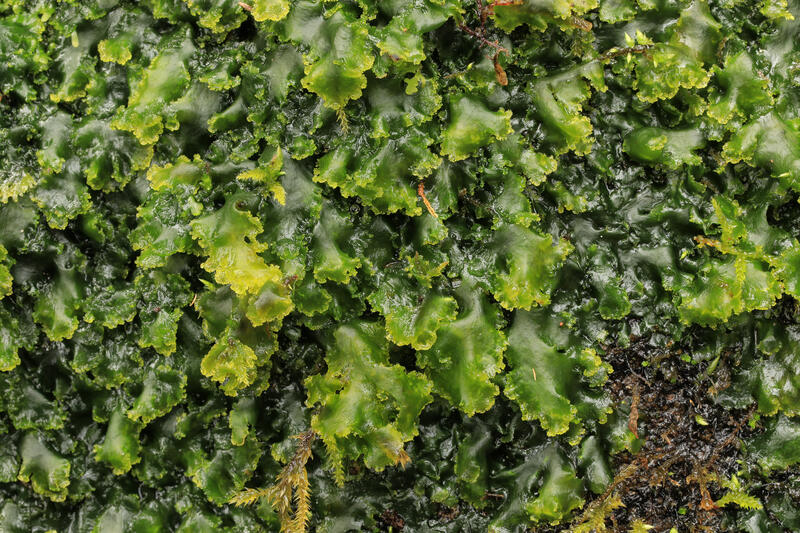
Megaceros aenigmaticus (synonym Nothoceros aenigmaticus) is a hornwort, a non-vascular plant related to mosses and liverworts, that forms masses of thin, dark green sheets on wet rocks. Plants are up to 1.6 inch (3 - 4 cm) long and less than 0.2 inch (3 - 4.2 mm) wide, dark blue-green, thick, and crisp; there are no veins or hair-like scales along the margins. Plants occur in 2 different forms. The “frilled” form has lobes that are about the same width as the body, and the edges of the plant are fringed, toothed, or distorted. The non-frilled form consists of a narrow strap-like body with many narrow, branching lobes. These plants are not known to reproduce sexually.
Headwaters Hornwort often occurs with Filmy Ferns (Trichomanes spp.), which have veins and are larger than most hornworts, and with Dumortier's Liverwort (Dumortiera hirsuta) which has hair-like scales along the margins.
None in Georgia.
Shaded, submerged or permanently wet rocks in small streams, spring heads, or waterfall spray zones; rarely on dead wood; usually under rosebay rhododendron. Plants cannot survive the siltation or scouring found in larger streams.
Headwaters Hornworts grow in thin, overlapping sheets on wet rocks. Under marginal conditions, plants do not produce reproductive structures at all. In better conditions, female plants will produce egg-bearing structures (archegonia). Plants that produce sperm-bearing structures (antheridia) have never been seen; presumably they have been destroyed. Thus reproduction is only vegetative, and occurs when fragments of the plants break off and are swept downstream.
Surveys may be conducted all year.
Georgia, North Carolina, and Tennessee.
Logging or other clearing near streams and waterfalls. Loss of Canada Hemlock to hemlock woolly adelgid infestations. Recreational over-use of habitat. Over-collection.
| Threat 1 | Threat 2 | Threat 3 | |
|---|---|---|---|
| General Threat | Natural system modifications | Pollution | None |
| Specific Threat | Other ecosystem modifications | Agricultural & forestry effluents | None |
Megaceros aenigmaticus is ranked S2 by the Georgia Department of Natural Resources, indicating that it is imperiled in Georgia. It is also listed as Threatened by the State of Georgia. Twenty-five populations have been documented in Georgia; most occur on state conservation land or in the Chattahoochee National Forest.
Avoid clearing, logging, and construction near streams and waterfalls. Eradicate Hemlock Woolly Adelgid, which kills the shade-providing, water-cooling hemlocks that border mountain streams. Direct foot and other recreational traffic away from populations. Limit collection.
Chafin, L.G. 2007. Field guide to the rare plants of Georgia. State Botanical Garden of Georgia and University of Georgia Press, Athens.
GADNR. 2020. Element occurrence records for Megaceros aenigmaticus. Georgia Department of Natural Resources, Wildlife Resources Division, Social Circle, Georgia.
Hicks, M.L. 1992. Guide to the liverworts of North Carolina. Duke University Press, Durham, North Carolina.
Hicks, M.L. and P.G. Davison. 1989. Some rare, endemic, and disjunct liverworts in North Carolina. Castanea 54: 255-261. https://www.jstor.org/stable/pdf/4033514.pdf
Hicks, M.L. and J.L. Amoroso. 1996. Bryophyte status survey: Megaceros aenigmaticus Schuster. North Carolina Natural Heritage Program and Endangered Species Field Office, U.S. Fish and Wildlife Service, Asheville.
Hyatt, P.E. 2006. Noteworthy collections: Megaceros aenigmaticus Schust. (Anthocerotaceae) in Georgia. Castanea 71(2): 178.
NatureServe. 2019. Megaceros aenigmaticus comprehensive report. NatureServe Explorer. Arlington, Virginia. http://explorer.natureserve.org/servlet/NatureServe?searchName=Megaceros+aenigmaticus
Renzaglia, K.S. and K.D. McFarland. 1999. Antheridial plants of Megaceros aenigmaticus in the southern Appalachians: anatomy, ultrastructure, and population distribution. Haussknechtia Beiheft 9: 307-316.
Schuster, R.M. 1992. On Megaceros aenigmaticus Schust. The Bryologist 95(3): 305-315. https://www.jstor.org/stable/pdf/3243489.pdf
Stotler, R.E. and B. Crandall-Stotler. 2005. A revised classification of the Antherocerotophyta and a checklist of the hornworts of North America, north of Mexico. The Bryologist 108(1):16-26. https://doi.org/10.1639/0007-2745(2005)108[16:ARCOTA]2.0.CO;2
Villarreal, J.C., B. Goffinet, R.J. Duff, D.C. Cargill. 2013. Phylogenetic delineation of Nothoceros and Megaceros (Dendrocerotaceae). Bryologist 113(1): 106-113. https://doi.org/10.1639/0007-2745-113.1.106
Villarreal, J.C., L.L. Forrest , K. McFarland, and B. Goffinet. 2012. Chloroplast, mitochondrial, and nuclear microsatellites from the southern Appalachian hornwort, Nothoceros aenigmaticus (Dendrocerotaceae). American Journal of Botany.
Villarreal, J.C., L.L. Forrest , K. McFarland, and B. Goffinet. 2013. The plastid genome of the hornwort Nothoceros aenigmaticus (Dendrocerotaceae): phylogenetic signal in inverted repeat expansion, pseudogenization, and intron gain. American Journal of Botany 100(3): 467-477.
Linda G. Chafin
L. Chafin, Jun 2008: original account
K. Owers, Feb 2010: added pictures
L. Chafin, Mar 2020: updated original account