


Loading profile. Please wait . . .
Ilex collina Alexander
Long-stalk Holly




Federal Protection: No US federal protection
State Protection: No Georgia state protection
Global Rank: G3
State Rank: S1
Element Locations Tracked in Biotics: Yes
SWAP 2015 Species of Greatest Conservation Need (SGCN): No
SWAP 2025 Species of Greatest Conservation Need (SGCN): Yes
2025 SGCN Priority Tier: High Conservation Concern
Element Occurrences (EOs) in Georgia: 2
Habitat Summary for element in Georgia: High elevation bolderfields on seepage slopes
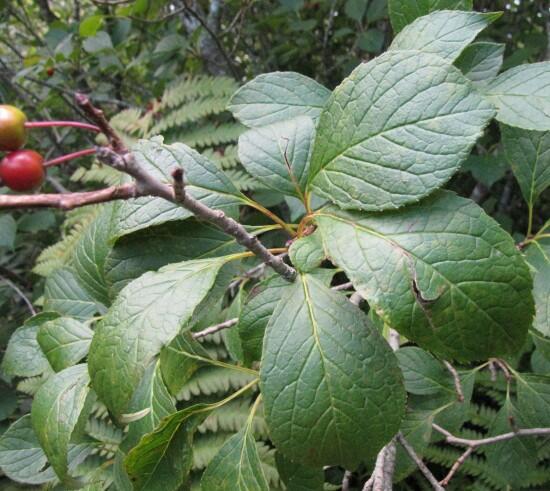
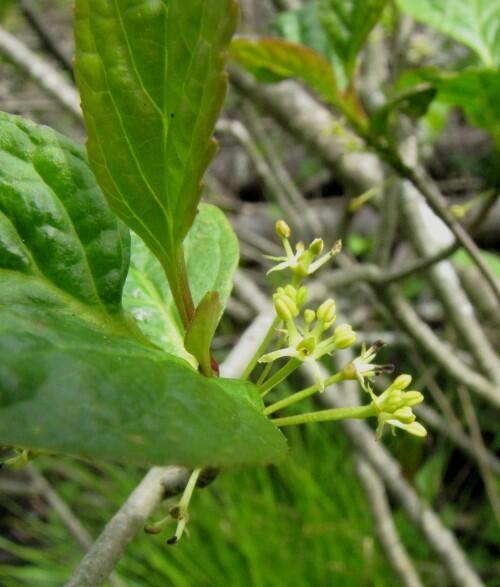
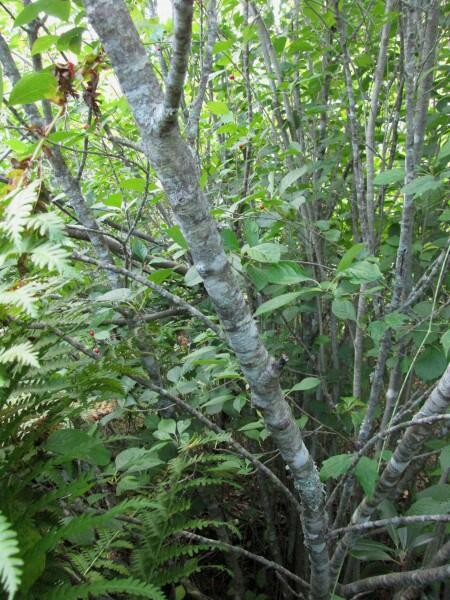
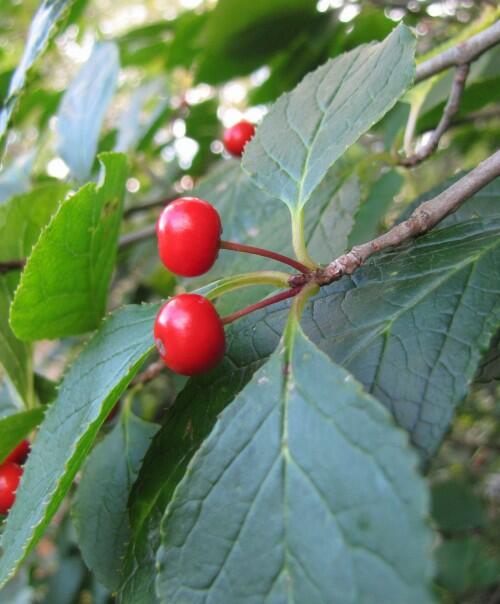
Deciduous shrub 10-13 feet (3-4 meters) tall, usually with multiple stems with smooth tawny-gray bark; young twigs are light green or tan and hairless. Leaves are 2-3 inches long and 2.5 inches wide (5-8 cm long, 6.5 cm wide), alternate, broadly elliptic to obovate with pointed tips, tapering bases, finely toothed margins (the teeth tipped by tiny glands), and smooth surfaces (possibly a few hairs on the lower surface). Leaf stalks are a bit shorter than 0.5 inch (10-12 mm) long with a deep U-shaped channel on the upper side and dark hairs in the channel. Like most hollies, Ilex collina is dioecious – female and male flowers are on separate plants. Flowers are held in few-flowered clusters. Female flowers are small, pale yellowish-green, with 4 petals that are fused at the base; in the center of the flower is a conspicuous green pistil and 4 non-functional stamens; flower stalks are about 0.5 inch (8-15) mm long. Male flowers are similar but have no pistil and 4 functional stamens. Female flowers produce shiny, bright red fruits 0.25-0.5 inch (7-12 mm) in diameter, on stalks 0.3-1 inch (8-30 mm) long. There are 4-5, heavily ridged seeds, less than 0.2 inch long (5-6 mm).
IIex collina closely resembles Mountain Holly (Ilex montana) but is distinguished by the length of the fruiting stalk on female plants. Ilex montana fruiting stalks are shorter than 0.3 inch (2-9 mm) versus 0.3-1 inch (8-30 mm) long on IIex collina. Ilex collina bark is tawny-gray; Ilex montana bark is purplish-gray. Other similar hollies have dull red or orange fruits and round leaf stalks, or if the leaf stalks are channeled, they have white hairs in the channel, and do not occur in high-elevation habitats.
Serviceberry Holly (Ilex amelanchier) occurs in wet, sandy thickets and cypress-gum swamps in Georgia's Coastal Plain. For more information, see: https://www.carolinanature.com/trees/ilam.html
Cuthbert Holly (Ilex cuthbertii) occurs in dry, upland forests in the Fall Line. For more information, see: https://www.georgiabiodiversity.org/portal/profile?group=plants&es_id=21400
Found only in the Southern Appalachian Mountains; in Georgia, Ilex collina occurs in seepy areas in boulderfields and northern hardwood forests with Yellow Birch (Betula alleghaniensis) on north-facing slopes above 4,000 feet.
Ilex collina forms small thickets or colonies by the spread of rhizomes. It also reproduces sexually, with female and male flowers on separate plants, a reproductive strategy that prevents self-fertilization. No studies of pollination in this species have been conducted, but hollies are usually pollinated by small bees and other insects. Holly fruits (technically called drupes) are an important late winter food source for birds.
Ilex collina can be best identified when the long fruit stalks are fully developed and the bright red fruits are conspicuous. Fruits begin to mature in August and persist until late winter. Earlier in the growing season, Ilex collina can be distinguished by the U- to V-shaped channel on the upper side of the leaf stalk (formed by leaf edges merging with the stalk) and by the presence of dark hairs in the channel.
Endemic to high-elevation areas in Southern Appalachian Mountains of Georgia, Tennessee, North Carolina, West Virginia, and Virginia.
Ilex collina habitat is largely protected by its rocky, wet, high-elevation habitat in national forests and parks. Logging, mining, or changes to hydrology would be fatal to this species.
| Threat 1 | Threat 2 | Threat 3 | |
|---|---|---|---|
| General Threat | Residential & commercial development | Climate change & severe weather | None |
| Specific Threat | None | None | None |
Only one population has been discovered so far in Georgia, in a protected area of the Chattahoochee National Forest.
Protect high-elevation forests from disturbance of all kinds. Determine if both female and male plants are present to ensure genetic diversity of the population.
Alexander, E.J. 1941. Two new species from the southern Appalachians. Castanea 6: 30-32.
Boetsch, J.R. and E Nielsen. 2003. Notes on the distribution of the Southern Appalachian endemic, Ilex collina. Castanea 68(3): 232-235.
Brooks, A.B. 1936. A new holly for West Virginia. Castanea 1: 83-85.
Brooks, M. 1940. A new form of Ilex longipes Chapman. Castanea 5(2): 15-16.
Baas, P. 1984. Vegetative anatomy and the taxonomic status of Ilex collina and Nemopanthus (Aquifoliaceae). Journal of the Arnold Arboretum of Harvard University 65: 243-250.
GADNR. 2019. Element occurrence record for Ilex collina. Georgia Department of Natural Resources, Wildlife Resources Division, Social Circle.
NatureServe. 2019. Ilex collina species profile. NatureServe Explorer: An online encyclopedia of life, Version 7.1. NatureServe, Arlington, Virginia. Accessed 22 May 2019. http://explorer.natureserve.org/servlet/NatureServe?searchName=Ilex+collina.
Weakley, A.S. 2015. Flora of the southern and mid-Atlantic States. University of North Carolina Herbarium, University of North Carolina, Chapel Hill. http://www.herbarium.unc.edu/flora.htm
Linda G. Chafin
28 May 2019